

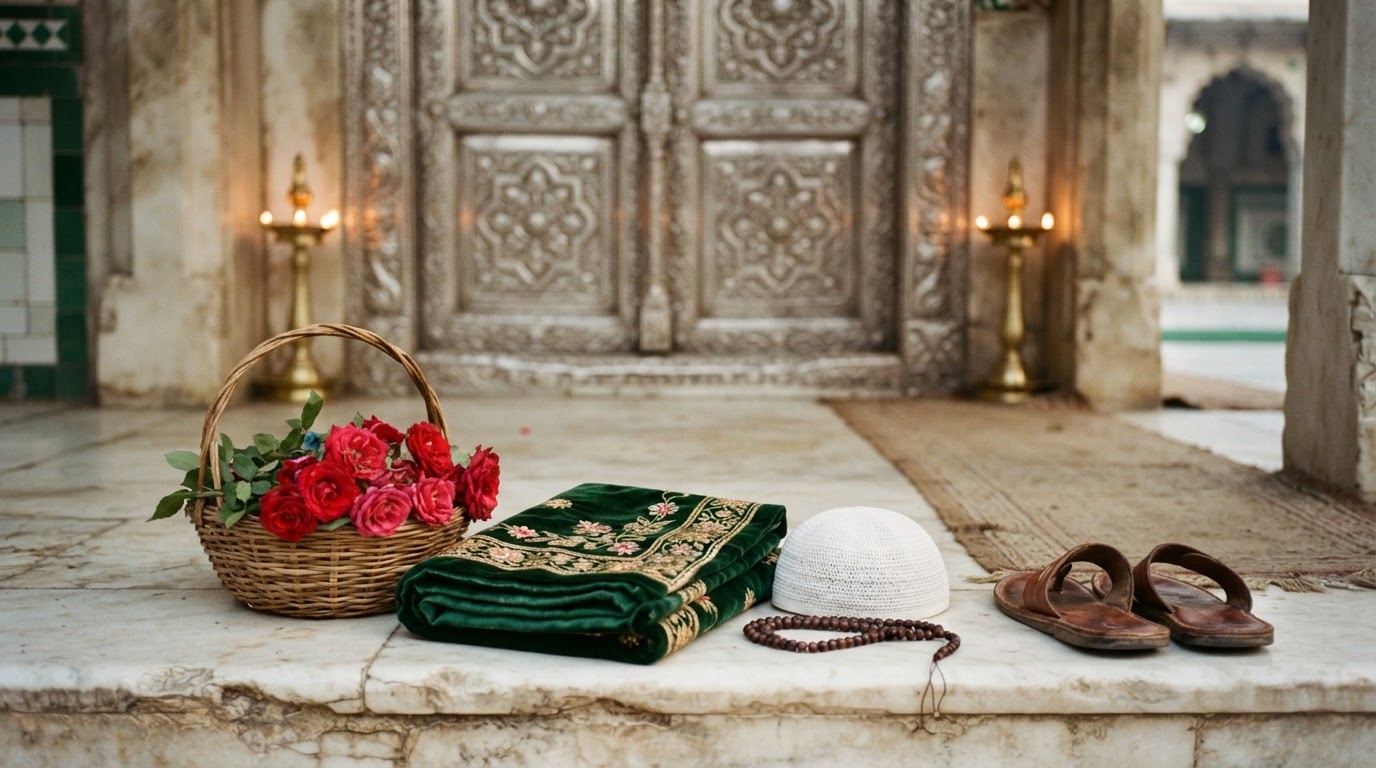
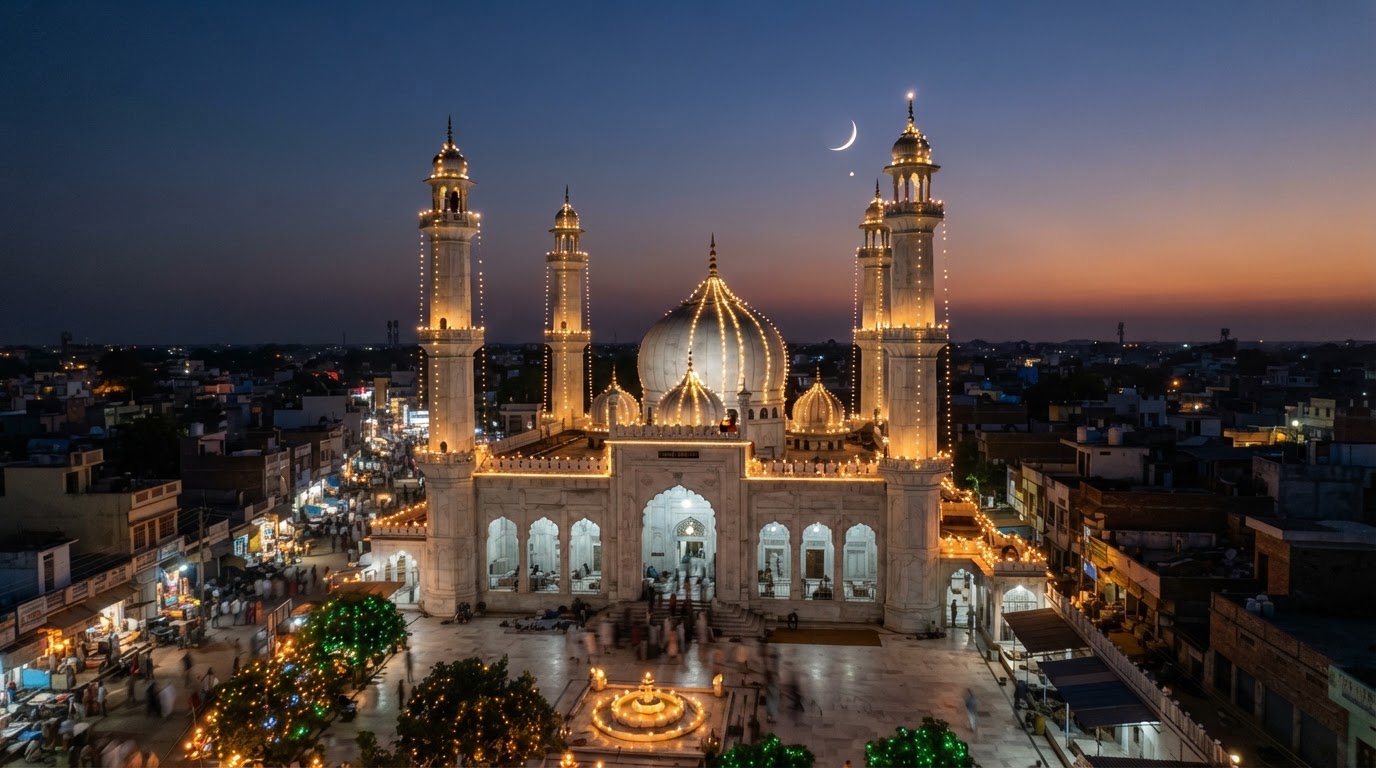
Late every night at Ajmer, after the last qawwali has faded and the crowds have been gently asked to leave, three khadims (hereditary attendants of the shrine) step inside and sweep around the Mazar. Not with ordinary brooms, but with brooms made of peacock feathers. Then the door is locked, and it opens again only before dawn.
That small detail says a lot about the place. Visiting the shrine of Hazrat Khwaja Moinuddin Chishti, Khwaja Gharib Nawaz, Rehmatullah Alaih (RA), is about adab: the inner and outer courtesy of a guest. In practice it means coming clean and modestly dressed, covering your head, greeting the people of the graves with Salam, reciting Fatiha, asking Allah alone in your Dua, never bowing or prostrating to the grave, and treating every other pilgrim gently.
With lakhs of people expected at the 815th Urs this December, here is a calm, practical guide to doing it right.
Quick facts for your visit
| Opening hours | About 5 am to 9 pm in winter, 4 am to 10 pm in summer (Incredible India) |
| Short daily closure | Around mid-afternoon, for khidmat (cleaning of the Mazar) |
| During the Urs | The main entrance to the tomb stays open almost day and night |
| Entry fee | None |
| Dress | Modest clothes, head covered for men and women |
| Shoes and bags | Left outside at stalls and cloakrooms for a small fee |
| Photography | Not inside the inner shrine |
| Who can visit | Everyone, of every faith; women are welcome |
Why do Muslims visit graves at all?
The answer begins with the Prophet Muhammad (peace be upon him). In Sahih Muslim, he tells his Companions that he had once forbidden them from visiting graves, but now they should visit them, because graves remind a person of death and the Hereafter. In another narration, he visited his own mother’s grave and wept.
So the first purpose of Ziyarat (visiting a grave or shrine) is humbling: to remember that the life you are rushing through will end. At Ajmer, you are reminded of that beside a man who chose poverty, fed the hungry and spent his life on the people nobody else noticed. Read his story in our profile of Khwaja Gharib Nawaz.
Before you go: prepare your heart and your body
- Make your intention clear. You are going to remember Allah, send Salam, pray for the soul of a friend of Allah and learn from his life.
- Come in wudu (ritual washing). Pilgrims have used the natural Jhalra tank inside the complex for wudu for centuries.
- Dress modestly. Arms and legs covered, nothing tight or showy. Leave expensive jewellery at home; crowds attract pickpockets.
- Cover your head. A cap or scarf for men, a dupatta or scarf for women. Both are sold everywhere in Dargah Bazaar.
- Wear slip-on footwear. You will take it off at the gate and want it back quickly in a crowd.
At the gate: shoes off, voice down
You enter through the tall Nizam Gate, then the Shahjahani Gate and the Buland Darwaza. We walked through every one of these buildings in From Nizam Gate to the Golden Crown. As you pass, lower your voice, put your phone away and keep the line moving. Pushing in a narrow passage is not devotion; it can hurt an elderly pilgrim or a child.
Many people bring red roses and a chadar (ceremonial cloth) to present at the Mazar. You do not have to. The khadims will guide you through the brief moment at the grave, and flowers or a chadar are an expression of love, not a requirement. The meaning of the chadar is explained in Rose Water, Sandal and Velvet.
At the Mazar: what to say and do
1. Send Salam. The Prophet (peace be upon him) taught his Companions a greeting for graveyards, recorded in Sahih Muslim. In transliteration it begins: As-salamu ‘alaikum ahlad-diyari minal-mu’minina wal-muslimin. In English, it means: peace be upon you, people of this home, believers and Muslims; we will join you if Allah wills, and we ask Allah for well-being for us and for you.
2. Recite something for his soul. Most pilgrims read Surah al-Fatiha, Surah al-Ikhlas three times and Durood (blessings on the Prophet), and gift the reward to Khwaja Sahib and to all Muslims who have passed away.
3. Make Dua to Allah. Raise your hands and ask Allah for whatever you need: health, guidance, a job, a cure, forgiveness. Many in the Sufi tradition hold that asking Allah in the company of His friends is a hope-filled moment. But the Dua is always to Allah.
4. Move on. During the Urs, thousands are waiting behind you. A few heartfelt minutes are better than a long struggle at the railing.
The one line no school of thought allows you to cross
Muslims hold different views about shrines. Some scholars discourage practices such as presenting chadars or tying threads; others, especially in the Sufi tradition, see them as harmless expressions of love. This article does not try to settle those debates.
But on one point the scholars agree: no sajda (prostration) to a grave. Even Imam Ahmad Raza Khan of Bareilly, the great defender of saint veneration in South Asia, wrote a whole treatise, al-Zubdat al-Zakiyya, proving that a prostration of respect to anyone but Allah is haram (forbidden), and that prostrating to or towards graves is forbidden too. Bowing low, kissing the ground before the Mazar, or placing your forehead on the railing all come too close to that line. Stand, greet, pray, and leave with dignity.
Did you know? Every night, after the last visitor has left, the qawwals recite the Karka, a short musical verse in Persian, Brij and Sanskrit, and only then is the shrine locked until the pre-dawn prayer.
The daily moments worth pausing for
- Khidmat before Fajr: the tomb is cleaned in the early morning; pilgrims enter for Ziyarat once it ends, before the Azaan.
- Afternoon khidmat: roughly an hour after Zuhr the Mazar is cleaned again. Plan around it rather than waiting in a jammed queue.
- Dua-e-Roshni: about 20 minutes before Maghrib, khadims carry large candles to the shrine as drums sound. Stand still and quiet; many pilgrims make their Dua at this moment.
- Mehfil-e-Sama: during the Urs, qawwali fills the Mehfil Khana through the night. Sit with respect, do not film in people’s faces, and leave space. Our guide: The Hall Where Ajmer’s Urs Qawwali Plays Until Dawn.
Money, touts and giving the right way
Adab also means guarding your intention from being exploited. During the Urs, self-appointed “guides” sometimes attach themselves to newcomers and press for money. Travel guides advise visitors to give donations through the official Dargah Committee boxes or office, and to agree nothing with strangers. If you want to share in the langar, the free food from the giant Badi Deg and Chhoti Deg, ask at the official counters.
The best gift of all is the one Khwaja Sahib himself loved: feed someone hungry on the street outside, quietly, without a photo.
Visiting with family, elders and children
- Women are welcome inside the Dargah and may attend the Mehfil-e-Sama, which is not common at every shrine. The tomb of Khwaja Sahib’s daughter, Bibi Hafiz Jamal (RA), lies in an enclosure for women south of the Mazar.
- Elders: go early in the morning on a weekday, avoid the evening rush near the Nizam Gate, and carry water.
- Children: write your phone number on a card in their pocket, and fix a meeting point in case you get separated.
- Friends of other faiths: they are welcome. Ajmer has drawn Hindus, Sikhs and others for centuries, and the same courtesy rules apply to everyone.
The lesson: adab is love that knows its place
The Sufis have a saying that the whole path is adab. At Ajmer you see why. The khadims who sweep with feathers, the pilgrim who waits his turn, the old woman who whispers her Dua and steps aside so a stranger can reach the railing: none of them is making a show. They are simply being good guests in the house of a man who treated everyone as a guest.
Go with that spirit, and you will take more home than a photo. Check the latest flag, moon and Chhati Sharif dates on our Ajmer Urs 2026 dates page before you travel.
Frequently asked questions
Is there a dress code at Ajmer Sharif Dargah?
There is no printed uniform, but modest clothing is expected: arms and legs covered, and the head covered for both men and women. Caps and scarves are sold right outside.
Can non-Muslims visit Ajmer Dargah?
Yes. People of every faith visit Ajmer Dargah and are welcome, as long as they follow the same rules of modest dress, covered head and respectful behaviour.
What should I recite at the Mazar of Khwaja Gharib Nawaz?
Begin with the Sunnah greeting for graves from Sahih Muslim, then recite Surah al-Fatiha, Surah al-Ikhlas and Durood, gift the reward to Khwaja Sahib and all believers, and make your own Dua to Allah.
Is it allowed to bow or do sajda at a dargah?
No. Scholars across schools agree that prostration of respect to anyone but Allah is forbidden. Imam Ahmad Raza Khan wrote a full treatise on this, ruling that prostrating to or towards graves is haram.
Related: Ajmer Urs 2026 dates · The Jannati Darwaza · Chhati Sharif and the cannon · Hazrat Nizamuddin Auliya · Great Sufi saints of India
Sources: Sahih Muslim 975 (Sunnah.com); Sahih Muslim 976 (Sunnah.com); Qibla.com via IslamQA.org: Prostration of reverence, citing Imam Ahmad Raza; Ajmer Sharif Dargah (Wikipedia); Incredible India: Ajmer Sharif
Follow Ruhani Dua on Facebook for short videos and reminders. / रूहानी दुआ को Facebook पर Follow करें।
Discover more from ImranJalna
Subscribe to get the latest posts sent to your email.





Leave a Reply