

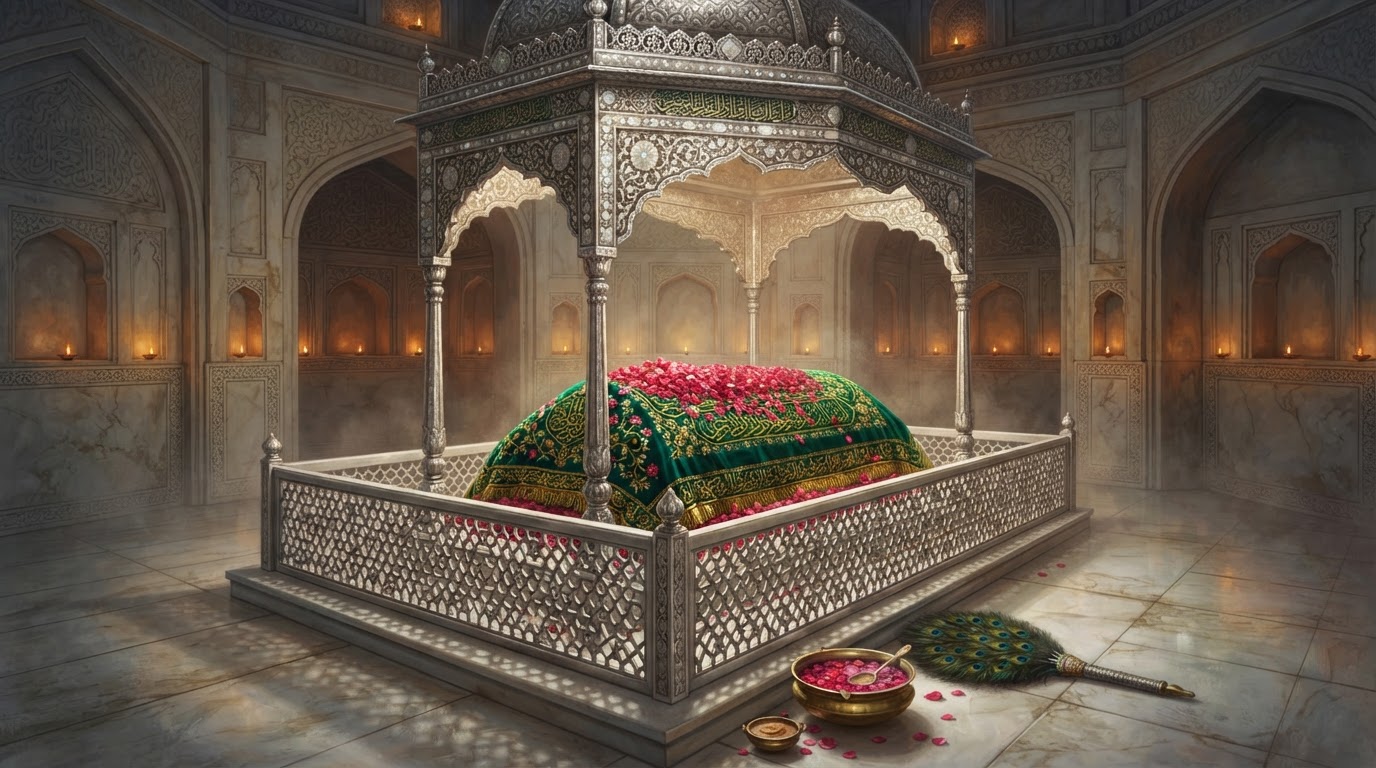
It is the middle of the afternoon at Ajmer Dargah. The courtyard is full, the qawwals are tuning up, and then something unusual happens: the main door of the shrine closes. At the back door, a black curtain drops. For a while, no pilgrim can see the Mazar (tomb) of Hazrat Khwaja Moinuddin Hasan Chishti, Khwaja Gharib Nawaz (Rehmatullah Alaih).
Then the fragrance arrives. It drifts out through the doors: rose, sandalwood, saffron. Inside, senior Khadims in black robes are washing the tomb, as their families have done for centuries.
In short: Ghusl (Arabic for “washing”) is the ritual cleaning of the Mazar with rose water, sandalwood paste, kewra (screwpine essence) and perfume. A small version happens every day; the grand one is part of the annual Urs in Rajab. A chadar is the cloth, usually velvet with gold borders, that pilgrims and even prime ministers offer to cover the tomb as a mark of love and respect. Both are ways of honouring a man who spent his life serving the poor, not acts of worship of the grave; the prayer itself is always made to Allah.
Ghusl and chadar: quick facts
| Daily khidmat | Mid-afternoon washing of the Mazar by Khadims, doors closed |
| What is used | Rose water, sandalwood paste, saffron, kewra, itr (perfume oil) |
| Evening | Lamps lit before sunset, with drums and Persian verses |
| Urs ghusl | Traditionally from the first night of Rajab; devotees wash the Dargah on Chhati Sharif |
| Chadar colours | Mostly deep red and green velvet, with gold or silver borders |
| Roses offered | Estimated at around seven tonnes a day |
| PM’s chadar | Sent every Urs, a custom dating to 1947 |
What happens during the daily khidmat?
The word khidmat means “service”. At Ajmer it is the name for the care of the tomb itself, and it is the hereditary right of the Khadims, the families who trace their line back to the companions of Khwaja Gharib Nawaz.
Writing in Dawn, the Pakistani journalist Reema Abbasi described watching the afternoon khidmat from the back door. The senior Khadims bathed the tomb in sandalwood, saffron and rose water. Small lamps were lit in the four corner niches of the chamber. The floor was swept with brooms of peacock feathers. Fresh covers and flowers were laid on the Mazar, and the ceremony closed with sandal and Fatiha. When the Khadims came out, she noted, their hair and clothes were soaked.
Before sunset, a second, gentler rite follows. The shrine’s drummers play while keepers carry oil lamps and recite Persian verses. Late at night, after the last qawwali, visitors are asked to leave and the chamber is swept once more with peacock-feather brooms.
Did you know? According to the shrine’s tradition, the incense, sandalwood paste and itr used at the Dargah have been supplied by a Brahmin family since the time of Khwaja Gharib Nawaz himself. Eight centuries of fragrance, shared across faiths.
What is the “sandal” that pilgrims take home?
The paste applied to the Mazar is called sandal. A Khadim at the shrine, Syed Qutbuddin Sakhi, told ANI in 2024 that it is a blend of sandalwood, rose, water, itr and kewra, and that it is applied to the tomb once a year.
Shortly before the Urs, that year’s sandal is taken off the Mazar. This is the Sandal utarne ki rasm (the ceremony of removing the sandal). Rajasthan Patrika has reported Khadims distributing it among pilgrims as tabarruk (a blessed keepsake), with crowds rushing to receive a little. Many families keep a pinch at home as a remembrance of the Dargah.
Local belief attaches hopes to it, such as children staying healthy. It is worth remembering what the scholars of the Chishti tradition themselves taught: blessing comes from Allah alone, and objects from a holy place are cherished for the memory and love they carry, not as medicine or magic.
How is the ghusl done during the Urs?
The Urs, held from 1 to 6 Rajab, is when the ghusl becomes a public event. By long-standing tradition, the Mazar is washed with rose water and sandalwood and anointed with perfume on the first night of Rajab, together with the first Mehfil (gathering) of the Urs. Press reports of past Urs describe the first Mehfil and the ghusl taking place on the same night.
The roles are carefully divided. A study by the Indian Institute of Public Administration on the management of the Dargah points to the ghusl as a clear example of how duties are shared between the Dewan (the spiritual head), the Khadims and the Dargah Committee that runs the shrine under the Dargah Khwaja Saheb Act of 1955.
Then comes the moment many pilgrims wait all year for. As the Urs reaches Chhati Sharif, the sixth day, ordinary devotees are allowed to wash the Dargah themselves with kewra and rose water. In the 813th Urs (January 2025), the Khadim told ETV Bharat that this began on the night of the fifth day, a day early, because so many pilgrims had to leave before the sixth. Washing went on until the afternoon of Chhati Sharif.
Picture it: thousands of people with bottles of rose water, the marble courtyards running with fragrant water, qawwali in the background and the cold December air heavy with the smell of roses.
Why do people offer a chadar?
Walk down Dargah Bazaar towards Nizam Gate and you will see shop after shop hung with chadars: deep red and green velvet, edged with gold or silver lace, some embroidered with Quranic verses or the name of Khwaja Gharib Nawaz. Inside the complex there are stalls of chadars, rose petals, misri (rock sugar) and incense.
Offering a chadar is an old custom of respect in South Asia, much like covering something precious with your finest cloth. For a pilgrim it is a way of saying: I came, I remembered, I am grateful. People bring one when a prayer has been answered, when a child is born, or simply out of love. At the Mazar, the Khadims guide the pilgrim, the chadar is laid or touched to the tomb, and Fatiha and Dua are read.
The custom is not unique to Ajmer. You will see the same love at the Delhi shrine of Hazrat Nizamuddin Auliya and at dargahs across the subcontinent, as our guide to the great Sufi saints of India shows.
The chadars of prime ministers and nations
Some chadars arrive with ceremony. Every year the Prime Minister of India sends one for the Urs, a tradition that the Dargah’s Sajjada Nashin family says goes back to 1947 and has been kept by every Prime Minister since. At the 814th Urs in December 2025, Union Minister Kiren Rijiju laid the Prime Minister’s velvet chadar on 22 December, then went to the Mehfil Khana, where the Khadims tied a turban on him in the traditional dastarbandi and gave him tabarruk.
- Chief Ministers of Rajasthan send chadars; after one is offered, the CM’s message of goodwill is read out from the Buland Darwaza.
- Political parties of different colours send chadars too.
- Pilgrims from Pakistan, when permitted, have walked to the Dargah in procession carrying bright red velvet chadars and singing qawwali.
The kings did it long before them. The silver and mother-of-pearl canopy above the Mazar today was commissioned by Emperor Jahangir, and his gold railing once surrounded the tomb. That story is told in why Mughal emperors walked to Ajmer, and you can see where everything stands in our walk through Ajmer Dargah.
What do scholars say about these customs?
Muslims hold different views on customs at shrines, and it is good to know them calmly. There is wide agreement on the basics: ziyarat (visiting graves) is Sunnah, reciting the Quran and making Dua for the departed is good, and worship belongs to Allah alone. Views differ on cultural practices such as chadars and washing the tomb. Many in the Sufi tradition see them as permissible expressions of love and respect; others prefer to avoid them and spend the money on the poor instead.
Both sides can agree on one thing Khwaja Gharib Nawaz is remembered for: feeding the hungry. Some pilgrims now do both, offering a modest chadar and sponsoring food from the great cauldrons of the Dargah.
Tips if you plan to offer a chadar at the 815th Urs
- Fix the price first. Chadars range from simple cloth to heavy embroidered velvet. Agree the price before you buy.
- Go early in the Urs. The first days are calmer than Chhati Sharif. The 815th Urs is expected from about 9 or 10 December 2026; check our Ajmer Urs 2026 dates page.
- Cover your head and remove shoes before entering the shrine area.
- Expect a few seconds, not minutes. In the Urs crowd you may only pass the Mazar briefly. Make your Dua in the courtyard with calm.
- Carry a small bottle of rose water if you wish to join the washing on Chhati Sharif, and follow the volunteers.
The lesson in the fragrance
There is something beautiful in the fact that the most famous shrine in South Asia is cared for, every single afternoon, with water and flowers. No grand speech, no display. Just people quietly cleaning, sweeping with feathers and lighting lamps for a man who, in his own life, fed strangers and comforted the poor of every faith. The chadar may be velvet, but the real offering is the same as it was 800 years ago: a clean heart and service to people. Read the full life of Khwaja Gharib Nawaz.
Frequently asked questions
What is ghusl at Ajmer Sharif?
Ghusl is the ritual washing of Khwaja Gharib Nawaz’s Mazar with rose water, sandalwood paste, kewra and perfume. Khadims do it daily in the afternoon, and a larger ghusl is part of the annual Urs in Rajab.
Can ordinary pilgrims take part in the ghusl?
The washing of the tomb itself is done by the Khadims. But on Chhati Sharif (and sometimes from the night before), devotees are allowed to wash the Dargah premises with kewra and rose water.
Why does the Prime Minister send a chadar to Ajmer?
It is a goodwill tradition said to date back to 1947. Each year a Union Minister lays the Prime Minister’s velvet chadar at the Mazar during the Urs and reads out a message of peace and brotherhood.
What colour chadar should I offer?
There is no religious rule on colour. Red and green velvet with gold borders are the most common at Ajmer, but a simple, clean chadar offered with sincerity is just as welcome.
Related: Ajmer Urs 2026 dates · Why a cannon fires on Chhati Sharif · The silver gate that opens 4 times a year · The flag that opens the Urs
Sources: Dawn, “The hopescape of Ajmer Sharif” (2015); Ajmer Sharif Dargah (Wikipedia); ANI on the 812th Urs and the sandal; Rajasthan Patrika on the sandal ceremony; ETV Bharat on the 813th Urs; All India Radio on the 814th Urs chadar.
Follow Ruhani Dua on Facebook for short videos and reminders. / रूहानी दुआ को Facebook पर Follow करें।
Discover more from ImranJalna
Subscribe to get the latest posts sent to your email.





Leave a Reply