

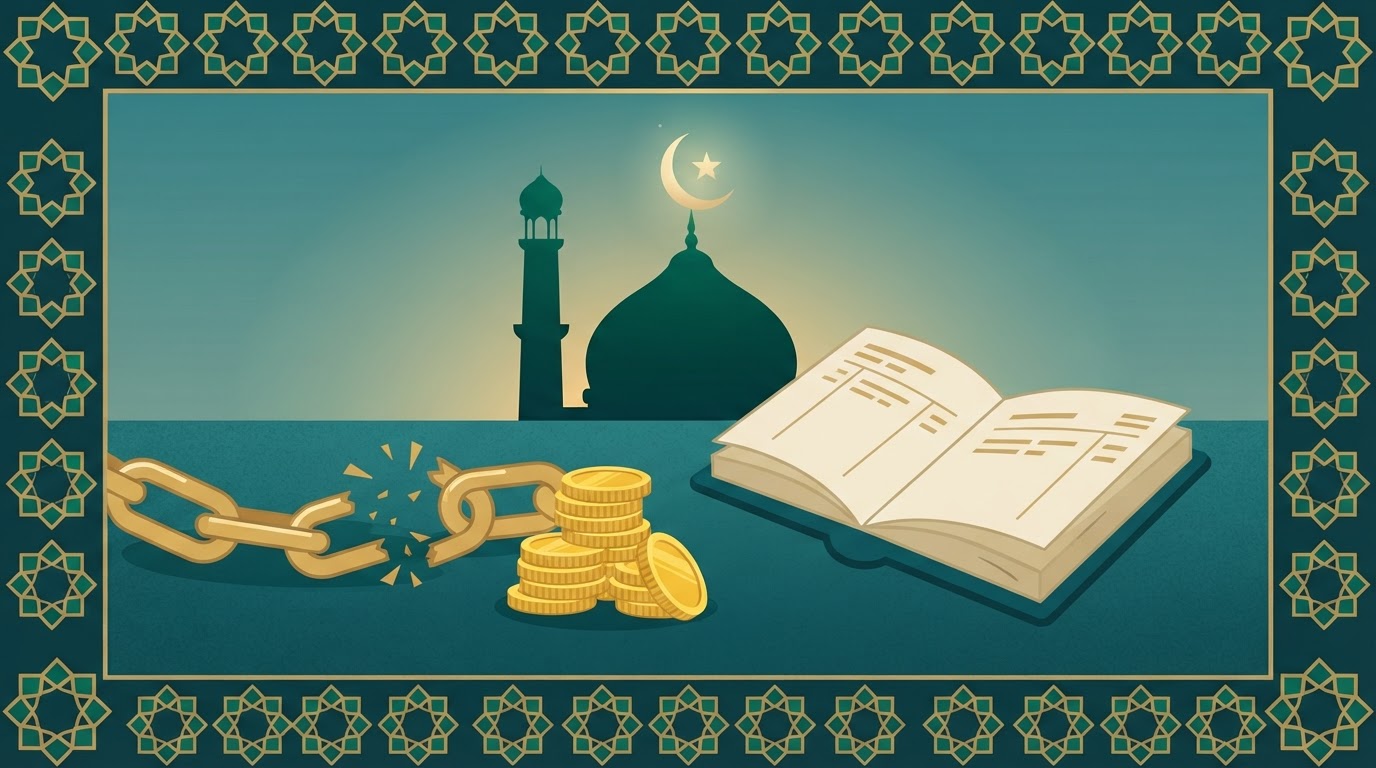
Islam allows borrowing, but it treats debt as a serious trust that must be repaid, and it forbids Riba (interest) completely. If you are already in an interest-based loan or credit card, most scholars say the way out is the same: sincere repentance, repaying the principal as fast as you reasonably can, and never taking on new interest. This guide explains the rulings and gives you a practical plan.
Quick facts
| Is borrowing allowed in Islam? | Yes, an interest-free loan (Qard) is permitted, and lending to someone in need is rewarded. |
| Is paying interest allowed? | No. Taking, paying, writing and witnessing Riba are all condemned. |
| Must I repay an interest-based loan? | Yes, the principal is a real debt. Scholars advise exiting the interest part where you lawfully can. |
| Key Quran verses | Surah Al-Baqarah 2:275–280 (Riba and relief for debtors), 2:282 (writing down debts) |
| Can Zakat help a debtor? | Yes. People overwhelmed by debt (al-gharimin) are one of the eight Zakat categories in Surah At-Tawbah 9:60. |
Why does Islam take debt so seriously?
Debt is a right owed to another person (huquq al-‘ibad). Sins between a person and Allah can be forgiven through repentance, but a debt stays owed until it is paid or the lender forgives it. The Prophet Muhammad (peace be upon him) said: “The believer’s soul is suspended by his debt until it is settled for him” (Jami’ at-Tirmidhi 1078, graded hasan).
Two other authentic narrations show the weight of this matter. In Sahih Muslim 1886, the Prophet (peace be upon him) said that a martyr is forgiven every sin except debt. In Sahih al-Bukhari 832, ‘Aishah (may Allah be pleased with her) reported that he often sought refuge with Allah from sin and from debt in his prayer. When asked why, he explained that a person in debt tends to lie when he speaks and break promises when he makes them.
This does not mean every loan is sinful. The Prophet (peace be upon him) himself borrowed and repaid generously. The warning is against careless debt, delaying repayment when you can pay, and debt that carries Riba.
What does the Quran say about interest-based debt?
Surah Al-Baqarah 2:275 states that Allah has permitted trade and forbidden Riba. Verses 2:278–279 tell believers to give up whatever interest remains owed, and promise that if they repent they keep their capital, neither wronging nor being wronged. Verse 2:280 then turns to the debtor: if he is in hardship, the lender should give him time until things ease, and writing the debt off as charity is better still.
Verse 2:282, the longest verse in the Quran, is about writing down loans with witnesses. Its lesson for today is simple: know exactly what you owe, to whom, and when. For a full explanation of what counts as interest in modern banking, see our guide Riba Explained.
I already have an interest-based loan. What do scholars say I should do?
Many people took a credit card, car loan, student loan or home loan before they understood the ruling, or out of real pressure. Scholars across schools give very similar advice, with some differences in detail:
- Repent sincerely. IslamQA (answer 60185) says the borrower should regret the act and firmly resolve never to return to it. It adds that if refusing to pay the interest would cause you real harm, you pay it, repent, and dislike it in your heart.
- Repay the principal. The capital is a genuine debt. Abandoning it is not an option.
- Get out as quickly as you reasonably can. Shaykh Faraz Rabbani of SeekersGuidance (Hanafi) advises paying down the principal as much as you are able and refinancing into a halal alternative when one becomes available.
- How fast is “fast”? Here opinions differ slightly. Some answers urge you to cut spending and even redirect money meant for voluntary acts, such as a nafl ‘Umrah, to clear the loan. Another IslamQA answer (85562) says hastening is better but not strictly obligatory, so you need not sell essential things like the car you depend on.
- No new Riba contracts. Every scholar agrees on this point.
What is a practical plan to become debt-free?
Faith and planning go together. Here is a seven-step plan that fits Islamic principles:
- Write every debt down (following the spirit of 2:282): lender, balance, interest rate, monthly payment and any penalty for early repayment.
- Stop the bleeding. Freeze or cut up interest-bearing credit cards and pause any new buy-now-pay-later plans. Our guide on Islamic credit cards and BNPL explains which products are a problem.
- Build a small emergency fund (even one month of essentials) in a non-interest or profit-sharing account, so the next surprise bill does not push you back into Riba.
- Make a strict budget. List essentials (rent, food, family, Zakat if due), then send every spare rupee, pound or dollar to debt.
- Target interest-bearing debts first. Pay minimums on everything, then attack the debt with the highest interest rate. This reduces the total Riba you pay, which is the goal.
- Look for halal refinancing. Ask trusted family for a Qard Hasan (a good, interest-free loan) to clear an interest loan. For homes, compare Islamic home finance options. See our guide Is a Home Loan Halal?
- Make du’a and keep going. In Jami’ at-Tirmidhi 3563 (hasan), ‘Ali (may Allah be pleased with him) taught a supplication for someone crushed by debt: Allahumma-kfini bi-halalika ‘an haramika, wa aghnini bi-fadlika ‘amman siwak (O Allah, make what is lawful enough for me so I do not need what is unlawful, and by Your grace make me independent of all besides You).
Which debts should I clear first?
| Type of debt | Islamic concern | Suggested priority |
|---|---|---|
| Credit card with revolving interest | Riba, often at the highest rates | Clear first |
| Personal or payday loan | Riba, plus heavy penalties | Clear first or second |
| Car loan with interest | Riba | High; refinance to halal if possible |
| Conventional home loan | Riba | Overpay where allowed; move to Islamic home finance when you can |
| Interest-free loan from family or friend (Qard) | Halal, but still a trust | Repay on time, as agreed |
| Islamic finance contract (Murabaha, Ijara) | Halal if properly structured | Pay as scheduled |
Did you know? Debtors who cannot pay are among the eight groups who may receive Zakat (Surah At-Tawbah 9:60). A relative or friend in genuine debt may be a valid recipient of your Zakat, so long as the debt was not taken for something haram. Ask a scholar about your specific case.
How do I avoid falling back into debt?
Getting out is half the work. Staying out needs a few habits:
- Live below your income. The Quran praises those who are neither wasteful nor stingy (Surah Al-Furqan 25:67).
- Save before you spend. Move a fixed amount to savings on payday. Our guide Is a Savings Account Halal? explains where to keep it.
- Plan big expenses. Weddings, Eid, school fees and Ramadan are predictable. Save monthly for them instead of borrowing.
- Grow wealth the halal way. Once debt-free, start with Shariah-screened investing. See Halal Investing for Beginners.
- Get free, regulated advice if you are overwhelmed. Many countries have free, non-profit debt advice services. In the UK, for example, the government-backed MoneyHelper service lists free advisers. Avoid paid “debt fix” companies that charge high fees.
Lessons for us today
Debt itself is not a sin, but the Prophet (peace be upon him) feared its effect on honesty and peace of mind, and Allah has declared Riba one of the gravest financial wrongs. The good news is that the door of repentance is open. Admit the problem, make a written plan, stop new interest, clear the costliest debt first, and ask Allah for help. Lenders who are owed by struggling people should remember 2:280: giving time, or forgiving the debt, is better for them too.
Frequently asked questions
Is it a sin to pay interest on a loan I already have?
Entering an interest contract is a sin, and scholars advise repenting from it. If you cannot legally avoid the interest without serious harm, you pay it, keep repenting, and exit the loan as soon as you reasonably can.
Should I stop paying my interest-based loan to avoid Riba?
No. The principal is a real debt owed to the lender, and defaulting on it wrongs them and harms you. The aim is to clear the loan faster, not to abandon it.
Can I use my savings to pay off debt instead of giving Zakat?
Zakat remains due on wealth above the Nisab held for a lunar year. Scholars differ on how much of your current debt can be deducted before calculating it. Use our Zakat Calculator and confirm your method with a scholar.
Is there a du’a for paying off debt?
Yes. A well-known one is Allahumma-kfini bi-halalika ‘an haramika, wa aghnini bi-fadlika ‘amman siwak, reported in Jami’ at-Tirmidhi 3563 and graded hasan. Pair it with a real repayment plan.
This article is general educational information, not personal financial or religious advice. For your own situation, consult a qualified scholar and a licensed financial adviser.
Read more: Halal Money hub · Zakat Calculator · Riba Explained
Sources: Sunnah.com – Jami’ at-Tirmidhi 1078 · Sunnah.com – Jami’ at-Tirmidhi 3563 · IslamQA – Repenting from an interest-based loan · SeekersGuidance – Exiting an interest-based loan
Follow Ruhani Dua on Facebook for short videos and reminders. / रूहानी दुआ को Facebook पर Follow करें।
Discover more from ImranJalna
Subscribe to get the latest posts sent to your email.











Leave a Reply