

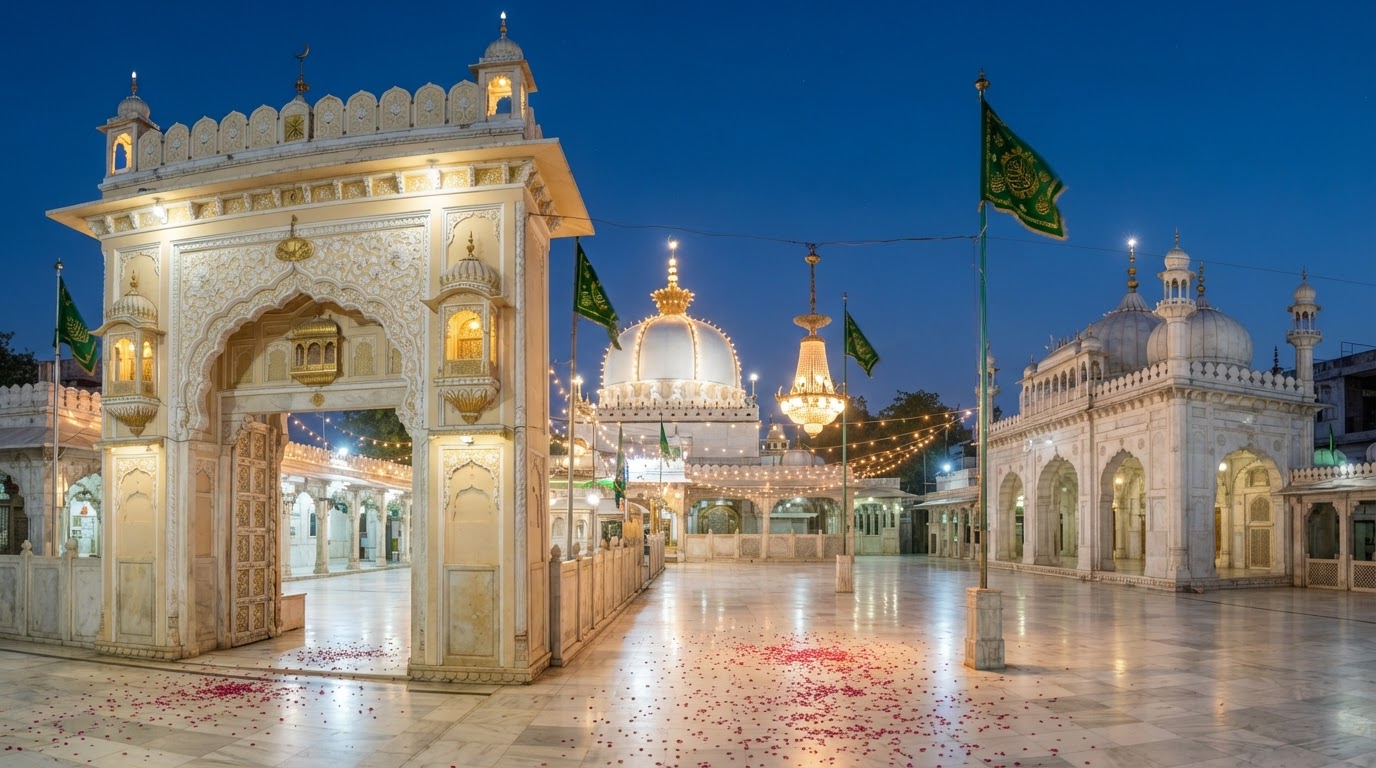
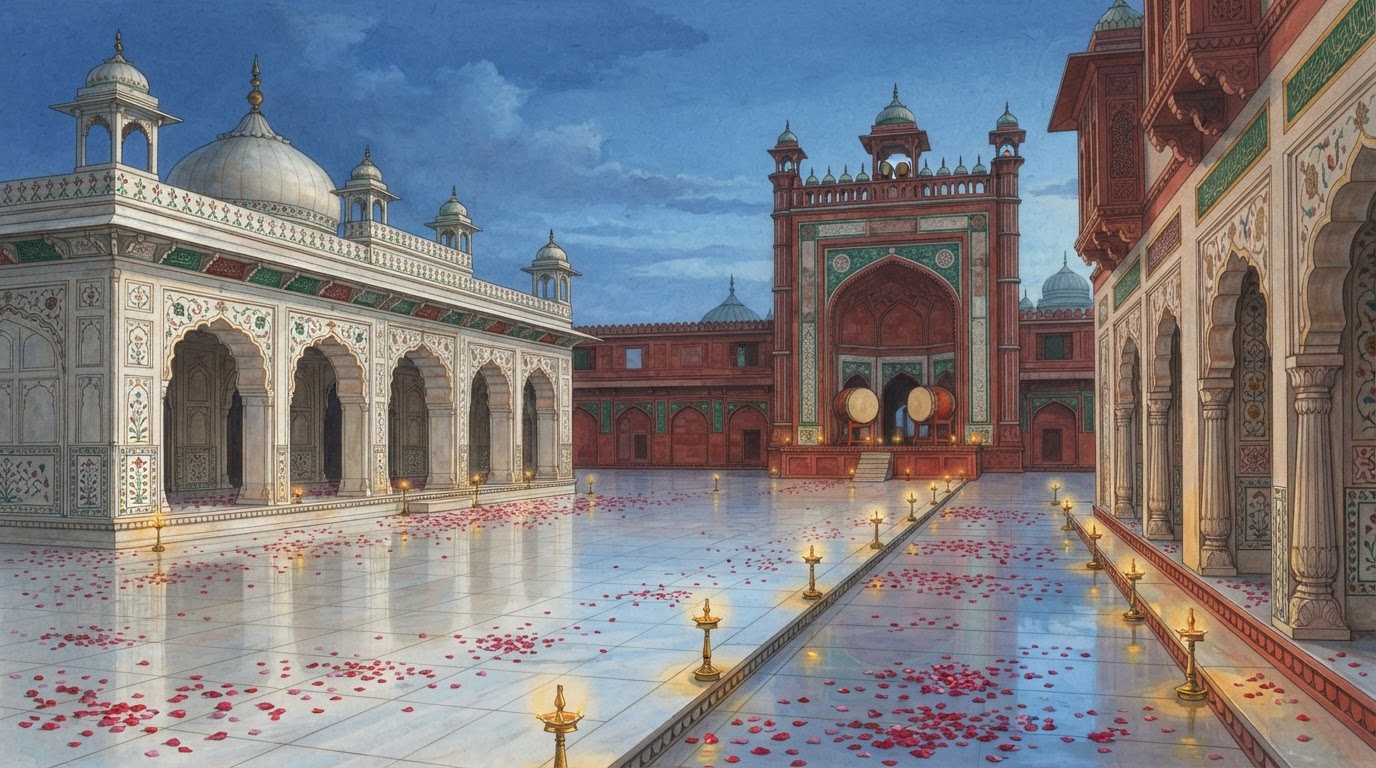
It is a little past one o’clock on the sixth day of Rajab. The lanes around Ajmer Dargah are so packed that people stand shoulder to shoulder, rose petals crushed under bare feet, the scent of itr (perfume oil) and incense hanging in the cold December air. Near the main entrance of the shrine, a group of qawwals begins to sing. There is no harmonium, no dholak. Only voices, and the sharp rhythm of hands clapping.
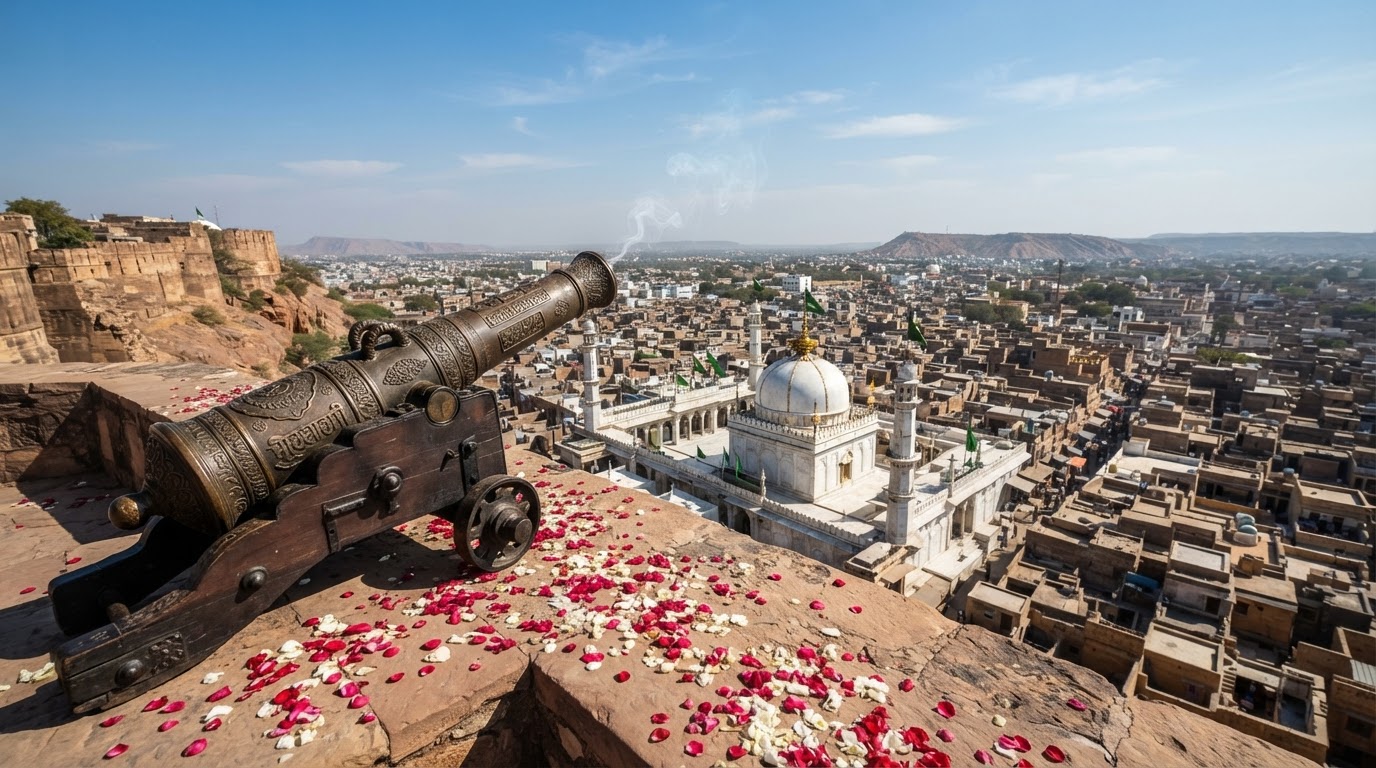
Then, at about 1:30 pm, a boom rolls down from the hill above the Dargah. Thousands of people raise their hands for Fatiha. The Chhati Sharif of Hazrat Khwaja Moinuddin Hasan Chishti, Khwaja Gharib Nawaz (Rehmatullah Alaih), is complete.
In short: Chhati Sharif (“the blessed sixth”) is 6 Rajab, the anniversary of Khwaja Gharib Nawaz’s passing and the most important day of the Ajmer Urs. From about 10 am the Khadims read the Shijra (the spiritual chain of the Chishti order), prayers are made, qawwals sing the clap-only Badhawa, Fatiha is recited, and a ceremonial cannon shot at around 1:30 pm marks the end of the Qul. In 2026, for the 815th Urs, Chhati Sharif is expected on 15 or 16 December, depending on the Rajab moon.
Chhati Sharif: quick facts
| What it marks | The passing of Khwaja Gharib Nawaz, 6 Rajab 633 AH (March 1236 CE) |
| Where | Inside the Dargah Sharif complex, Ajmer, Rajasthan |
| Timing | Roughly 10 am to 1:30 pm on 6 Rajab |
| Key rites | Shijra, Fariyad (supplication), Badhawa, Qul, Fatiha, cannon salute |
| Also called | Chhoti Qul (the “small” Qul); the Badi Qul follows on 9 Rajab |
| 2026 date | Tuesday 15 or Wednesday 16 December 2026 (moon-dependent) |
| Every month | A smaller “Mahana Chhati” is held on the 6th of every Islamic month |
Why is the sixth day the most important?
The answer lies in how Khwaja Gharib Nawaz left this world. According to the tradition preserved by the Chishtis of Ajmer, at the start of Rajab 633 AH he went into his hujra (private room) and asked not to be disturbed. For six days his companions waited outside. On the sixth day the door was opened, and he was found to have passed away.
That is why the Ajmer Urs runs for six days, from 1 to 6 Rajab, and why the sixth is its heart. Sufis call such an anniversary Urs, an Arabic word for “wedding”, because they see a saint’s death as his meeting with Allah, the Beloved. You can read the full story of his life, from Sistan to Ajmer, in our guide to Khwaja Gharib Nawaz: life, teachings and the Ajmer Dargah.
Did you know? Counting one Urs for every Hijri year since 633 AH, the Urs of 1448 AH is the 815th. Because the Islamic year is about 11 days shorter than the solar year, Chhati Sharif comes roughly 11 days earlier every December, then slides into November and earlier.
What happens on Chhati Sharif, hour by hour?
The day starts long before the ceremony. Pilgrims who arrived through the night on special trains and buses move towards Nizam Gate after Fajr, carrying chadars, baskets of roses and small bottles of itr. The Dargah, which has been running almost round the clock for six days, is at its fullest.
- Morning: the final ziyarat (visit) through the Jannati Darwaza, the silver “Gate of Paradise” that stays open for the Urs and is shut again at the Qul.
- From about 10 to 11 am: the Qul ceremony begins inside the shrine. The Khadims on duty, dressed in their finest, read the Shijra, the chain of masters linking Khwaja Gharib Nawaz back through his teacher Khwaja Usman Harooni to the founders of the Chishti order. This is followed by Fariyad, heartfelt prayers made on behalf of everyone present.
- The Dewan’s arrival: travellers’ accounts describe the Dargah Dewan (the spiritual head, or Sajjada Nashin) coming from the Mehfil Khana to the shrine for the Qul.
- Just before the end: qawwals sing the Badhawa at the main entrance of the shrine.
- Around 1:30 pm: Fatiha is recited, the Jannati Darwaza is closed, and the cannon fires from the hill.
The Badhawa: a song sung with only hand-claps
All week, the nights of the Urs ring with qawwali, harmoniums and dholaks in the Mehfil Khana. (We told that story in the hall where Ajmer’s Urs qawwali plays until dawn.) The Badhawa is different. It is a poem of praise, and it is performed with no musical instrument at all, only voices and clapping.
The Badhawa is attributed to Syed Behlol Chishty, an ancestor of the Syedzadgan Khadims of Ajmer, the families who still serve at the shrine. Hearing it sung in the open air, in the middle of a silent crowd of thousands, is for many pilgrims the most moving moment of the whole Urs. Its recitation is the signal that the Qul is about to close.
Why does a cannon fire at the end?
Before loudspeakers and mobile phones, a cannon was the fastest way to tell a whole city that something had happened. At Ajmer, that old method never stopped. The cannon stands on a hillock close to the Dargah, known locally as Bade Peer ki Pahadi, and its sound carries over the rooftops of the old city.
Open magazine reported that the Dargah’s cannon was a gift from Emperor Akbar, the Mughal ruler who famously walked to Ajmer (read why Mughal emperors walked to Ajmer). According to reports in Rajasthan Patrika, the cannon speaks all year round:
- 21 rounds during the Urs flag ceremony on the Buland Darwaza.
- 6 rounds on Chhati Sharif, the sixth day.
- 3 or 5 rounds to announce a new moon.
- One round at Sehri time each day of Ramadan, and again when Sehri ends.
Did you know? For centuries the cannon was fired only by men. In 2008, Fauzia Khan became the first woman given the duty, and Patrika reported that she fires around 290 salutes in a year.
Chhoti Qul and Badi Qul: what is the difference?
The Urs does not end the moment the cannon fires. Chhati Sharif is the Chhoti Qul, the small conclusion. Rajasthan Patrika has described how, on this day, devotees wash the Dargah with kewra (screwpine essence) and rose water, filling the marble courtyards with fragrance.
Three days later, on 9 Rajab, comes the Badi Qul, the grand finale. The shrine is washed again, final prayers are read, and the lakhs of pilgrims begin their journey home. Through all these days, food cooked in the Dargah’s giant cauldrons is shared as tabarruk (blessed food), a tradition explained in our story on the Mughal cauldrons that still feed thousands.
A Chhati Sharif every month
The sixth of Rajab is not the only “sixth” that matters in Ajmer. On the 6th of every Islamic month, the Dargah holds a Mahana Chhati (monthly Chhati) with special prayers in the morning. Thousands come for it, and when it falls close to another occasion, such as Muharram, local papers describe Ajmer as hosting a “mini Urs”.
The love for this day travels far beyond Rajasthan. In Sanwer, a town near Indore, Patrika reported a special chadar that is kept all year in the government treasury. It is brought out only on the day of Chhati Sharif of the Ajmer Urs, offered at the town’s dargah, and returned to the treasury the next day.
When is Chhati Sharif in 2026?
For the 815th Urs, the flag is announced for Saturday 5 December 2026, and the Urs begins with the Rajab moon from 9 December. That puts Chhati Sharif on Tuesday 15 or Wednesday 16 December 2026, and the Badi Qul on 18 or 19 December. We update the full timetable as soon as the moon is confirmed on our Ajmer Urs 2026 dates page.
Tips if you are at Ajmer for Chhati Sharif
- Arrive a day early. Chhati Sharif is the most crowded day of the year; trains and rooms fill up fast.
- Plan your ziyarat for the morning. The Jannati Darwaza closes at the Qul.
- Travel light. Keep your phone and money in an inside pocket and leave valuables at your hotel.
- Follow the volunteers and police at Nizam Gate and in the lanes; routes are often one-way on this day.
- Dress warmly and cover your head. Ajmer’s December mornings are cold.
The lesson of the sixth day
Strip away the crowds and the cannon, and Chhati Sharif is a very quiet idea. A man who spent his life feeding the poor and serving people of every faith withdrew to be alone with Allah, and left without fuss. Eight centuries later, his day is marked not with a speech but with a chain of names, a prayer for everyone present and a song sung with bare hands. It is a reminder that what lasts is not what we own, but whom we served and whom we loved.
Frequently asked questions
What is Chhati Sharif?
Chhati Sharif is 6 Rajab, the anniversary of the passing of Khwaja Gharib Nawaz and the main day of the Ajmer Urs. It ends with the Qul ceremony and a cannon salute at about 1:30 pm.
When is Chhati Sharif 2026?
Chhati Sharif of the 815th Urs is expected on Tuesday 15 or Wednesday 16 December 2026, depending on when the Rajab moon is sighted in India.
What is the Badhawa at Ajmer?
The Badhawa is a poem of praise sung by qawwals at the main entrance of the shrine just before the Qul ends. It is performed with hand-clapping only, without any musical instrument, and is attributed to Syed Behlol Chishty.
What is the difference between Chhoti Qul and Badi Qul?
Chhoti Qul is held on Chhati Sharif (6 Rajab) and closes the six-day Urs. Badi Qul, on 9 Rajab, is the final concluding ceremony, after which the shrine is washed and pilgrims return home.
Related: Ajmer Urs 2026 dates · The silver gate that opens 4 times a year · Qawwali at the Mehfil Khana · Life of Khwaja Gharib Nawaz
Sources: Urs festival, Ajmer (Wikipedia); Open magazine, “The Cannon Girl” (2014); Rajasthan Patrika on the Dargah cannon; Rajasthan Patrika on the Urs rites; Rajasthan Patrika on the Sanwer chadar; Outlook Traveller on the Ajmer Urs.
Follow Ruhani Dua on Facebook for short videos and reminders. / रूहानी दुआ को Facebook पर Follow करें।
Discover more from ImranJalna
Subscribe to get the latest posts sent to your email.





Leave a Reply