

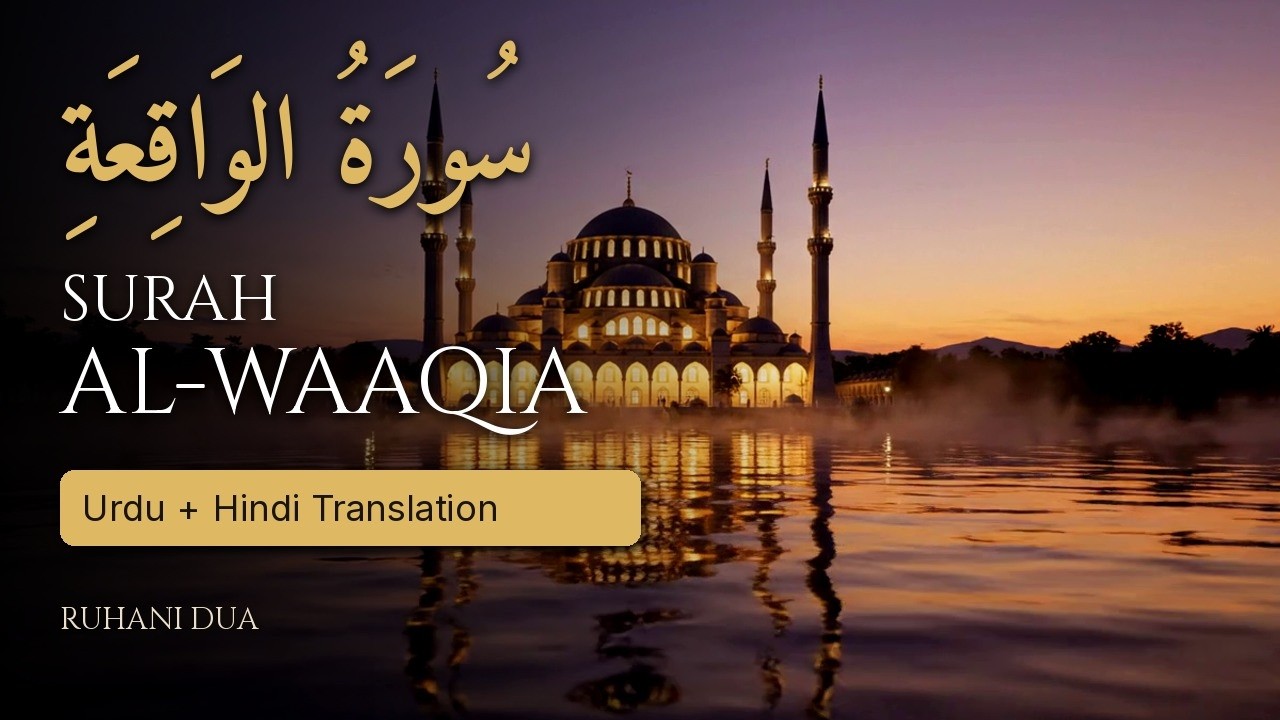
What is Surah Al-Waqi’ah about? In short, it is a Makkan surah that speaks about the Day of Resurrection, the “Event” that no one can deny when it comes. It divides humanity into three groups, describes the outcome of each, and calls us back to reflect on the signs of Allah in creation, in the Quran and in our own lives. It is surah number 56, has 96 ayahs, and falls in Juz 27.

Watch the full video: Surah Al-Waqi’ah Full | Urdu & Hindi Translation | سورۃ الواقعہ | Ruhani Dua on the Ruhani Dua YouTube channel.
Quick facts about Surah Al-Waqi’ah
| Detail | Information |
|---|---|
| Number | 56th surah of the Quran |
| Meaning of the name | “The Event” or “The Inevitable” |
| Ayahs | 96 |
| Revelation | Makkan |
| Position | Juz 27 |
| Main theme | The Day of Resurrection, three groups of people, signs of Allah, the Quran |
The opening: a Day that cannot be denied
The surah begins by announcing that the Event will occur, and that no one will be able to deny its occurrence. The opening ayahs speak of the earth being shaken violently and the mountains crumbling into dust. The tone is serious and direct. It is meant to wake the heart before it moves on to explain who will stand where on that Day.
Three groups of people (56:7–10)
The central teaching comes in Surah Al-Waqi’ah 56:7. It tells us that people will become of three kinds: the companions of the right, the companions of the left, and the forerunners. These are commonly named As-Sabiqun (the foremost), Ashab al-Yamin (companions of the right) and Ashab al-Shimal (companions of the left).
- The foremost (As-Sabiqun): described as those brought near to Allah, in the Gardens of Pleasure (56:10–12).
- The companions of the right: the righteous believers, whose reward is described from 56:27 onward.
- The companions of the left: those who denied the truth, whose end is described from 56:41 onward.
Scholars of tafsir have different views on who exactly the “foremost” are. Commentators have variously identified them with the prophets, the truthful, the martyrs, the first to accept Islam, and others. The shared lesson is that nearness to Allah is a rank to aim for, not only safety.
The reward of the believers and the end of the deniers
Ayahs 11–26 describe the foremost in the Gardens of Pleasure, on thrones, in a place of peace. Ayahs 27–40 describe the companions of the right and the blessings prepared for them. In contrast, ayahs 41–56 describe the companions of the left and the severe outcome of those who denied the Hereafter and persisted in arrogance. Near the end, 56:88–94 returns to the same three-way division at the moment of death. The companions of the right will be greeted with peace, while the astray deniers face a very different end.
Signs of Allah: creation, crops, water and fire (56:57–73)
The middle of the surah turns from the Hereafter to everyday signs, with a series of questions. It begins: “We created you, then why do you believe not?” (56:57). The following ayahs ask us to consider our own creation, the seed that grows into a human being, the crops we sow, the rain that falls and the fire we kindle. Each time the question is the same: who is truly the Creator and Provider?
This section is the heart of the surah’s message about provision. Our effort is real, but the growth, the water and the fuel come from Allah. That is a very different idea from treating the surah as a formula for wealth, and it is a good reason to read its meaning and not only its sound.
The oath by the stars and the noble Quran (56:75–80)
Another key passage begins in 56:75. Allah swears by the setting of the stars and says this is a very great oath, if only we knew. The oath is made for the Quran itself. It is a noble Quran, in a well-preserved Record, touched by none except the purified angels, in the translation shown on Quran.com. Ayah 80 adds that it is a revelation from the Lord of all worlds.
Scholars have discussed how far this ayah applies to touching the Quran in a state of ritual purity. That is a matter where views differ, so for rulings please ask a trusted scholar. What all agree on is the main point: the Quran is a serious, honoured and preserved message.
فَلَآ أُقْسِمُ بِمَوَٰقِعِ ٱلنُّجُومِ
“So I do swear by the positions of the stars.” (Surah Al-Waqi’ah 56:75)
An authentic hadith: the surahs that turned the Prophet’s ﷺ hair grey
The best-known authentic report about this surah is in Jami’ at-Tirmidhi 3297. Ibn Abbas reported that Abu Bakr (RA) said, “O Messenger of Allah, you have become gray.” The Prophet ﷺ replied that he had gone grey from Surah Hud, Al-Waqi’ah, Al-Mursalat, ‘Amma Yatasa’alun and Idha ash-Shamsu Kuwwirat. At-Tirmidhi called it hasan gharib. The five surahs are Hud, Al-Waqi’ah, Al-Mursalat, An-Naba and At-Takwir.
Some scholars note that al-Albani graded it sahih, though some earlier critics found its chains inconsistent. Commentators explain that these surahs discuss the terrors of the Day of Qiyamah as well as the punishments of past nations. If the Prophet ﷺ was moved this deeply by these ayahs, they deserve our reflection, not only our recitation.
A note on the “never poor” narration
Many people know a saying that whoever recites Surah Al-Waqi’ah every night will never be afflicted by poverty. We should be careful here. One scholarly answer states that there is a hadith about the virtues of this surah, but it is not sahih. Another source says there is no reliable hadith reported from the Prophet ﷺ in this regard. So we should not present it as a guaranteed way to wealth. Reciting the Quran regularly is a good habit on its own: Tirmidhi reports through an authentic chain that each letter of the Book of Allah brings a good deed, multiplied by ten. The surah’s real message about rizq is to trust Allah as the Provider while continuing to work lawfully.
Lessons for us today
- Aim for nearness, not just safety. The surah places the foremost above the companions of the right.
- Remember the certainty of the Hereafter. The opening makes clear that the Event will come.
- See Allah in daily provision. Food, water and fire are signs of His care.
- Honour the Quran. Read it with respect and try to understand it.
- Balance fear and hope. The Prophet ﷺ was deeply moved by these surahs, yet the surah also describes great mercy for the believers.
Frequently asked questions
Is Surah Al-Waqi’ah Makki or Madani?
It is a Makkan surah. Muslims believe it was revealed in Makkah, around seven years before the Hijrah. The exact timing is based on tradition.
Who are the three groups in Surah Al-Waqi’ah?
They are the foremost (As-Sabiqun), the companions of the right (Ashab al-Yamin) and the companions of the left (Ashab al-Shimal), introduced in 56:7.
Does reciting Surah Al-Waqi’ah guarantee wealth?
No. The narration about never being poor is not established as an authentic hadith. Recite the Quran with understanding, trust Allah for provision and keep working lawfully.
Read more:
- Surah Al-Kahf: Four Stories, Four Trials and the Friday Sunnah
- Prophet Ibrahim (AS): The Story of Allah’s Khalil in the Quran
Sources:
- Jami’ at-Tirmidhi 3297 (sunnah.com)
- Surah Al-Waqi’ah 56:7–13 (quran.com)
- Surah Al-Waqi’ah 56:75–81 (quran.com)
- Surah Al-Waqi’ah 56:75 (quran.com)
Discover more from ImranJalna
Subscribe to get the latest posts sent to your email.


Leave a Reply