

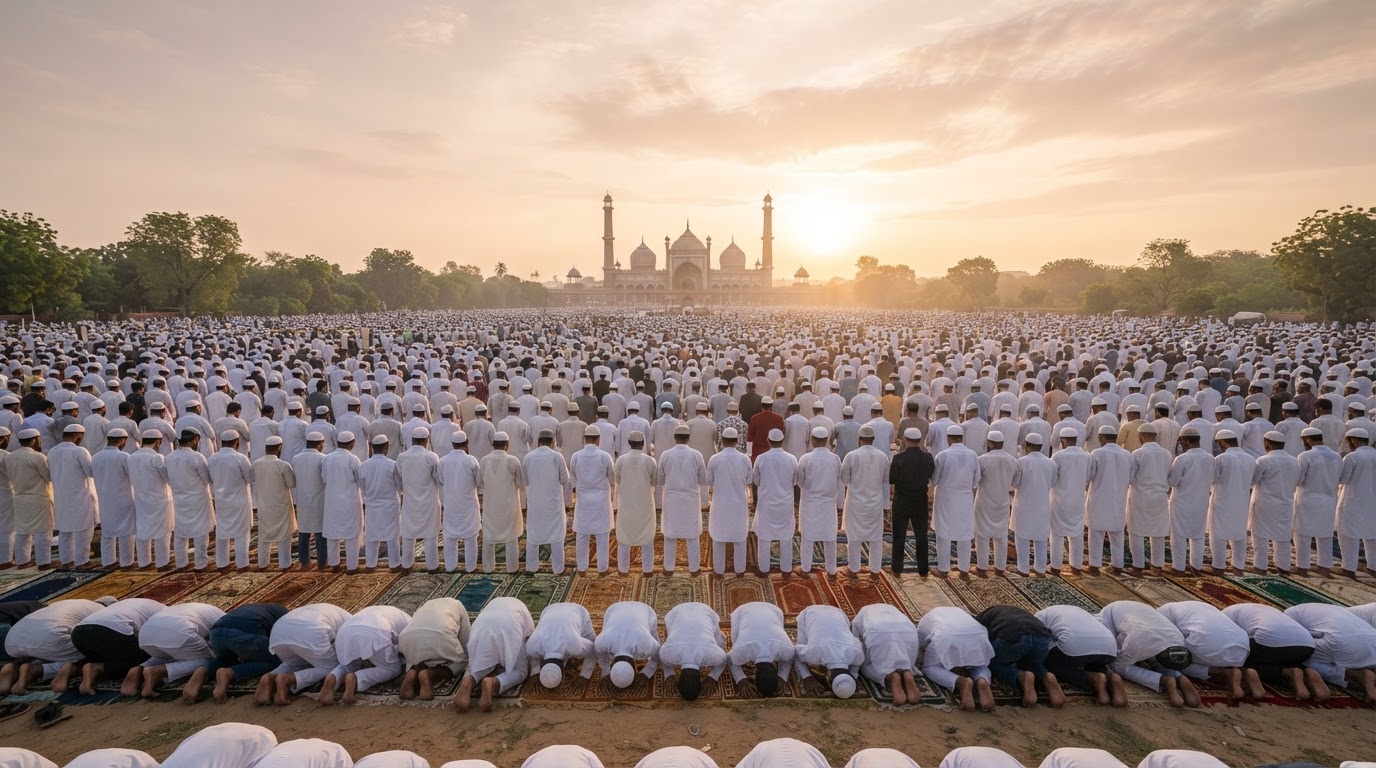
Eid al-Fitr 2027 (1 Shawwal 1448 AH) is expected on Tuesday, March 9, or Wednesday, March 10, 2027, Inshallah, depending on when the Shawwal crescent is sighted. In India, Pakistan and Bangladesh, Eid usually falls a day after the Gulf, so it is likely on Wednesday, March 10, or Thursday, March 11, 2027. Below is a complete guide: the expected dates, how to pray the Eid Salah step by step, the Sunnahs of the day, and when to pay Zakat al-Fitr (Fitrana).

Eid al-Fitr 2027 at a Glance
| Item | Expected (subject to moon sighting) |
|---|---|
| Ramadan 1448 begins | Monday, February 8, 2027 (Gulf); February 8 or 9 in India |
| Night of moon sighting (29 Ramadan) | Monday evening, March 8, 2027 (Gulf) |
| Eid al-Fitr: Saudi Arabia, UAE, Gulf | Tuesday, March 9, or Wednesday, March 10, 2027 |
| Eid al-Fitr: USA, UK, Canada, Europe | Most likely March 9 or 10, depending on the authority your Masjid follows |
| Eid al-Fitr: India, Pakistan, Bangladesh | Likely Wednesday, March 10, or Thursday, March 11, 2027 |
| Last time for Zakat al-Fitr | Before the Eid Salah on Eid morning |
Astronomers in the UAE expect the Shawwal crescent could be seen on the evening of March 8; if it is, Eid will be on March 9, and if not, Ramadan will complete 30 days and Eid will fall on March 10, as reported by Khaleej Times. The final date is always announced by the moon-sighting committee in each country, so follow your local Masjid or Ruet-e-Hilal committee on the evening of 29 Ramadan. For every other date of the year, see our Islamic Calendar 2027.
What Is Eid al-Fitr?
Eid al-Fitr, the “Festival of Breaking the Fast”, is celebrated on the first day of Shawwal, right after Ramadan ends. It is a day of gratitude to Allah for the month of fasting. Allah says in the Quran: “He wants you to complete the prescribed period and to glorify Allah for having guided you, so that you may be grateful” (Surah Al-Baqarah 2:185). Scholars explain that this glorification is the Takbir Muslims say from the sighting of the moon until the Eid Salah.
Anas (RA) reported that when the Prophet ﷺ came to Madinah, its people had two days of play, and he said that Allah had given them two better days instead: Eid al-Adha and Eid al-Fitr (Sunan Abi Dawud 1134). Fasting on the day of Eid is not allowed; the Prophet ﷺ forbade fasting on the two days of Eid (Sahih al-Bukhari 1991, Sahih Muslim 1138).
Zakat al-Fitr (Fitrana): Pay It Before the Eid Prayer
Every Muslim who has food beyond the needs of the day of Eid pays Zakat al-Fitr for himself and his dependants. Ibn Umar (RA) said the Messenger of Allah ﷺ made Zakat al-Fitr compulsory as one sa’ of dates or one sa’ of barley on every Muslim, young and old, male and female, and ordered that it be given before the people go out to the prayer (Sahih al-Bukhari 1503). Ibn Abbas (RA) explained that it purifies the fasting person from idle talk and provides food for the poor; whoever pays it before the prayer, it is an accepted Zakat, and whoever pays it after the prayer, it is ordinary charity (Sunan Abi Dawud 1609).
- When: any time in Ramadan (many pay it in the last days) and no later than the Eid Salah.
- How much: one sa’ (roughly 2.5 to 3 kg) of a staple food such as dates, barley, raisins or rice. In the Hanafi school, half a sa’ of wheat (about 1.6 to 2 kg) or its cash value is accepted. Local Ulama announce the amount in rupees, dollars or pounds every year, so follow your Masjid’s figure.
- Who receives it: poor and needy Muslims, so they too can celebrate Eid.
Zakat al-Fitr is separate from the annual Zakat on wealth. Many families also pay their yearly Zakat in Ramadan; work it out with our free Zakat calculator and read Zakat for beginners: Nisab, recipients and common questions.
How to Pray Eid al-Fitr Salah, Step by Step
The Eid prayer is two Rak’ahs, prayed in congregation after sunrise, with no Adhan and no Iqamah. Jabir ibn Samurah (RA) said he prayed Eid with the Prophet ﷺ more than once without Adhan or Iqamah (Sahih Muslim 887). The prayer comes first and the Khutbah after it: Ibn Umar (RA) reported that the Prophet ﷺ, Abu Bakr and Umar prayed the two Eids before the sermon (Sahih al-Bukhari 963). In the Hanafi school the Eid prayer is Wajib; the Shafi’i and Maliki schools hold it to be a confirmed Sunnah.
Hanafi method (followed by most Muslims in India and Pakistan)
- Make the Niyyah in your heart to pray two Rak’ahs of Wajib Eid al-Fitr Salah behind the Imam, with six extra Takbirs.
- Say the opening Takbir (Allahu Akbar) and recite Thana (Subhanakallahumma).
- Say three extra Takbirs, raising your hands each time; drop the hands to the sides after the first two and fold them after the third.
- The Imam recites Surah Al-Fatihah and another Surah aloud; complete Ruku and Sujood as normal.
- In the second Rak’ah, the Imam recites Al-Fatihah and a Surah first. Then say three extra Takbirs with raised hands, dropping them each time, and with the fourth Takbir go into Ruku.
- Complete the prayer with Tashahhud, Durood and Salam.
- Stay and listen to the Khutbah.
Shafi’i, Maliki and Hanbali method
In these schools the extra Takbirs are said before the recitation in both Rak’ahs: seven in the first Rak’ah (the Shafi’i count them after the opening Takbir) and five in the second, after rising from Sujood. This follows the narration of Amr ibn Shu’ayb from his father and grandfather that the Prophet ﷺ said seven Takbirs in the first Rak’ah and five in the second (Sunan Abi Dawud 1151). Both methods are valid; follow the Imam of your Eidgah.
If you miss the congregation, many scholars allow praying two Rak’ahs on your own or with your family; ask your local Alim about your school’s ruling. New to Salah? Our guide to the Five Pillars of Islam covers the basics.
Sunnahs of the Day of Eid al-Fitr
- Take a bath (Ghusl) before going out. Imam Malik reports in the Muwatta that Abdullah ibn Umar (RA) used to do Ghusl on the day of Eid al-Fitr before going to the Eidgah.
- Wear your best clean clothes and apply Itr (men). Umar (RA) once brought the Prophet ﷺ a cloak and suggested he wear it for Eid and for receiving delegations (Sahih al-Bukhari 948), which shows dressing well for Eid was known.
- Eat before leaving for the prayer, preferably an odd number of dates. Anas (RA) said the Prophet ﷺ would not go out on the morning of Eid al-Fitr until he had eaten some dates, and he ate an odd number (Sahih al-Bukhari 953).
- Say the Takbir on the way: “Allahu Akbar, Allahu Akbar, La ilaha illallah, wallahu Akbar, Allahu Akbar, wa lillahil hamd.”
- Go by one route and return by another. Jabir (RA) said the Prophet ﷺ used to take different routes on the day of Eid (Sahih al-Bukhari 986).
- Bring the family. Umm Atiyyah (RA) said they were commanded to bring out women, even those who were not praying, so they could witness the good and the gathering of the believers (Sahih al-Bukhari 974).
- Greet one another. The Companions used to say to each other on Eid: “Taqabbalallahu minna wa minkum” (May Allah accept from us and from you), as Ibn Hajar mentions in Fath al-Bari. “Eid Mubarak” is also widely used.
- Visit relatives, forgive and give gifts. Eid is a time to join family ties (Silah-Rehmi) and make sure no neighbour is left out.
After Eid: The Six Fasts of Shawwal
Abu Ayyub al-Ansari (RA) reported that the Messenger of Allah ﷺ said: “Whoever fasts Ramadan and then follows it with six days of Shawwal, it will be as if he fasted for a lifetime” (Sahih Muslim 1164). The six fasts can start from the second day of Shawwal, together or separately. If you owe missed Ramadan fasts, many scholars advise making those up first.
Get Ready for Ramadan and Eid 2027
- Ramadan 2027: Expected start date and a 100-day preparation plan
- Ramadan 2027 Sehri and Iftar timetable for Jalna and major Indian cities
- Ramadan 2027 calendar for the USA, UK, Canada, UAE and Saudi Arabia
- Laylatul Qadr 2027: Dates, signs, duas and what to do
- Ramadan budget plan: spend less and give more
Frequently Asked Questions
When is Eid al-Fitr 2027?
Eid al-Fitr 2027 is expected on Tuesday, March 9, or Wednesday, March 10, 2027, in the Gulf, the USA and the UK. In India, Pakistan and Bangladesh it is likely on Wednesday, March 10, or Thursday, March 11. The exact date depends on the sighting of the Shawwal moon.
When is Eid al-Fitr 2027 in India?
Most likely Wednesday, March 10, or Thursday, March 11, 2027. The Markazi Ruet-e-Hilal committees announce the date on the evening of 29 Ramadan after the moon is sighted.
What time is the Eid prayer?
The Eid prayer time begins about 15 to 20 minutes after sunrise and ends before Zawal (midday). Each Masjid and Eidgah announces its own Jamaat time, often between 7:00 and 9:30 am.
How many Takbirs are there in the Eid prayer?
In the Hanafi method there are six extra Takbirs: three in the first Rak’ah after Thana and three in the second Rak’ah after the recitation. In the Shafi’i, Maliki and Hanbali methods there are seven in the first Rak’ah and five in the second, before the recitation.
Can I pay Fitrana after the Eid prayer?
It should be paid before the Eid Salah. According to Ibn Abbas (RA), if it is paid after the prayer it counts only as ordinary charity (Sunan Abi Dawud 1609), so anyone who delays it without reason should still pay it as soon as possible.
Is there an Adhan for the Eid prayer?
No. The Eid prayer has no Adhan and no Iqamah (Sahih Muslim 887). The Imam simply begins the prayer at the announced time.
Can women attend the Eid prayer?
Yes. Umm Atiyyah (RA) reported that women were told to come out on Eid to witness the gathering of the believers (Sahih al-Bukhari 974). Many Eidgahs and Masjids arrange a separate area for women.
ImranJalna Desk
Follow Ruhani Dua on Facebook for short videos and reminders. / रूहानी दुआ को Facebook पर Follow करें।
Discover more from ImranJalna
Subscribe to get the latest posts sent to your email.







Leave a Reply