
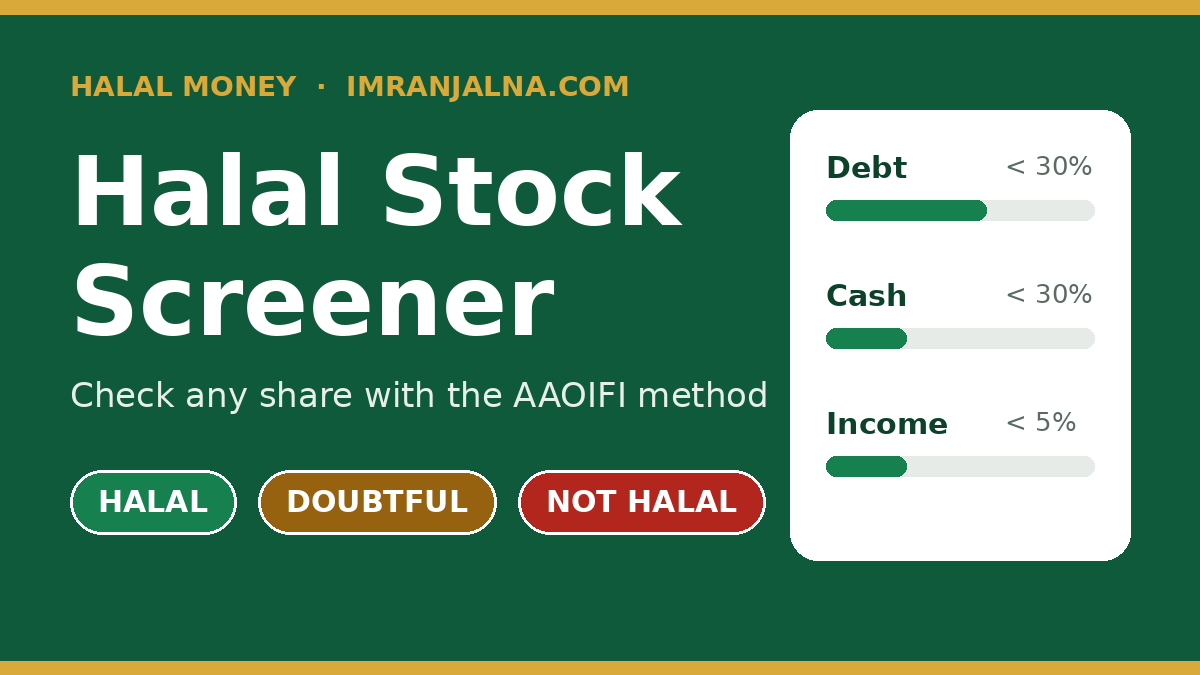
Use this free tool to check whether a listed company passes Shariah screening before you buy its shares. It follows the AAOIFI method: first the business activity, then three financial ratios. You enter the numbers from the company’s annual report and get a clear result with the reason for each test, plus the amount of dividend to give in charity. Nothing you type leaves your phone or computer.
Where to find these numbers
- Market capitalisation: shown at the top of the company page on screener.in and on the NSE and BSE quote pages.
- Interest-bearing debt: the “Borrowings” line of the balance sheet (non-current plus current). On screener.in, open Balance Sheet and read Borrowings.
- Cash and interest-bearing securities: in the annual report balance sheet, add “Cash and cash equivalents”, “Other bank balances” and the part of “Investments” held in fixed deposits, bonds, debentures and debt mutual funds. The notes to the accounts give the split.
- Non-permissible income: the “Other income” note lists interest income. Add revenue from any prohibited segment shown under “Segment reporting”.
- Total revenue: “Total income” in the statement of profit and loss.
- Annual report: the company’s Investor Relations page, or the Annual Reports section on nseindia.com and bseindia.com. Use consolidated figures.
- Dividend: your bank statement or the dividend report from your broker.
How the result is decided
- Halal: main business is permissible and all three ratios are comfortably under their limits.
- Doubtful: nothing fails, but you are unsure of the main business, or a ratio is within 10% of its limit (27% to 30%, or 4.5% to 5%). The caution zone is this tool’s own safety margin, not part of the AAOIFI text.
- Not Halal: the main business is prohibited, or any ratio is at or above its limit.
- Purification: dividend × (non-permissible income ÷ total revenue), rounded up.
How to Check if a Stock is Halal in India
When you buy a share, you become a part-owner of a business. So a Muslim investor has two questions to answer, not one: will this share grow, and what exactly am I becoming an owner of? India has thousands of companies listed on the NSE and BSE, and none of them carries an official halal label. You have to check each company yourself. The method below is the same one the screener above uses, so you can follow every step by hand.
Which standard does the screening follow?
The most widely used benchmark is Shariah Standard No. 21 of AAOIFI, the Accounting and Auditing Organization for Islamic Financial Institutions. It tests a company in two stages: what the business does, and how much interest (riba) is mixed into its finances. Other screening bodies use slightly different limits. India’s Nifty Shariah indices, for example, are screened by TASIS under its own criteria. This is why the same share can pass one screen and fail another. Choose one standard and apply it consistently.
Step 1: Check what the company does
Open the latest annual report and read the business overview and the segment reporting note. If the main income comes from alcohol, conventional banking or lending, conventional insurance, gambling, pork, tobacco or adult content, the screening ends there and the share is not halal. Many Shariah screens also exclude weapons makers. In India this single step removes most banks, NBFCs, insurers, breweries and cigarette companies.
Some companies have a permissible main business with a small impermissible part, such as a hotel chain that serves alcohol or an IT company that earns interest on its deposits. These move on to step 2, where that small part is counted as non-permissible income.
Step 2: Check the three financial ratios
- Interest-bearing debt ÷ market capitalisation must be under 30%. A company that runs mainly on interest-based loans is too deeply tied to riba.
- Cash plus interest-bearing securities ÷ market capitalisation must be under 30%. This covers bank deposits, bonds, debentures and debt funds that earn interest.
- Non-permissible income ÷ total revenue must be under 5%. This is interest income plus revenue from any prohibited side activity.
Take a worked example. A company has a market cap of ₹10,000 crore, borrowings of ₹1,800 crore, cash and fixed deposits of ₹900 crore, and interest income of ₹60 crore on total income of ₹4,000 crore. Its debt ratio is 18%, its cash ratio is 9% and its non-permissible income is 1.5%. It passes all three tests.
You can find these figures in the annual report, on screener.in, and on the company pages of NSE and BSE. Always use consolidated figures, because they include subsidiaries.
Step 3: Purify your dividend
A pass does not mean every rupee is clean. If 1.5% of the company’s income is non-permissible, then 1.5% of your dividend carries that portion. On a dividend of ₹2,000 you would give ₹30 to charity and keep ₹1,970. This amount is given away to cleanse your income. It is separate from your zakat and does not replace it. To work out zakat on your shares and savings, use our Zakat Calculator.
Mistakes to avoid
- Trusting an old list. “Halal stock lists” shared on WhatsApp or social media go out of date. Ratios change every quarter.
- Checking only the business. A company selling a perfectly permissible product can still fail because of heavy interest-based debt.
- Screening once and forgetting. Market cap moves with the share price, so a ratio can cross 30% even when the company has not borrowed a single new rupee. Recheck after each annual report and when the price falls sharply.
- Ignoring how you trade. Screening covers the company only. Margin trading on borrowed money and most futures and options raise separate Shariah questions that this tool does not answer.
What this tool can and cannot do
The screener applies published AAOIFI limits to the numbers you enter. It does not fetch live data, it does not know anything about the company beyond what you type, and it cannot settle matters on which scholars differ. Treat the result as a first filter. For a final answer on a specific share, consult a qualified scholar, and for the investment decision itself, a SEBI-registered adviser. You will find more guides in our Halal Money section.
Frequently Asked Questions
Is investing in the stock market halal in Islam?
Many contemporary scholars and standard-setting bodies such as AAOIFI permit owning shares in companies whose main business is permissible and whose finances pass Shariah screening. Buying a share is treated as owning part of a real business. Trading that resembles gambling, and shares of companies in prohibited sectors, are not permitted. Opinions differ on details, so ask a qualified scholar about your own case.
What is the AAOIFI rule for halal stocks?
The company’s main business must be permissible. In addition, interest-bearing debt must be under 30% of market capitalisation, cash and interest-bearing securities must be under 30% of market capitalisation, and non-permissible income must be under 5% of total revenue. A share has to pass every test.
Are bank and insurance shares halal?
Shares of conventional banks, NBFCs and conventional insurance companies do not pass, because their main income comes from interest or from contracts that Shariah screening treats as impermissible. This applies to public sector and private sector lenders alike.
Is a company with debt automatically haram?
No. Almost every large company has some borrowing. Under the AAOIFI method a company passes the debt test as long as its interest-bearing debt stays under 30% of its market capitalisation. A debt-free company passes this test easily but must still pass the other tests.
How do I calculate purification on dividends?
Divide the company’s non-permissible income by its total revenue to get a percentage, then apply that percentage to the dividend you received. If non-permissible income is 2% and your dividend is ₹5,000, give ₹100 to charity. The screener above does this calculation for you.
Is the Nifty Shariah index the same as AAOIFI screening?
No. The Nifty Shariah indices are screened by TASIS using its own criteria, which are not identical to the AAOIFI ratios. A share in the index is a useful starting point, but it may give a different result under AAOIFI, and index membership changes over time.
How often should I rescreen my shares?
Rescreen at least once a year when the annual report is published, and ideally after each quarterly result. Also recheck after a sharp fall in the share price, because the debt and cash ratios are measured against market capitalisation.
Do I have to pay zakat on shares?
Yes, shares are generally counted among zakatable wealth once your total wealth reaches the nisab and a lunar year has passed. Shares bought for trading are usually valued at their market price on your zakat date. Scholars describe different methods for long-term holdings, so confirm the method with a scholar and use our Zakat Calculator for the figures.