

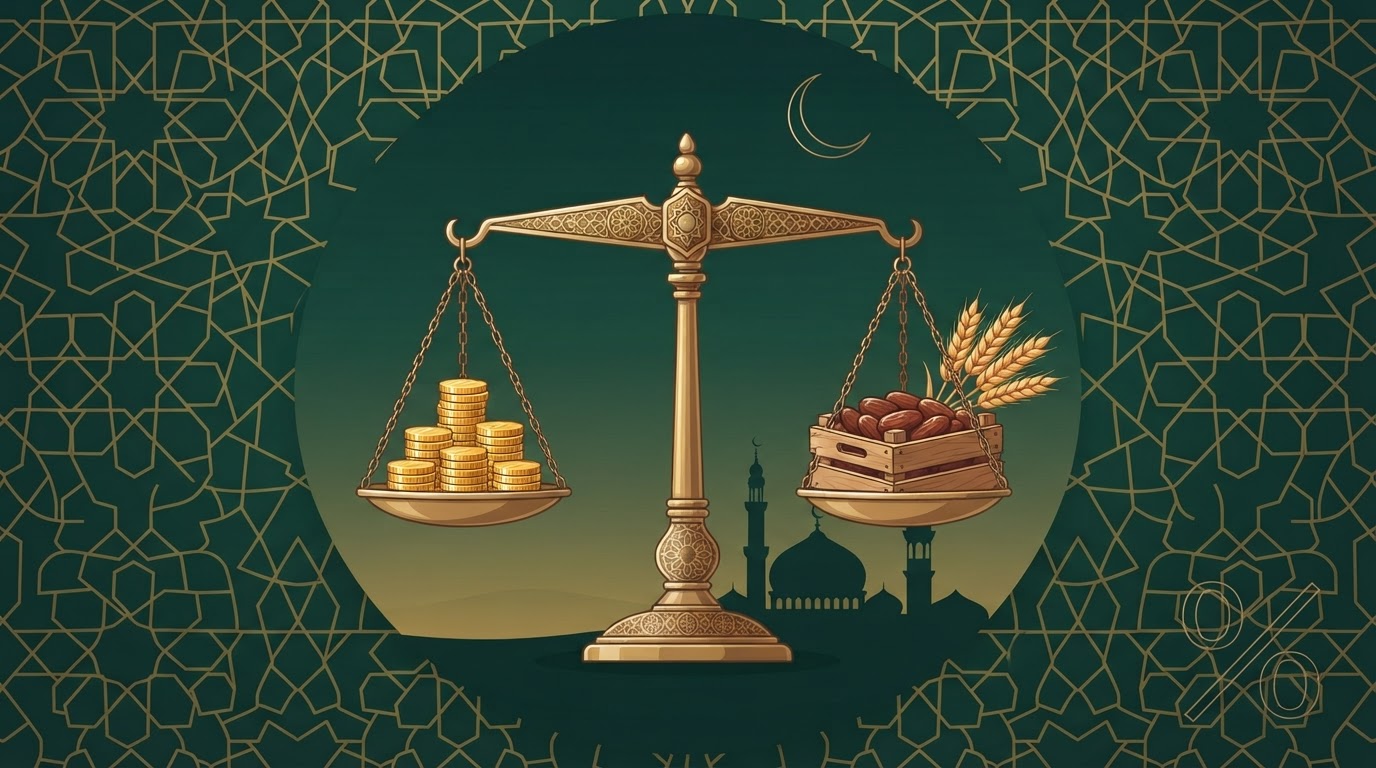
Riba is any fixed, pre-agreed extra charged on a loan or debt, plus certain unequal swaps of the same kind of money or staple goods. In modern banking, that means interest on loans, credit cards, overdrafts and ordinary savings accounts is treated as Riba by the large majority of scholars and every major Islamic finance standards body. This guide explains what counts, what does not, and how to start moving your money away from it.
Quick facts
| Meaning of the word | “Increase” or “growth” in Arabic |
| Main Quran verses | Al-Baqarah 2:275–279, Aal-Imran 3:130, Ar-Rum 30:39 |
| Two main types | Riba al-Nasi’ah (interest on debt) and Riba al-Fadl (unequal exchange) |
| Who is blamed | The taker, the payer, the writer and the witnesses (Sahih Muslim 1598) |
| Majority ruling on bank interest | Riba, whether the rate is high or low |
| Halal alternatives | Trade (Murabaha), leasing (Ijarah), partnership (Musharakah, Mudarabah) |
What does the Quran say about Riba?
The clearest verse is Surah Al-Baqarah 2:275. People in the Prophet’s time argued that trade and Riba are the same thing, since both produce a gain. Allah answers that He has made trade lawful and Riba unlawful. The next verse (2:276) says Allah wipes out the blessing of Riba while He increases charity (Sadaqah).
Verses 2:278–279 go further. Believers are told to give up whatever Riba is still owed to them, and those who refuse are warned of war from Allah and His Messenger. The same passage gives a fair exit: you keep your original capital, so you neither wrong others nor are wronged. Surah Aal-Imran 3:130 forbids Riba that is “doubled and multiplied”, and Surah Ar-Rum 30:39 contrasts Riba, which does not grow with Allah, with Zakat (the obligatory annual charity), which does.
In the Sunnah (the Prophet’s teaching), Jabir reported that the Messenger of Allah ﷺ cursed the one who consumes Riba, the one who pays it, the one who writes it down and its two witnesses, and said they are all equal (Sahih Muslim 1598). So Riba is not only the lender’s problem.
What are the two types of Riba?
1. Riba al-Nasi’ah (Riba of delay). This is an extra amount a lender requires because the borrower pays later. Borrow 1,000 and promise to return 1,100 in a year, and the 100 is Riba al-Nasi’ah. It does not matter whether the extra is called interest, a fee, APR or a “service charge” if it is really a price for time on a loan. This is the type found in almost every conventional loan product.
2. Riba al-Fadl (Riba of excess). This comes from the hadith of Ubadah ibn as-Samit, who heard the Prophet ﷺ forbid swapping gold for gold, silver for silver, wheat for wheat, barley for barley, dates for dates and salt for salt, except equal for equal and hand to hand. Whoever gave or asked for more had dealt in Riba (Sahih Muslim 1587). Swapping 1 kg of good dates for 2 kg of poorer dates is the classic example. Today it matters most for gold, silver and currency exchange.
Which modern banking products contain Riba?
Here is how common products are usually classified by mainstream scholars and Shariah boards. Details vary by provider, so always read the contract.
| Product | Usual status | Why |
|---|---|---|
| Personal loan, car loan, payday loan | Riba | Fixed extra charged for time on borrowed money |
| Conventional mortgage / home loan | Riba | Interest on the loan amount |
| Credit card balance carried over | Riba | Interest on unpaid debt |
| Overdraft with interest | Riba | Interest on a short-term loan from the bank |
| Interest-paying savings or fixed deposit | Riba | Your deposit is legally a loan to the bank; the interest is a guaranteed extra |
| Government bonds and most corporate bonds | Riba | Interest-bearing debt |
| Current account with no interest | Generally allowed | No extra is taken or paid |
| Islamic profit-sharing account | Generally allowed | Return depends on real business results, not a guaranteed rate |
| Buying shares in a halal business | Generally allowed | Ownership with real risk (with screening rules) |
The International Islamic Fiqh Academy of the OIC ruled at its 1985 session in Jeddah that both interest set at the start of a loan and extra charged for extending an overdue debt are Riba. The Fiqh Council of the Muslim World League and later Fiqh Academy resolutions confirmed this, including interest on bank deposits. Their housing resolution adds that the size of the rate makes no difference.
Is there any difference of opinion on bank interest?
Yes, but it is a minority view. In December 2002 the Islamic Research Institute of Al-Azhar in Egypt, under Shaykh Muhammad Sayyid Tantawi, said that placing money with banks that set profits in advance is permissible. It treated the bank as an investment agent rather than a borrower. A few earlier modern thinkers also questioned whether every form of interest is Riba.
This view was strongly rejected by the Fiqh Academies and by scholars such as Mufti Muhammad Taqi Usmani. Their main reply: if the bank must return your capital in full plus a fixed percentage no matter how its business performs, that is a loan with a guaranteed increase, whatever name it is given. Islamic finance bodies such as AAOIFI build their standards on the majority position. If you follow a particular scholar or school, ask them directly; for most Muslims the safer path is the majority view.
How is halal profit different from interest?
Islam has no problem with earning money. The question is how the gain is earned. Profit is halal when it comes from a real sale, a real lease or a real partnership where the money-provider carries some risk or ownership. Riba is a guaranteed gain on money lent, with the risk pushed entirely onto the borrower.
- Murabaha (cost-plus sale): the bank buys an item and sells it to you at an agreed higher price, paid in instalments. The price is fixed once agreed and cannot grow if you pay late.
- Ijarah (leasing): the bank owns an asset and charges you rent for using it.
- Musharakah (partnership): you and the bank co-own an asset or business and share profit, while losses are shared according to each side’s capital.
- Mudarabah: one side gives capital, the other gives work; profit is shared by an agreed ratio, not a fixed sum.
One test helps: does the lender’s return stay guaranteed even if the business fails? If yes, it is very likely Riba.
Did you know? In his Farewell Sermon at Hajj, the Prophet ﷺ declared all pre-Islamic Riba cancelled, and the first he cancelled was the Riba owed to his own uncle, al-Abbas ibn Abd al-Muttalib (Sahih Muslim 1218).
How can I start leaving Riba behind?
- List every product you hold: accounts, cards, loans, pension, investments. Mark which ones pay or charge interest.
- Stop new Riba first. Pay credit cards in full each month and avoid new interest-based loans where you can.
- Move savings to a non-interest current account or an Islamic profit-sharing account where one is available to you.
- Clear interest debt fastest starting with the highest rate, without stopping essential spending on family.
- Give away interest already received. Many scholars say to pass it on to charity without expecting reward, rather than spending it on yourself.
- Screen investments for halal business activity and low interest-based debt.
- Ask a scholar about hard cases, such as a student loan or a home loan you already hold.
Lessons for us today
Riba is one of the few sins the Quran links to a warning of war from Allah, yet it has become so normal that many of us carry it without noticing. The lesson is not panic but steady action: learn which products contain it, stop adding more, and replace each one when a halal option exists. Allah gives a clear promise in 2:276: Riba loses its blessing, while honest trade and charity grow. Small, consistent steps, like moving your savings or paying a card in full, are real worship when done for His sake.
Frequently asked questions
Is a small interest rate still Riba?
Yes, according to the majority. The Fiqh Academy states that the ruling does not depend on whether the rate is high or low. Any pre-agreed extra on a loan counts.
Is it haram to work in a conventional bank?
Many scholars discourage roles that directly write, approve or witness interest contracts, based on Sahih Muslim 1598. Roles unrelated to interest dealings are viewed more leniently by some. This depends heavily on the exact job, so ask a qualified scholar.
Are late payment fees in Islamic banks Riba?
An Islamic bank cannot keep extra money as profit for late payment. Many Islamic banks instead charge a late fee that must be given to charity, to discourage deliberate delay. Check how your provider handles it.
What should I do with interest my bank already paid me?
Most scholars advise giving it away to charity or public welfare without intending reward, and not using it for yourself. Do not count it as your Zakat.
This article is general educational information, not personal financial or religious advice. For your own situation, consult a qualified scholar and a licensed financial adviser.
Read more: Halal Money: all guides · Is a Savings Account Halal? What to Do With Bank Interest · Halal Investing for Beginners
Sources: Sahih Muslim 1598 (sunnah.com) · Sahih Muslim 1587 (sunnah.com) · International Islamic Fiqh Academy, Resolution 10 (1985) · Islamic Finance Guru: What is Riba?
Follow Ruhani Dua on Facebook for short videos and reminders. / रूहानी दुआ को Facebook पर Follow करें।









Leave a Reply