

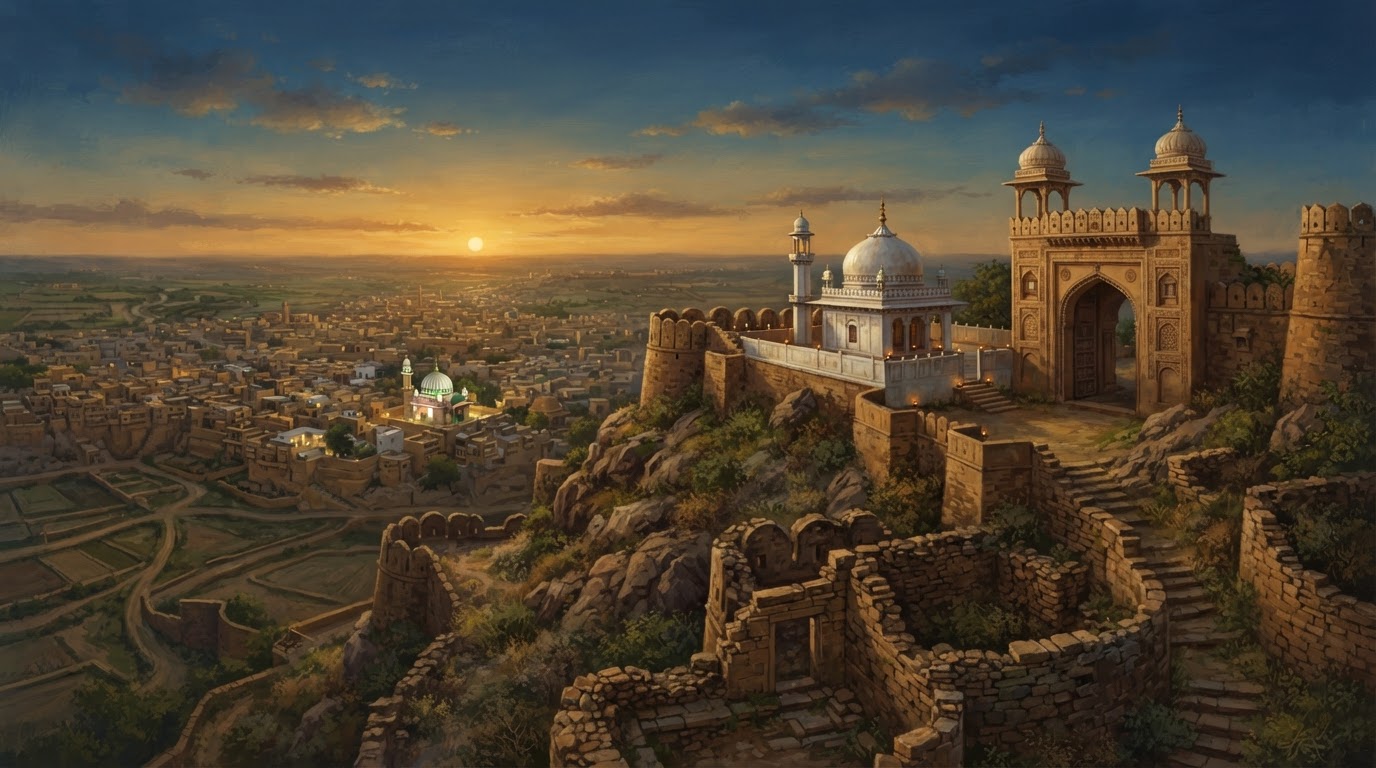
Stand in the courtyard of Ajmer Dargah and look up. Behind the domes and the pigeons, a bare brown hill rises steeply over the city, its crest ringed by broken walls. That is Taragarh. And at the top, among the ruins of one of the oldest hill forts in Rajasthan, there is a second dargah that many first-time pilgrims never hear about.
It belongs to Hazrat Miran Sayyid Husain Khing Sawar (Rehmatullah Alaih), known lovingly in Ajmer as Miran Sahib. In short: he was the Muslim garrison commander of Taragarh Fort in the years after 1192. According to tradition, he was killed with his companions in a surprise attack while they were at prayer, around 1202 CE, on 18 Rajab. He is buried on the hilltop, his white horse lies near him, and his shrine is still one of the most visited places in Ajmer after the Dargah of Khwaja Gharib Nawaz below.
Miran Sahib and Taragarh: quick facts
| Full name | Hazrat Miran Sayyid Husain Khing Sawar Mashhadi |
| Role | Qiladar (garrison commander) of Taragarh Fort |
| Martyrdom | 18 Rajab, around 1201–1202 CE (sources differ by a year) |
| His Urs | 17–18 Rajab, about 12 days after Chhati Sharif |
| “Khing” | Persian for a white horse; his horse is buried in the complex |
| Main gate | Mughal gateway about 19.5 m high, credited to Ismail Quli Khan |
| Old name of the fort | Ajaymeru Durg |
| Distance | About 3.5 km from Ajmer Junction by road, up a steep hill |
Who was Miran Sahib?
After the Second Battle of Tarain in 1192, Ajmer passed to Sultan Shihabuddin Muhammad Ghori, and later to his general and successor, Qutbuddin Aibak. The fort on the hill above the city needed a commander. The man chosen was a Sayyid with roots in Mashhad, in Khorasan, which is why he is also called Mashhadi. Shrine accounts trace his lineage to Imam Ali Raza (Imam Rida), the eighth Imam of the Ahl-e-Bait.
Sources describe his job a little differently. Most call him the qiladar, the keeper of the fort; the Rough Guide to India says he was also appointed chief tax collector. What the shrine’s own tradition stresses is his character. He is remembered as a pious, generous man who cared for the sick, including people suffering from leprosy and epilepsy, and who drew local communities towards Islam through kindness rather than force.
This was the same Ajmer where Hazrat Khwaja Moinuddin Hasan Chishti, Khwaja Gharib Nawaz (RA), was living among the poor and teaching love of Allah and service to people. One man held the hill with the sword; the other won the city below with a bowl of food.
What happened on 18 Rajab?
Ajmer had only recently changed hands, and the Rajput rulers who had lost it tried to take the fort back. According to the shrine’s account, two earlier attempts failed. The third came by surprise.
Tradition says Miran Sahib and his men were standing in Namaz when the attackers broke in. Wikipedia, citing the Rough Guide and the historian Catherine Asher, records that he was killed during prayer in 1202 CE. The shrine tradition is more precise: it was the Asr (afternoon) prayer on 18 Rajab. His companions fell with him. So did his horse.
What followed is one of the most moving stories told in Ajmer. When news of the killing reached the city, there was mourning. According to local tradition, Khwaja Gharib Nawaz climbed the hill with his disciples, led the Namaz-e-Janaza (funeral prayer) and buried the martyrs himself. Another version credits a different elder with the burial, so it is fair to call this a tradition rather than settled history. But it explains why the two shrines, one at the foot of the hill and one at its top, have always felt linked in the hearts of Ajmer’s people.
Did you know? The word Khing in Miran Sahib’s title means a white horse in Persian. “Khing Sawar” simply means “the rider of the white horse”.
The white horse that pilgrims greet first
Inside the complex there is a small grave that surprises visitors. It belongs to Khing, Miran Sahib’s horse. Tradition says the horse was badly wounded in the same attack and was buried near its master because of how close the two had been.
A local custom has grown around it. The shrine’s committee says devotees usually stop at the horse’s grave with flowers and a handful of pulses (dal) before going on to the Mazar (tomb) itself. A small shrine to the horse also stands in the neighbourhood below, part of a local route of little shrines around Taragarh.
Who built the shrine we see today?
For three centuries the grave was a simple place. It became grand in the Mughal age, and the list of people who added to it reads like a roll call of Indian history:
- Sher Shah Suri, after his campaign against Raja Maldeo of Marwar, is said to have visited and, troubled by the lack of water on the hill, ordered a spring to be made.
- Emperor Akbar reportedly visited around 1570, and the towering gateway, about 19.5 metres high and 5 metres wide with two small domed pavilions on top, is credited to his noble Ismail Quli Khan.
- Emperor Jahangir, who spent long years in Ajmer, is linked with the marble screen (kathera) around the grave; Wikipedia, citing the architectural historian R. Nath, dates it to 1615.
- Maratha nobles came too. Shrine records name Daulat Rao Scindia among visitors, and say a noble called Guman Rao Scindia built a courtyard after his prayer for a son was answered.
The gate has a band of Quranic verses framing its single pointed arch. The dome over the grave once looked much like the dome over Khwaja Gharib Nawaz below. From 1992 the managing committee rebuilt the main enclosure, and today the dome is modelled on the shrine of Imam Ali Raza in Mashhad, a fitting link to the family Miran Sahib came from. You can compare it with the domes and gates of the main shrine in our walk through Ajmer Dargah, and read how the same emperors honoured Khwaja Sahib in why Mughal emperors walked to Ajmer.
What is left of Taragarh Fort?
The fort is older than the shrine by centuries. It was first called Ajaymeru Durg, and the city of Ajmer takes its name from the same root. Old Ajmer guidebooks repeat a claim from the Mughal-era writer Abdul Haq Dehlvi that it was the first hill fort ever built in India. Historians date it differently, linking it with the Parmar Rajputs and with the Chauhan king Ajayaraja.
The name Taragarh came much later. In the late 15th century, Prince Prithviraj of Mewar, elder brother of Rana Sanga, captured the fort and named it after his wife, Tarabai. After Babur’s victory at Khanwa it passed to the Mughals and became the military base of the province of Ajmer.
- Gates: Lakshmi Pol, Phuta Darwaza and Gagudi ki Phatak, now mostly in ruins.
- Bastions: 14 in the wall; the largest, the 16th-century Bhim Burj, once carried a huge cannon called Garbh Gunjam, “thunder from the womb”.
- Water: several old reservoirs, the reason the fort could hold out on a dry hill.
Today the walls are broken, but the view is the reward. On a clear winter morning you can see the whole of Ajmer below, Ana Sagar lake shining to one side and the white domes of the Dargah of Khwaja Gharib Nawaz tucked against the foot of the hill.
How to visit during the 815th Urs
Many pilgrims who come for the 815th Urs of Khwaja Gharib Nawaz in December 2026 make Taragarh part of their ziyarat (visit to a holy place). A few practical points:
- Go by road. Taxis and shared jeeps run up the hill road from the city. The old footpath is steep and best left to fit walkers.
- Go early. Mornings are calmer and the light is better; Urs days get busy in the afternoon.
- Dress for the cold. The hilltop is windy and December mornings are chilly. Our Ajmer Urs travel guide covers trains, stays and winter tips.
- Keep the same adab (good manners) as at the main Dargah: cover your head, remove shoes, speak softly and make your Dua to Allah. See the quiet rules of Ajmer Dargah.
- Respect all visitors. The shrine is cared for by a trust and is especially dear to the Shia community, which holds Muharram gatherings here; Sunni and other pilgrims visit too. It is a place to pray, not to debate.
Remember the calendar too. Miran Sahib’s own Urs falls on 17–18 Rajab, so in 2026 it comes around the last week of December, after most Urs pilgrims have gone home. If you can stay on, the hill is quieter and deeply moving then.
The lesson on the hill
There is something worth sitting with at the top of Taragarh. A soldier, remembered not for his battles but for nursing the sick. A man who died standing in prayer. A saint below who, according to tradition, climbed the hill to bury him with his own hands. Eight hundred years on, both are remembered in the same breath by the people of Ajmer, and the way up to one usually begins at the door of the other. Faith, in the end, is measured by how we live and how we stand before Allah, not by who holds the fort.
Frequently asked questions
Who is buried at the dargah on Taragarh hill?
Hazrat Miran Sayyid Husain Khing Sawar (Miran Sahib), the commander of Taragarh Fort, who according to tradition was martyred with his companions at prayer on 18 Rajab around 1202 CE.
How far is Taragarh from Ajmer Dargah?
Ajmer Dargah sits at the foot of Taragarh hill. By road, the hilltop shrine is roughly 3.5 km from Ajmer Junction railway station, a short but steep drive.
What does “Khing Sawar” mean?
“Khing” is Persian for a white horse, so “Khing Sawar” means “rider of the white horse”. His horse, also called Khing, is buried in the shrine complex.
When is the Urs of Miran Sahib?
His Urs is held on 17 and 18 Rajab, about twelve days after Chhati Sharif of Khwaja Gharib Nawaz. Exact Gregorian dates depend on the Rajab moon.
Related: Ajmer Urs 2026 dates · Why a cannon fires on Chhati Sharif · The ghusl and chadar of Ajmer · Sufi saints of India
Sources: Taragarh Fort, Ajmer (Wikipedia); Husayn Khing Sawar (Wikipedia, citing Asher and the Rough Guide); Dr Mazhar Naqvi, based on the Taragarh shrine committee’s account; Shared Sacred Sites: Taragarh’s Miranji; Trawell: Taragarh Fort.
Follow Ruhani Dua on Facebook for short videos and reminders. / रूहानी दुआ को Facebook पर Follow करें।
Discover more from ImranJalna
Subscribe to get the latest posts sent to your email.





Leave a Reply