

In the winter of 1570, the most powerful man in India set out from Agra on foot. Courtiers, soldiers and musicians trailed behind him across the dusty plains of Rajasthan. A Mughal painter later showed him in plain white, walking among his people like any pilgrim.
The man was Emperor Akbar, and he was walking to Ajmer to thank Hazrat Khwaja Moinuddin Chishti, Khwaja Gharib Nawaz (RA), for the birth of his son. For three generations, the Mughal emperors treated the Ajmer Dargah as their spiritual home: Akbar visited it 17 times, Jahangir pierced his ears for the saint, and Shah Jahan and his daughter Jahanara left the marble buildings pilgrims still walk through today.
Quick facts: the Mughals at Ajmer
| Akbar’s first visit | January 1562, after setting out from Agra on 14 January |
| Akbar’s visits | 17 pilgrimages between 1562 and 1579 (historian Pratyay Nath) |
| Akbari Masjid | Red sandstone, built around 1571; today a madrasa |
| Jahangir in Ajmer | About three years (1613 to 1616); met the English envoy Sir Thomas Roe here |
| Shahjahani Masjid | White marble Jami Masjid, 1637 to 1638 |
| Begumi Dalan | Porch built by Princess Jahanara in 1643 |
| Sandali Masjid | Added by Aurangzeb |
How did Akbar find his way to Ajmer?
It began almost by accident. According to Akbar’s court historian Abul Fazl, the young emperor heard qawwals in Agra singing about the saint of Ajmer. On 14 January 1562 he left Agra on a hunting trip and turned west, ending up at the Dargah. He prayed, gave gifts and distributed alms.
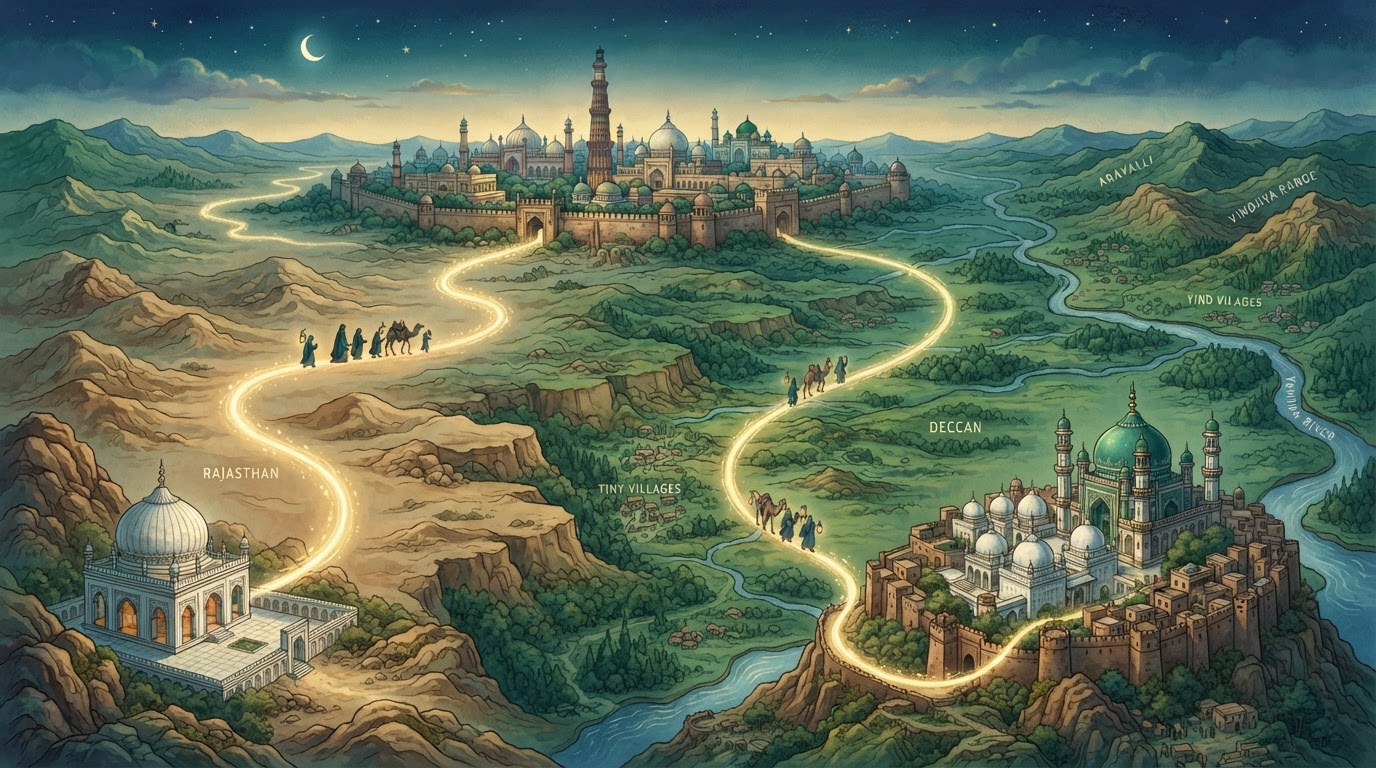
It was the first of many visits. Historian Pratyay Nath of Ashoka University counts 17 pilgrimages in the 18 years between 1562 and 1579. Akbar usually walked at least part of the way, and on some trips he walked the whole distance from Agra, roughly 350 to 400 km.
Why did Akbar walk all the way from Agra?
Akbar had no surviving son for years. He prayed at the shrines of the Chishti saints, and he grew close to Shaikh Salim Chishti of Sikri, a spiritual descendant of Khwaja Gharib Nawaz. In August 1569 a prince was born. Akbar named him Salim, after the Shaikh. The boy would later rule as Emperor Jahangir.
Akbar had made a vow. In early 1570 he set out from Agra to Ajmer on foot to give thanks. The Victoria and Albert Museum in London holds a page from the Akbarnama, outlined by the painter Basawan and coloured by Nand Gwaliari, that shows this very journey, with the emperor walking at the centre in white.
Did you know? Local tradition in Rajasthan links the tall kos minars (milestone towers) along the old Agra to Ajmer road with the royal pilgrimages. Historians see them mainly as Mughal road markers, but the story is still told along the route.
Was it only faith, or politics too?
Both, say historians. Ajmer sat on the main roads into Rajasthan, Malwa and Gujarat. Akbar’s visits often came just before or after major campaigns, including Chittor (1567 to 1568), Ranthambore (1569) and Gujarat (1572 to 1573). He prayed at the Dargah before battles and later presented items captured from defeated rivals at the shrine.
Nath notes that the pilgrimages stopped after 1579, as Akbar’s court began presenting the emperor himself as a universal sovereign. But the bond between the Mughal family and Ajmer did not end. It passed to his son.
Why did Jahangir wear pearl earrings?
Jahangir came to Ajmer in 1613 and stayed close to the Dargah for nearly three years. In the ninth year of his reign (1614) he fell seriously ill. In his memoirs, the Tuzuk-i-Jahangiri, he records a vow: if he recovered, he would pierce his ears as a sign that he was the Khwaja’s devoted servant.
He recovered, pierced his ears and wore a pearl in each. His nobles copied him, and pearl earrings for men quickly became the fashion at court. Mughal portraits from these years show the emperor with the pearls clearly visible.
Jahangir’s gifts are still inside the shrine. The silver chaparkhat (canopy) over the Mazar, inlaid with mother-of-pearl, is credited to him. So is one of the two giant cauldrons near the Buland Darwaza. A painting in Mumbai’s CSMVS museum shows him distributing food from it, and his memoirs say he ordered food cooked in it for the poor of Ajmer. Read their full story in The Mughal Cauldrons That Still Feed Thousands.
Did you know? It was in Ajmer, in January 1616, that Jahangir received Sir Thomas Roe, the first official ambassador from England. The meeting rooms of Akbar’s Ajmer fort, now a museum, can still be visited.
What did Shah Jahan build at the Dargah?
Shah Jahan, the builder of the Taj Mahal, gave Ajmer its most elegant building: the Jami Masjid, better known as the Shahjahani Masjid, completed around 1637 to 1638. It is built of white marble, traditionally said to come from Makrana, the same quarries that supplied the Taj. A Persian inscription on the wall records the date.
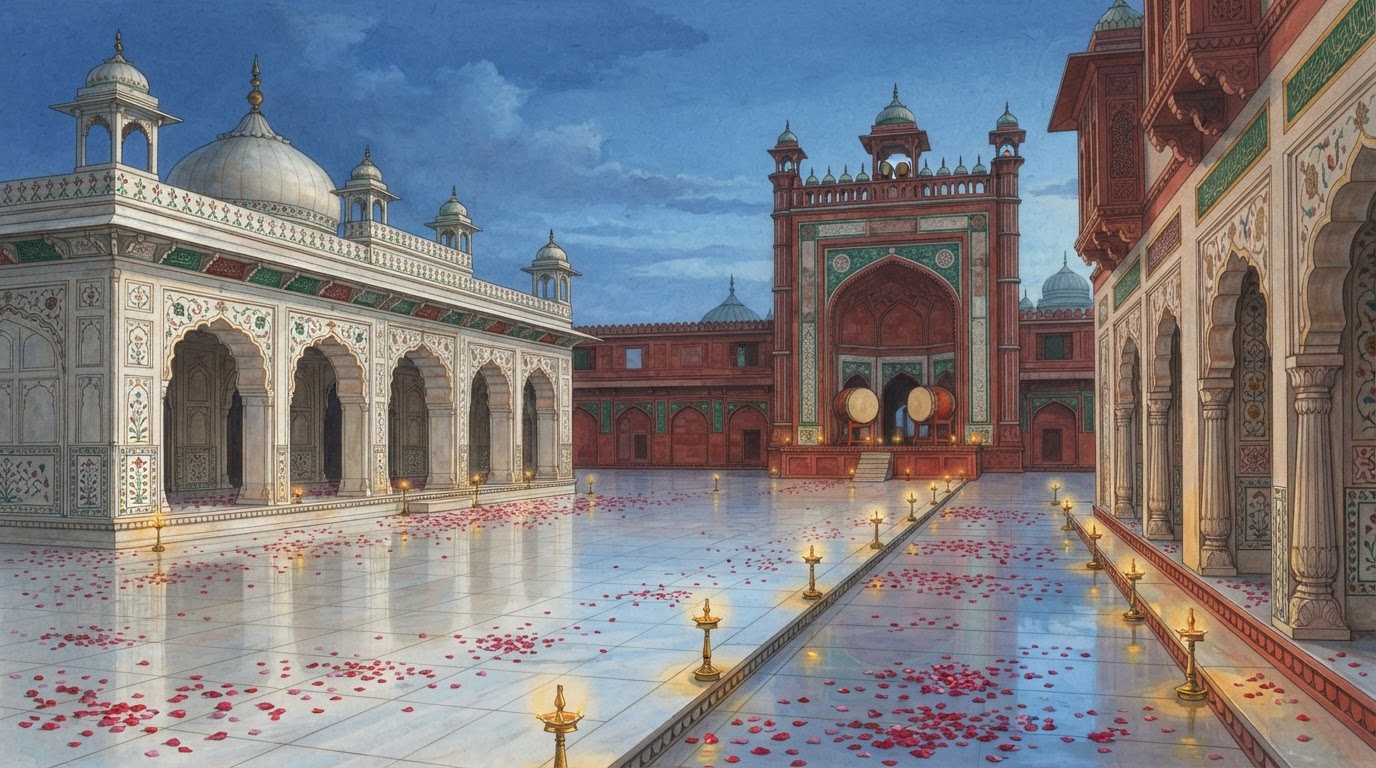
He also gave the Shahjahani Gate, which extended the complex beyond the old Buland Darwaza. Pilgrims call it the Naqqar Khana (drum house), because huge ceremonial drums are mounted above it. Their sound still announces special moments of the Urs.
Who was the Mughal princess who wrote the saint’s life?
Shah Jahan’s eldest daughter, Jahanara Begum, was born in Ajmer on 23 March 1614, while her grandfather Jahangir was staying near the Dargah. Her brother Dara Shikoh was born there too.
Jahanara grew up devoted to the saint. After she survived serious burns in 1644, she made a pilgrimage to Ajmer in thanksgiving, following the example of her great-grandfather Akbar. She wrote a biography of Khwaja Gharib Nawaz in Persian, Mu’nis al-Arwah (“Companion of Souls”), which scholars still praise for its judgement and literary quality.
Her gifts to the shrine include the Begumi Dalan, the porch on the east of the tomb built in 1643, a railing around the shrine and a small platform called the Begumi Chabutra. Close to the Jannati Darwaza lies the grave of her little sister, Princess Gaiti Ara, who died young.
Which Mughal buildings can you see on a visit today?
- Akbari Masjid: red sandstone with green and white marble, between the Buland Darwaza and the Shahjahani Gate. Built around 1571, now a school for Arabic and Persian.
- The two Degs: on either side of the Buland Darwaza, gifts linked to Akbar and Jahangir.
- Shahjahani Gate: with its drums on top.
- Shahjahani (Jami) Masjid: white marble, west of the tomb.
- Begumi Dalan: Jahanara’s gilded porch, east of the tomb.
- Sandali Masjid: added by Emperor Aurangzeb.
During the 815th Urs in December 2026, these courtyards will be packed day and night. Check the latest flag, moon and Chhati Sharif dates on our Ajmer Urs 2026 dates page.
The lesson: emperors at the door of a dervish
Khwaja Gharib Nawaz owned almost nothing. He lived on simple food, slept on the ground and spent his days serving the poor. Three centuries after he passed away, the richest rulers on earth came to his grave on foot, with bowed heads.
That is the quiet message of the Mughal buildings at Ajmer. Thrones and empires passed. The Mughal palaces are museums now. But the Dargah of a man who chose poverty for the love of Allah is still full of people every night. Read more about his life and teachings in our profile of Khwaja Gharib Nawaz.
Frequently asked questions
How many times did Akbar visit Ajmer Dargah?
According to historian Pratyay Nath, Akbar made 17 pilgrimages to Ajmer between 1562 and 1579, often walking part or all of the way from Agra.
Which Mughal emperor built the marble mosque at Ajmer Dargah?
Shah Jahan built the white marble Jami Masjid, also called the Shahjahani Masjid, around 1637 to 1638. Akbar’s earlier mosque, the Akbari Masjid, is of red sandstone.
Why did Jahangir pierce his ears?
In his memoirs Jahangir says he vowed, during a serious illness in 1614, to pierce his ears as a mark of devotion to Khwaja Moinuddin Chishti if he recovered. He kept the vow and wore pearl earrings.
Did the Mughals build the Ajmer Dargah?
No. The shrine existed long before them. The Buland Darwaza was built by Sultan Mahmud Khalji of Malwa in the 15th century, and the white dome over the tomb dates to 1532. The Mughals added mosques, gates, the cauldrons and many gifts.
Related: Ajmer Urs 2026 dates · The Badi Deg and Chhoti Deg · Khwaja Bakhtiyar Kaki · The Chishti relay across India · Great Sufi saints of India
Sources: Pratyay Nath, “Why Did the Emperor Become a Pilgrim?” (Ashoka University); Victoria and Albert Museum: Akbar’s pilgrimage to Ajmer; CSMVS Mumbai: Jahangir distributing alms at the Dargah of Ajmer; Live History India: Dargah Ajmer Sharif; Jahanara Begum (Wikipedia)
Follow Ruhani Dua on Facebook for short videos and reminders. / रूहानी दुआ को Facebook पर Follow करें।
Discover more from ImranJalna
Subscribe to get the latest posts sent to your email.





Leave a Reply