

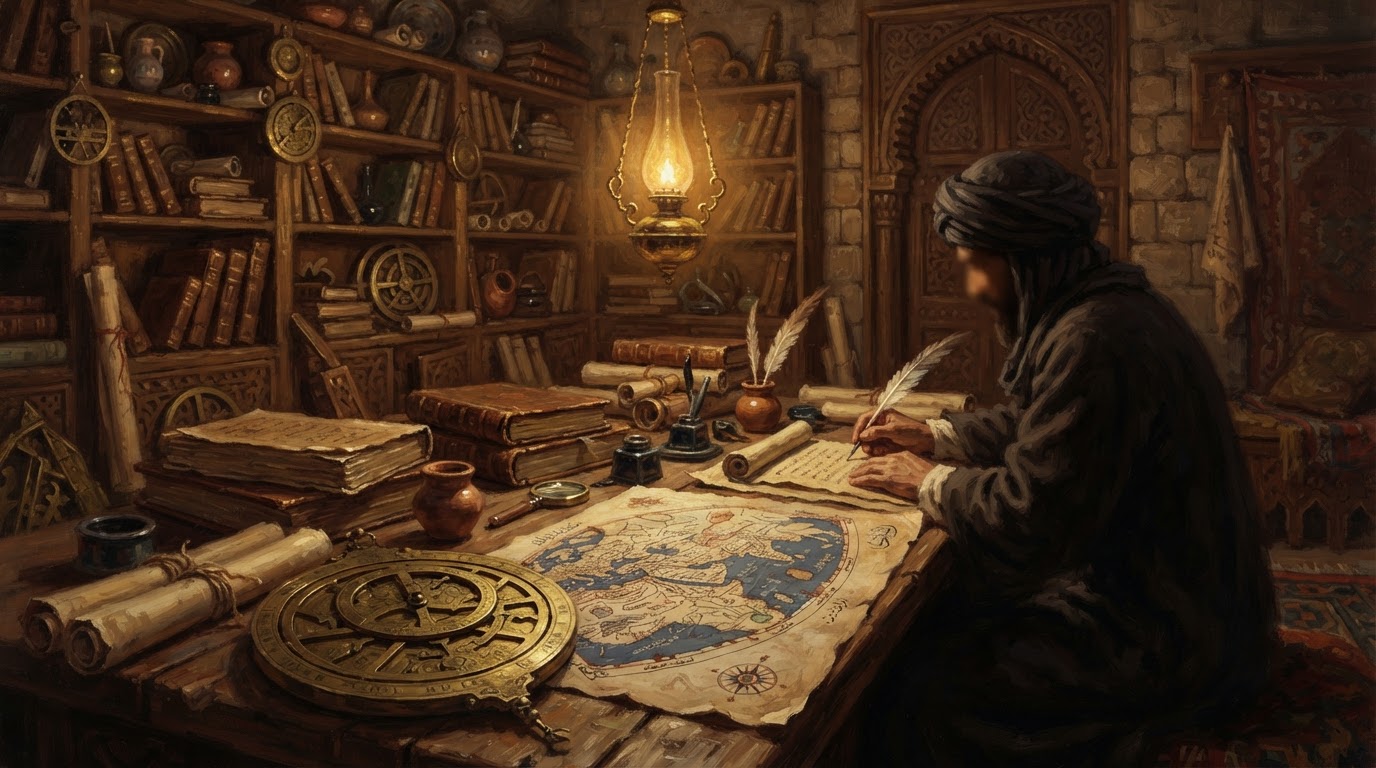
Al-Masudi (Abu al-Hasan Ali ibn al-Husayn al-Masudi, c. 896–956 CE) was a Baghdad-born Muslim historian, geographer and traveller, often called the “Herodotus of the Arabs”. He is famous for Muruj al-Dhahab (“The Meadows of Gold and Mines of Gems”), a world history that, according to Britannica, made him the first Arab to combine history and scientific geography in a large-scale work.
He lived in the Abbasid era, when Baghdad was a centre of books, paper and scholarship. Instead of only copying earlier chronicles, he sailed, rode and asked questions, then wrote about kings, seas, religions and customs from Spain to China.
Quick facts
| Full name | Abu al-Hasan Ali ibn al-Husayn al-Masudi |
| Born | Baghdad, before 893 according to Britannica; c. 895–896 in other sources |
| Died | September 956 (some sources say 956 or 957), Al-Fustat (Old Cairo), Egypt |
| Fields | History, geography, travel writing, comparative religion |
| Most famous works | Muruj al-Dhahab (The Meadows of Gold); Kitab al-Tanbih wa al-Ishraf (The Book of Notification and Verification) |
| Known for | Joining history with geography; using merchants, sailors and non-Muslims as sources; wide-ranging travels |
Who was al-Masudi and what do we really know about his life?
Surprisingly little. Writing in Saudi Aramco World, Caroline Stone notes that our knowledge of him relies almost entirely on what he tells us himself, and that even his birth and death years are uncertain. Britannica gives his birth as before 893 in Baghdad; Stone says about 895 and a death in 956 or 957. That is why this article uses “c.” for his dates.
Britannica describes a child with a remarkable memory, quick writing and boundless curiosity, whose main interests were history and geography, alongside comparative religion and science. Muslim Heritage states that he was a descendant of Abdullah ibn Masud (RA), a Companion of the Prophet ﷺ. Wikipedia mentions a link to the Banu Hudhayl tribe, but marks that claim as needing a citation, so treat it as unconfirmed.
Where did al-Masudi travel?
Britannica lists Syria, Iran, Armenia, the Caspian Sea shores, the Indus valley, Sri Lanka, Oman and the East African coast as far south as Zanzibar at least, and possibly Madagascar. In The Meadows of Gold he himself says he visited Sind, Zanzibar, Indochina, China and Java, though historians are cautious: Wikipedia notes he may have reached Sri Lanka and China, but he is known to have met the trader Abu Zayd al-Sirafi on the Persian Gulf coast and received China information from him.
Britannica adds that he had no settled home for most of his adult life. In 945 he settled in Damascus, two years later moved to Al-Fustat, and stayed there until his death in 956.
Travel to learn is a thread in Islamic teaching. The Quran says: “Travel through the earth and see how He began creation” (Surah Al-Ankabut 29:20). The Prophet ﷺ also said that Allah makes easy the path to Paradise for whoever walks a path seeking knowledge (Sahih Muslim 2699).
What is The Meadows of Gold?
It is al-Masudi’s surviving masterpiece. Britannica explains that he first wrote a 30-volume Akhbar al-Zaman (“The History of Time”) and then Kitab al-Awsat, but neither had much effect, perhaps because of their length. So he combined and shortened them into Muruj al-Dhahab, which quickly became famous.
Britannica’s description of the 132-chapter version says the first half begins with creation and then mixes history, geography, social life and religious customs of lands such as India, Greece and Rome with chapters on oceans, calendars, climate and great temples. The second half is a history of Islam beginning with the Prophet Muhammad ﷺ and the caliphs. Britannica calls this part superficial and says al-Tabari’s work is better for that purpose.
Stone says the first version seems to have been finished by 947 and revised repeatedly almost until his death. Wikipedia adds that only the 947 draft survives, and that al-Masudi says the revised edition had 365 chapters.
How did he change the way history was written?
Earlier historians such as al-Tabari gathered huge amounts of material, each report backed by a chain of transmission like hadith. Stone explains that al-Masudi built on the newer, more continuous narrative style of al-Dinawari and al-Ya’qubi and added as much first-hand knowledge as he could.
- He gave as much weight to social, economic, religious and cultural matters as to politics (Britannica).
- He used information from merchants, local writers including non-Muslims, and people met on his travels, sources earlier scholars had not trusted (Britannica).
- He showed interest in Hinduism and Zoroastrianism as well as Judaism and Christianity (Britannica).
- He often said when he had been told something he could not verify (Stone).
The Quran encourages this kind of reflection on past peoples: “So travel through the land and see how was the end of those who denied” (Surah Al-Imran 3:137). It also says that Allah made humanity into nations and tribes “that you may know one another” (Surah Al-Hujurat 49:13).
What did he describe in the Meadows of Gold?
Britannica highlights sections on pearl diving in the Persian Gulf, amber from East Africa, Hindu burial customs, the land route to China and the hazards of sea navigation such as storms and waterspouts.
According to Wikipedia, he gave an important early account of the Rus, noting they were more than a few traders, and he knew that the Black Sea and Caspian Sea are separate bodies of water. He also wrote that he knew no sea more dangerous than the one off Zanj (East Africa), and that several captains he sailed with drowned. Wikipedia also states that the name “Istanbul” for Constantinople can be traced to his writing of 947, though that is a secondary-source claim.
Stone adds a human side: the Meadows includes caliphs’ feasts, the Barmakid family’s rise and fall, and portraits of women such as Zubayda, wife of Harun al-Rashid.
How reliable was he?
Historians give a mixed verdict. Britannica says he tended to repeat what he heard uncritically, so his explanations of natural phenomena are often wrong, but adds that he was no worse in this than European travellers such as Marco Polo. Ibn Khaldun called him an imam for historians, while Stone argues that critics who dismiss his stories as frivolous are unfair, since the anecdotes often make a point.
His beliefs are also debated. According to Wikipedia, Ibn Hajar called his books imprecise because he saw him as a Shia and Mu’tazili, and al-Dhahabi thought he held Mu’tazili views. Al-Subki said he studied under the Shafi’i scholar Ibn Surayj, and modern scholarship leans towards seeing him as a Zahiri. Historians do not agree, and his surviving works do not clearly state his school.
Legacy
Ibn Khaldun, writing more than 400 years later, praised the Meadows for describing the conditions of nations East and West, calling al-Masudi a model for historians. A complete Arabic text with French translation was published in nine volumes in Paris by the Societe Asiatique between 1861 and 1877. The English-speaking world has Paul Lunde and Caroline Stone’s 1989 translation of the Abbasid material.
His last book, Kitab al-Tanbih wa al-Ishraf, written in Al-Fustat in the final year of his life, summarised, corrected and updated his earlier writings. Most of his 20-plus known titles are lost.
What this means for you
Al-Masudi’s example is to seek knowledge first-hand, listen to different people, and be honest about what you cannot verify. That fits the Quranic call to travel, reflect and know one another.
Frequently asked questions
Why is al-Masudi called the “Herodotus of the Arabs”?
Because, like the ancient Greek historian Herodotus, he travelled widely and wrote about many peoples and lands. Britannica uses the title, and Stone says the comparison is made with good reason.
What is the Meadows of Gold about?
It is a world history from creation to al-Masudi’s own century, mixing geography, religions, customs and anecdotes, followed by a history of Islam and the caliphs.
When and where did al-Masudi die?
Britannica says he died in September 956 in Al-Fustat (now part of Cairo), Egypt. Some sources give 956 or 957, so the exact year is not certain.
Read more: Browse the full series at Great Muslim Scientists, and see Al-Idrisi: The Muslim Geographer Who Mapped the World and Thabit ibn Qurra (Thebit): The Harran Scholar Who Found Amicable Numbers.
Sources: Britannica: al-Masudi; Caroline Stone, “The Model of the Historians”, Saudi Aramco World; Muslim Heritage: Maps from Muslim Civilisation; Wikipedia: Al-Masudi (for details attributed to it).
Follow Ruhani Dua on Facebook for short videos and reminders. / रूहानी दुआ को Facebook पर Follow करें।
Discover more from ImranJalna
Subscribe to get the latest posts sent to your email.








Leave a Reply