

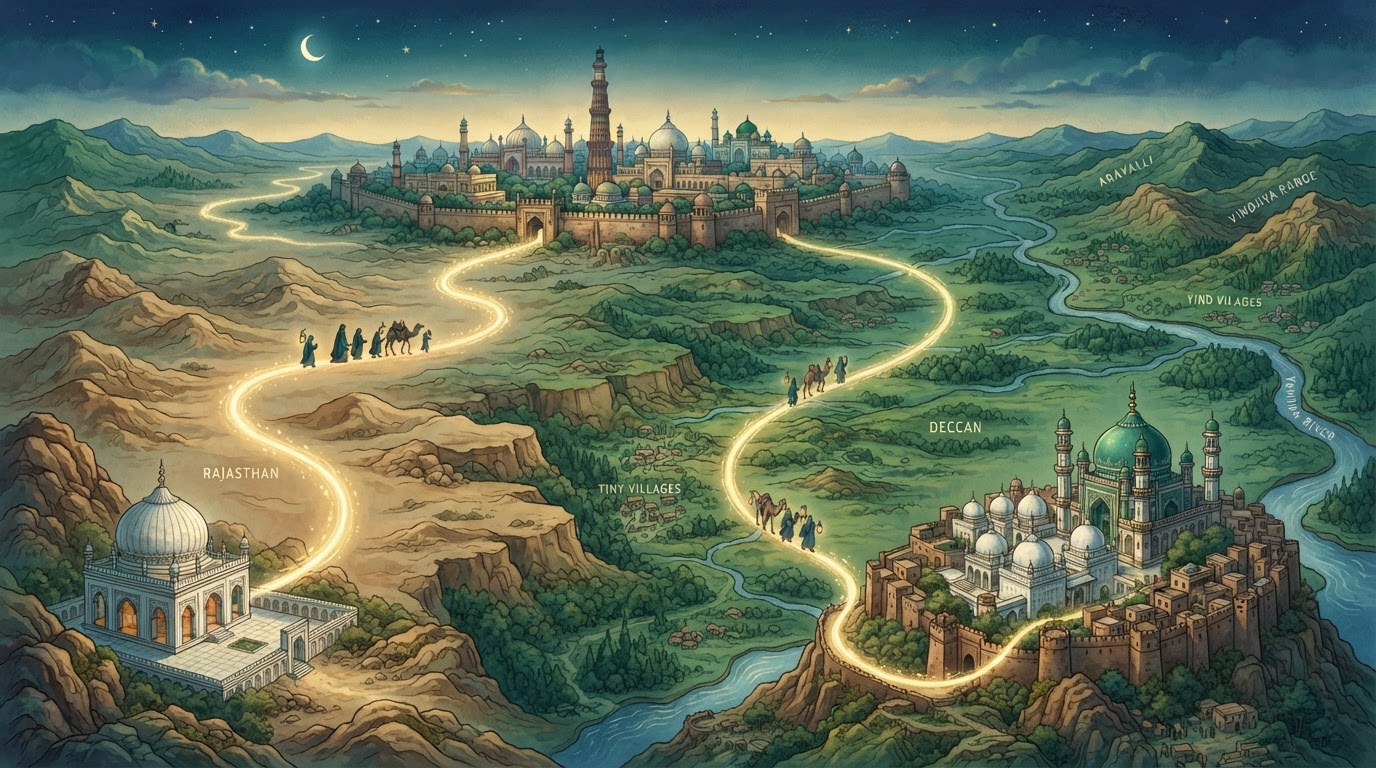
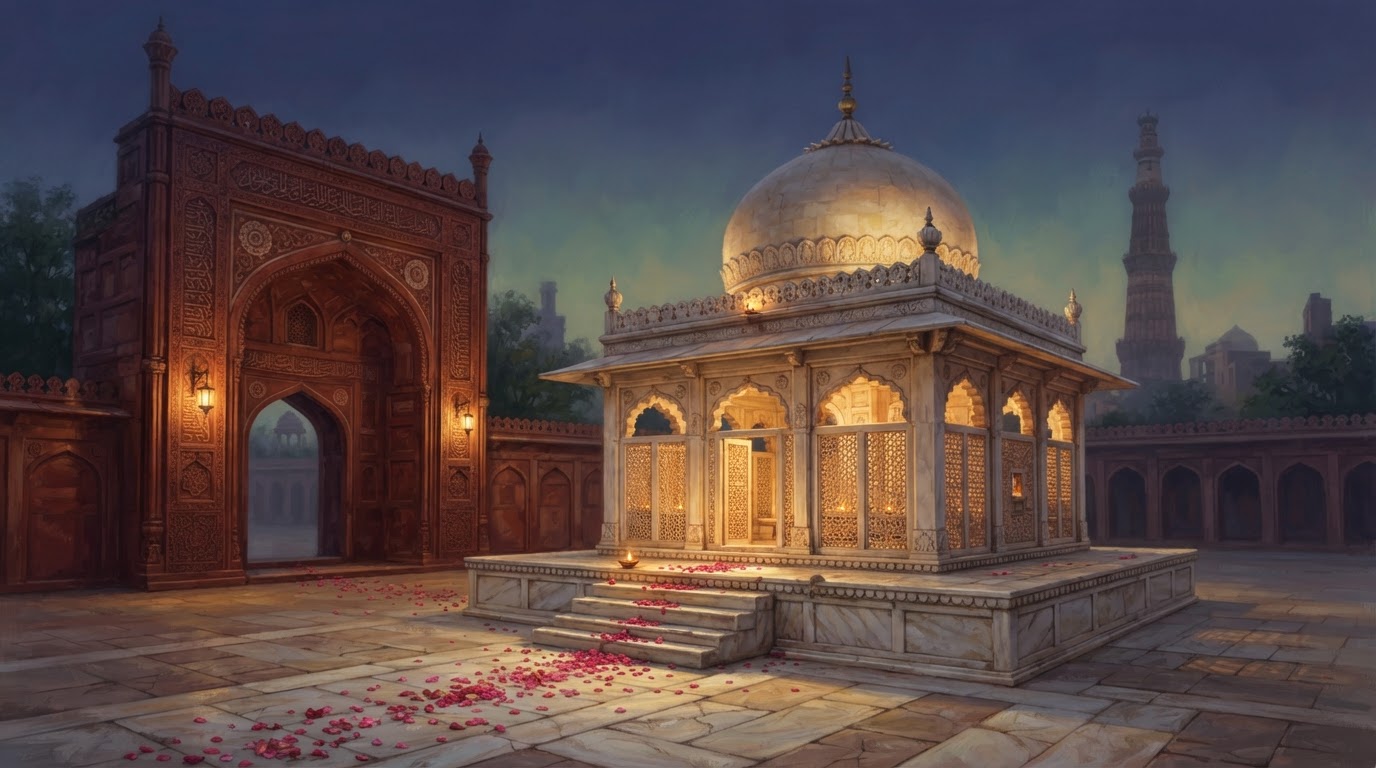
On 17 December 1398, Timur’s army was camped at Hauz Khas, outside Delhi. Everyone knew what would happen next. A long line of people left the city that week, heading south as fast as they could. Among them walked a 77-year-old Sufi with a group of disciples. Seventy years earlier he had made this same journey as a boy, when a sultan forced his family to move to the Deccan. Now he was making it again, and this time he would not come back.
He was Hazrat Khwaja Bande Nawaz Gesu Daraz, Rehmatullah Alaih (RA), and he would found the greatest shrine of South India at Gulbarga. His journey was one leg of a relay that lasted about two hundred years: master handing the teaching to disciple, from Khwaja Gharib Nawaz in Ajmer to Delhi, then Pakpattan, then outward to the Deccan, Bengal and beyond. Here is that route, saint by saint, and why it still matters as the 815th Urs approaches.
Quick facts: the Chishti chain in India
| Saint | Centre | Passed away | Role in the chain |
|---|---|---|---|
| Khwaja Moinuddin Chishti (Gharib Nawaz) | Ajmer, Rajasthan | 6 Rajab 633 AH (1236 CE) | Brought the order to India c. 1191–92 |
| Khwaja Qutbuddin Bakhtiyar Kaki | Mehrauli, Delhi | 1235 CE | His khalifa in Delhi |
| Baba Fariduddin Ganj-e-Shakar | Pakpattan, Punjab | 1266 CE | Kaki’s successor; the chain later splits after him |
| Hazrat Nizamuddin Auliya | Delhi | 1325 CE | Founder of the Nizami branch |
| Nasiruddin Chiragh Dehlavi | Delhi | 757 AH (1356 CE) | “The Lamp of Delhi” |
| Burhanuddin Gharib | Khuldabad, Maharashtra | 741 AH (1340 CE) | Took the order to the Deccan |
| Bande Nawaz Gesu Daraz | Gulbarga, Karnataka | 1422 CE | The great Chishti of the South |
Where did the Chishti order begin?
Not in India. The order takes its name from Chisht, a small town about 95 miles (150 km) east of Herat in today’s Afghanistan. Around 930 CE a Syrian-born teacher, Abu Ishaq Shami, taught there. He later returned to Syria, and his grave lies on Mount Qasiyun in Damascus, near that of the great scholar Ibn Arabi.
For two and a half centuries the Chishtis stayed a regional order around Herat. Then a young seeker from Sistan joined it. He studied for years under Khwaja Usman Harooni, travelled through Baghdad, Makkah and Madinah, and around 1191 reached Ajmer. He was eighth in the line from Abu Ishaq Shami. The world would call him Khwaja Gharib Nawaz, “the one who cherishes the poor”.
Leg one: Ajmer to Delhi and Nagaur
Khwaja Gharib Nawaz did not build an empire of buildings. He built people. His best-known khalifa (spiritual successor), Khwaja Qutbuddin Bakhtiyar Kaki, took the teaching to Delhi, the new capital of the Sultanate. Tradition says Khwaja Sahib once wanted to take Kaki back to Ajmer, but the people of Delhi begged him not to, and he left his disciple there. We told that story in the saint Delhi refused to let go.
Another disciple, Hamiduddin Sufi Nagauri (d. 1274), chose village life in Nagaur, Rajasthan. He farmed his own small plot and lived as simply as the people around him. From the very start, then, the Chishti way had two faces: the capital and the countryside.
Leg two: Delhi to Pakpattan, and the great split
Kaki’s successor, Baba Farid Ganj-e-Shakar, left Delhi for a small river town in Punjab, Ajodhan, later called Pakpattan. It was a deliberate step away from the court. You can read his story in the saint who asked for a needle, not scissors.
After Baba Farid, the chain divided into two great branches, each named after one of his disciples:
- Chishti Sabiri: from Alauddin Ali Ahmad Sabir, buried at Kaliyar near Roorkee in Uttarakhand.
- Chishti Nizami: from Hazrat Nizamuddin Auliya (1238–1325) of Delhi, whose disciples carried the order to almost every corner of India.
Leg three: how a sultan’s order sent Sufis to the Deccan
In 1327, Sultan Muhammad bin Tughluq decided to move his capital from Delhi to Daulatabad, a hill fortress in the Deccan near today’s Chhatrapati Sambhajinagar (Aurangabad). Large parts of Delhi’s Muslim elite were made to move with him, and many Sufis were among them.
One of them was Shaikh Burhanuddin Gharib, born around 1240 in Hansi. For years he had supervised the kitchen at Nizamuddin Auliya’s khanqah (Sufi lodge), the heart of its free langar. His master respected him so much that he called him “Maulana Burhanuddin” and once compared him to the early saint Bayazid Bastami. He lived a celibate life and allowed sama (devotional music) at his gatherings, just as Ajmer still does.
Burhanuddin spent his last years at Rauza, a hilltop town near Daulatabad, and passed away there in 741 AH (1340 CE). His successor, Shaikh Zainuddin Shirazi, carried on until 1369. Around their graves the town became so full of saints that it earned the name Valley of Saints. We explored it in Khuldabad, the Valley of Saints.
Did you know? The city of Burhanpur in Madhya Pradesh is named after Burhanuddin Gharib. The Faruqi ruler of Khandesh founded it in his honour around 1399. And in Khuldabad, a few steps from the dargah complex, lies the plain open-air grave of Emperor Aurangzeb, paid for, it is said, by caps he stitched and Qurans he copied by hand.
Leg four: the long-haired saint of Gulbarga
Back in Delhi, Nizamuddin’s successor Nasiruddin Chiragh Dehlavi, “the Lamp of Delhi”, passed the mantle in 1356 to a disciple named Muhammad Hussaini. People called him Gesu Daraz, “the one with long locks”, because of his long hair.
That was the man who fled Timur in 1398. He travelled through Gwalior, Chanderi and Cambay to Daulatabad, where he wanted to visit his father’s grave. The new Bahmani Sultan, Firuz Shah, heard he was in the kingdom, came in person and invited him to his capital, Gulbarga. Gesu Daraz stayed there for the rest of his life, about 23 years, and passed away in 1422 at around 101 years of age.
He was a prolific writer. A treatise on the life of the Prophet ﷺ, Miraj-ul-Ashiqin, attributed to him, is often called the first known prose work in Dakhni, the Deccan form of Urdu. His dargah was enlarged in 1640, and the historian Ferishta noted that people of every community came to it. Read more in our profile of Khwaja Bande Nawaz of Gulbarga.
Other branches: Bengal, Fatehpur Sikri and beyond
- Bengal: Akhi Siraj, a disciple of Nizamuddin Auliya, went east on his master’s instruction. His successor Alaul Haq Pandavi settled at Pandua, and Bengal’s sultans honoured him as their spiritual guide. From this line came Ashraf Jahangir Simnani of Kichhauchha.
- Fatehpur Sikri: Shaikh Salim Chishti, from Baba Farid’s family line, is the saint whose prayers Akbar sought for a son. The prince was named Salim and became Emperor Jahangir. Akbar also kept a vow to visit Ajmer on foot.
- The wider world: in the 20th century Chishti teachers set up centres in the UK, the USA, Canada, Australia and Africa.
Why did kings court the Chishtis, and why did the saints keep away?
New rulers in Delhi, Bengal and the Deccan often sought the blessing of a Chishti shaikh. A saint’s presence gave a young kingdom respect. Historian Richard Eaton has argued that bringing Gesu Daraz to Gulbarga was partly a political move by the Bahmani sultan, and their friendship did not last.
The saints themselves had been warned. Chishti tradition records Khwaja Gharib Nawaz’s last advice to his followers: ask help from no one but Allah, stay away from the courts of kings, and never turn away the poor, the widow or the orphan who comes to your door. That rule is the thread running through every leg of the relay.
The lesson: a teaching travels through people
None of these saints had armies, printing presses or the internet. What they had was a kitchen that fed everyone, a door that never closed and a habit of training one sincere student at a time. That was enough to carry a message from one desert town in Rajasthan to the whole subcontinent.
For anyone travelling to Ajmer this December, it is worth remembering that the shrine you visit is the first station on a very long road. Check the flag ceremony, moon sighting and Chhati Sharif dates on our Ajmer Urs 2026 dates page.
Frequently asked questions
Who brought the Chishti order to India?
Hazrat Khwaja Moinuddin Chishti, known as Khwaja Gharib Nawaz. He reached Ajmer around 1191–92 CE and made it the centre of the order in India.
What is the difference between Chishti Nizami and Chishti Sabiri?
Both come from Baba Farid Ganj-e-Shakar. The Nizami branch follows Hazrat Nizamuddin Auliya of Delhi; the Sabiri branch follows Alauddin Sabir of Kaliyar.
How did the Chishti order reach Maharashtra?
Through the 1327 shift of the capital to Daulatabad. Shaikh Burhanuddin Gharib, a khalifa of Nizamuddin Auliya, settled near Daulatabad and is buried at Khuldabad, which became known as the Valley of Saints.
Who is the Chishti saint of Gulbarga?
Khwaja Bande Nawaz Gesu Daraz, a successor of Nasiruddin Chiragh Dehlavi. He settled in Gulbarga at the invitation of the Bahmani sultan and passed away there in 1422.
Related: Ajmer Urs 2026 dates · Khwaja Usman Harooni · Baba Farid · Khuldabad · Great Sufi saints of India
Sources: Chishti Order (Wikipedia); Burhanuddin Gharib (Wikipedia); Khuldabad (Wikipedia); Live History India: Gulbarga and the Great Chishti of the South; New Age Islam: Hazrat Burhanuddin Ghareeb
Follow Ruhani Dua on Facebook for short videos and reminders. / रूहानी दुआ को Facebook पर Follow करें।
Discover more from ImranJalna
Subscribe to get the latest posts sent to your email.







Leave a Reply