

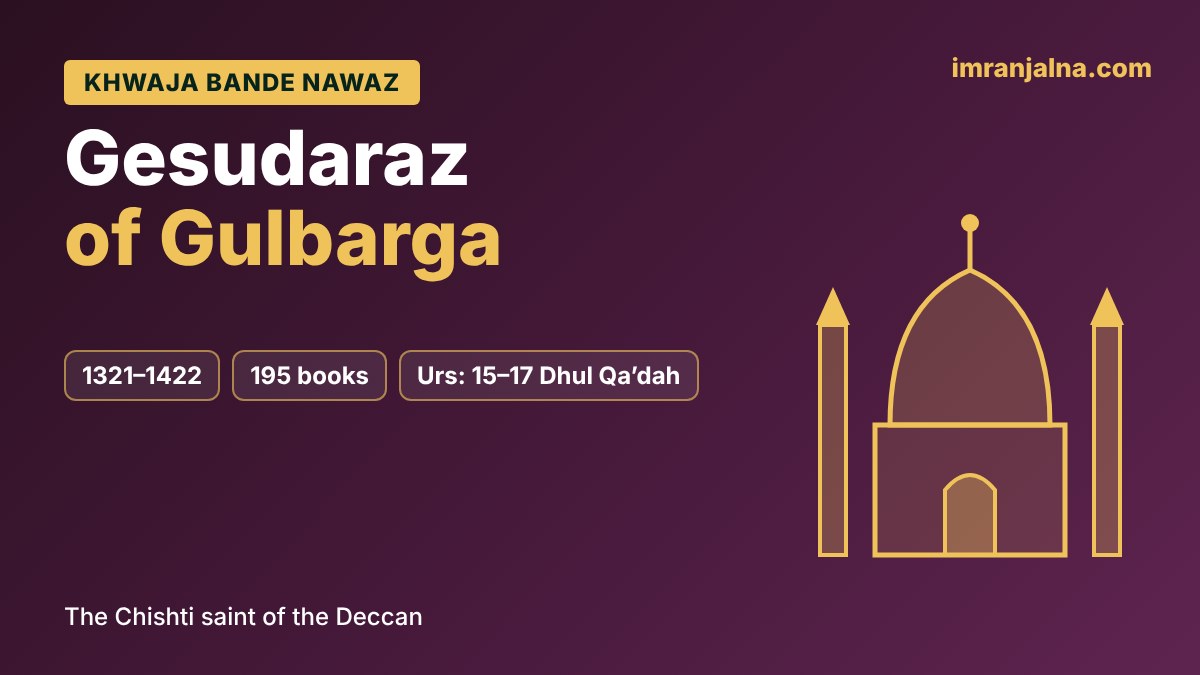
Hazrat Khwaja Bande Nawaz Gesudaraz (Syed Muhammad ibn Yusuf al-Husaini, 1321–1422 CE) is the most loved Sufi saint of the Deccan. He lived about 101 years, wrote some 195 books, and was among the first to write Islamic teaching in Dakhni, the early form of Urdu. His Urs is held every year on 15–17 Dhul Qa’dah at his Dargah in Gulbarga (Kalaburagi), Karnataka; the next is expected around 23–25 April 2027.
Quick facts
| Name | Syed Muhammad ibn Yusuf al-Husaini |
| Titles | Bande Nawaz, Gesudaraz (“the long-haired”) |
| Born | 1321 CE, Delhi |
| Passed away | 1 November 1422, Gulbarga, aged about 101 |
| Teacher | Hazrat Nasiruddin Chiragh Dehlavi |
| Books | About 195, in Arabic, Persian and Dakhni Urdu |
| Dargah | Gulbarga (Kalaburagi), Karnataka, about 400 km from Jalna |
| Urs | 15–17 Dhul Qa’dah (next: around 23–25 April 2027, depending on the moon) |
Who was Khwaja Bande Nawaz Gesudaraz?
He was a Chishti Sufi master, scholar and teacher who spent his youth and middle age in Delhi and his last twenty-odd years in the Deccan. He was born in Delhi in 1321 to a Sayyid family whose roots were in Herat. When he was about seven, Sultan Muhammad bin Tughluq moved his capital to Daulatabad in the Deccan, and the family travelled south with thousands of other Delhi residents. His father, Sayyid Yusuf al-Husaini (Raju Qattal), died there and is buried at Khuldabad, near Chhatrapati Sambhajinagar. As a young man he returned to Delhi in the 1330s.
Who was his teacher in Delhi?
His teacher was Hazrat Nasiruddin Chiragh Dehlavi, the successor of Hazrat Nizamuddin Auliya. During these years he received the name Gesudaraz, “the one with long hair”. Before his death in 1356, Chiragh Dehlavi passed his prayer rug to him, naming him his successor, and for more than forty years he taught in Delhi.
This long apprenticeship reflects a principle the Quran sets out: “And patiently stick with those who call upon their Lord morning and evening, seeking His pleasure” (Surah Al-Kahf 18:28). Sufi tradition reads such verses as encouragement to learn under a sincere teacher, though scholars differ on how far formal spiritual lineage (silsila) is required.
Why did he move to Gulbarga?
He left Delhi in December 1398, at the age of 77, ahead of Timur’s invading army. After travelling through Gwalior and Gujarat, he reached the Deccan and around 1400 settled in Gulbarga, capital of the Bahmani sultanate, at the invitation of Sultan Firuz Shah Bahmani. His khanqah there became a great centre of learning. Relations with Firuz Shah later cooled, but he supported Firuz Shah’s brother Ahmad, who became Sultan in 1422. A month later, on 1 November 1422, the saint passed away, and Sultan Ahmad Shah built his tomb.
What did Bande Nawaz write?
Bande Nawaz was both a Sufi and a scholar of Tafsir, Hadith and Fiqh, and about 195 books are attributed to him. His best-known work is Mi’raj al-Ashiqin, a book on the Prophet Muhammad ﷺ written for ordinary readers in Dakhni, which makes him one of the founders of Urdu prose. He also wrote commentaries that made the works of earlier Sufis accessible to Indian scholars, and guides for disciples such as Adab al-Muridin. Historians differ on the exact number and authorship of some titles, so the figure of 195 is best taken as traditional.
His decision to teach in the language of the people matches the Prophetic instruction: “Convey (my teachings) to the people even if it were a single sentence” (Sahih al-Bukhari 3461). The Quran likewise reminds us of the worth of learning: “Are those who know equal to those who do not know?” (Surah Az-Zumar 39:9). And the Prophet ﷺ said: “Whoever takes a path seeking knowledge, Allah will make easy for him a path to Paradise” (Sahih Muslim 2699).
When and where is the Urs of Bande Nawaz?
The Urs is held every year on 15, 16 and 17 Dhul Qa’dah at the Dargah of Khwaja Bande Nawaz in Gulbarga (Kalaburagi), Karnataka, about 400 km from Jalna. In 1448 AH it falls around 23–25 April 2027 in India, depending on the moon. People of different faiths attend. The Dargah and its surroundings draw lakhs of visitors, including many from Marathwada.
What this means for you
If you plan to visit, confirm the Urs dates after the Dhul Qa’dah moon is sighted and book travel early, as crowds are large. Whatever your view on Dargah customs, which scholars debate, the visit is best used for dhikr, Quran recitation and prayer for the departed. As the Quran says, “those who believe and whose hearts find comfort in the remembrance of Allah. Surely in the remembrance of Allah do hearts find comfort” (Surah Ar-Ra’d 13:28). His life is also a reminder to seek knowledge sincerely and share it in a language people understand.
Frequently asked questions
What does Gesudaraz mean?
Gesudaraz (Gisu Daraz) is Persian for “the one with long hair”, a name he received during his years with his teacher in Delhi.
When is the Urs of Bande Nawaz?
The Urs is on 15–17 Dhul Qa’dah every year. The next Urs is expected around 23–25 April 2027, depending on the moon.
Why is Bande Nawaz important for Urdu?
He wrote religious teaching in Dakhni, the early form of Urdu, so ordinary people could understand it. His Mi’raj al-Ashiqin is often cited as one of the earliest Urdu prose works.
Related: Great Sufi saints of India · Hazrat Nizamuddin Auliya · Events in Dhul Qa’dah
Sources: Quran 18:28; Quran 39:9; Quran 13:28; Sahih al-Bukhari 3461; Sahih Muslim 2699 (via Riyad as-Salihin 1381); Bande Nawaz; Khuldabad; Richard M. Eaton, A Social History of the Deccan, 1300–1761 (2005).
Follow Ruhani Dua on Facebook for short videos and reminders. / रूहानी दुआ को Facebook पर Follow करें।
Discover more from ImranJalna
Subscribe to get the latest posts sent to your email.








Leave a Reply