

Someone once came to a dervish in Punjab with a gift: a fine pair of scissors. The dervish thanked him, set the scissors aside and asked for a needle instead. Scissors cut things apart, he explained. A needle joins them together. In the words the story has carried for eight centuries: “I have come to join, not to sever.”
That dervish was Hazrat Baba Fariduddin Masud Ganj-e-Shakar, Rehmatullah Alaih (RA). He was the third great master of the Chishti order in India, after Khwaja Gharib Nawaz and Khwaja Bakhtiyar Kaki, the first major poet of the Punjabi language, and the teacher of Hazrat Nizamuddin Auliya. And inside the Ajmer Dargah there is a small room where, according to tradition, he spent forty days in prayer near the tomb of Khwaja Gharib Nawaz.
Quick facts: Baba Farid Ganj-e-Shakar
| Name | Fariduddin Masud; known as Baba Farid, Shaikh Farid, Ganj-e-Shakar (“Treasure of Sugar”) |
| Born | c. 1188 CE (some sources say 1173 or 1179) in Kothewal, about 10 km from Multan, Punjab |
| Parents | Jamaluddin Sulaiman and Qarsum Bibi (also called Maryam Bibi) |
| Murshid | Hazrat Khwaja Qutbuddin Bakhtiyar Kaki (RA) |
| Settled in | Ajodhan, later renamed Pakpattan, Punjab, Pakistan |
| Passed away | 1266 CE by most modern accounts; his Urs is held in Muharram |
| Famous disciples | Hazrat Nizamuddin Auliya, Jamaluddin Hansvi, Alauddin Ali Ahmad Sabir Kaliyari |
| Chilla in Ajmer | Inside the Dargah complex; opens once a year from 4 Muharram |
Why is he called “Ganj-e-Shakar”?
Farid was born in Kothewal, a village near Multan. His family had come from Kabul in his grandfather’s time. His mother, Qarsum Bibi, was known for her piety, and she wanted her son to love Namaz.
The best-known story says she used to hide a little sugar under his prayer mat as a reward. One day she forgot. The boy finished his prayer, lifted the mat, and found sugar there anyway. The family took it as a sign from Allah, and the child became Ganj-e-Shakar, the “Treasure of Sugar”. Other explanations exist, but all of them point to the same sweetness of character that people saw in him.
Did you know? The word farid in Arabic means “unique”, and it is also the name for the larger central bead of a tasbih (prayer beads).
How did a Multan student join the Chishti chain?
Farid studied in Multan, then one of the great centres of Muslim learning. There he met Khwaja Qutbuddin Bakhtiyar Kaki, who was passing through on his way from Baghdad to Delhi. The young scholar gave him his bay’ah (oath of discipleship) and later followed him to Delhi.
He then lived for years in Hansi, in today’s Haryana. When Khwaja Bakhtiyar Kaki passed away in 1235, Farid became his successor. You can read how Delhi loved his master in our story Khwaja Bakhtiyar Kaki: the saint Delhi refused to let go. But Farid did not stay in the capital. He went back to his native Punjab and settled in the small river town of Ajodhan.
That move shaped the whole chain. It ran like this: Khwaja Usman Harooni → Khwaja Gharib Nawaz → Khwaja Bakhtiyar Kaki → Baba Farid → Hazrat Nizamuddin Auliya, who received his training from Baba Farid in Ajodhan.
What is Baba Farid’s chilla in Ajmer?
A chilla is a forty-day spiritual retreat of fasting, prayer and dhikr (remembrance of Allah), and also the small room where it is kept. Inside the Ajmer Dargah, between the Jama Masjid and the Sandali Masjid, there is a chilla linked with Baba Farid. Tradition says he stayed there for forty days, close to the resting place of Khwaja Gharib Nawaz, the master of his own master.
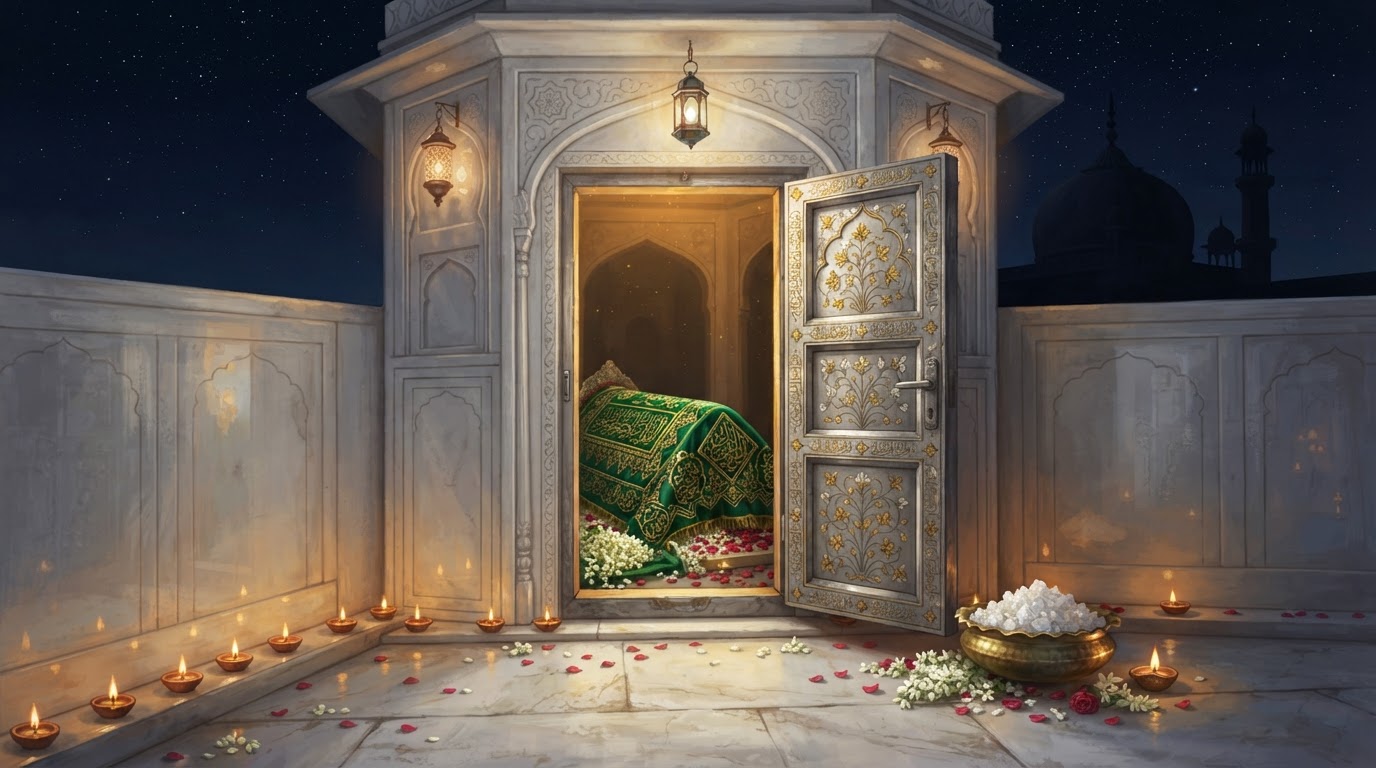
The door stays locked almost all year. It is opened only during Muharram, from the 4th of the month, for about three days (Rajasthan Patrika has reported it open for 72 hours). Every year pilgrims from across India, of many faiths, queue with chadars (ceremonial cloths) and rose petals to pray there.
Ajmer is not the only place. Chillas of Baba Farid are remembered in Mehrauli in Delhi, in Faridkot in Punjab, in villages of Rajasthan and even in Maharashtra. And one stands much further away.
The Indian saint remembered in Jerusalem
Around the year 1200, a little over a decade after Salahuddin Ayyubi took Jerusalem back from the Crusaders, the young Farid is said to have walked into the city. Later accounts say he spent his days sweeping the stone floors around Masjid al-Aqsa and fasting in a cave inside the city walls.
Nobody knows how long he stayed. But for centuries afterwards, Indian Muslims passing through Jerusalem on their way to Makkah wanted to pray where he had prayed. A lodge grew around his memory, known today as the Indian Hospice (Al-Hindi Serai), and it still welcomes travellers from the subcontinent.
Why do Sikhs and Hindus revere him too?
In Baba Farid’s time, serious writing was done in Persian, Arabic or Sanskrit. Punjabi was the language of villages. Farid chose to speak to people in their own tongue, and became the first major poet of Punjabi. His short verses talk about patience, humility, the shortness of life and refusing to return a blow with a blow.
More than a hundred of the verses attributed to him were included by Guru Arjan Dev Ji, the fifth Sikh Guru, in the Adi Granth, the scripture that became the Guru Granth Sahib. Sikhs honour him as one of the fifteen Bhagats. Some scholars believe parts of these verses were reworded, or composed, by a later successor in his line, Shaikh Ibrahim Farid (Farid Sani), so the question of exact authorship is still discussed.
He is also credited with bringing the langar (free communal kitchen) to Punjab, where people of every faith and caste ate together. The institution and the word were later adopted by the Sikhs. Ajmer’s own version of this tradition lives on in the giant Mughal cauldrons of the Dargah.
What did Baba Farid teach?
- Be a needle, not scissors. Bring people together; never be the reason a family, a street or a community breaks apart.
- Don’t strike back. His verses advise forgiving those who hurt you instead of answering in kind.
- Greed kills love. Where there is greed, he warned, love is only pretence.
- Simple living. He lived on very little, refused gifts of land from rulers and shared what came to him.
- Feed people. His langar was open to everyone, a direct echo of Khwaja Gharib Nawaz’s teaching that feeding the hungry is among the highest forms of worship.
What happens at Pakpattan during his Urs?
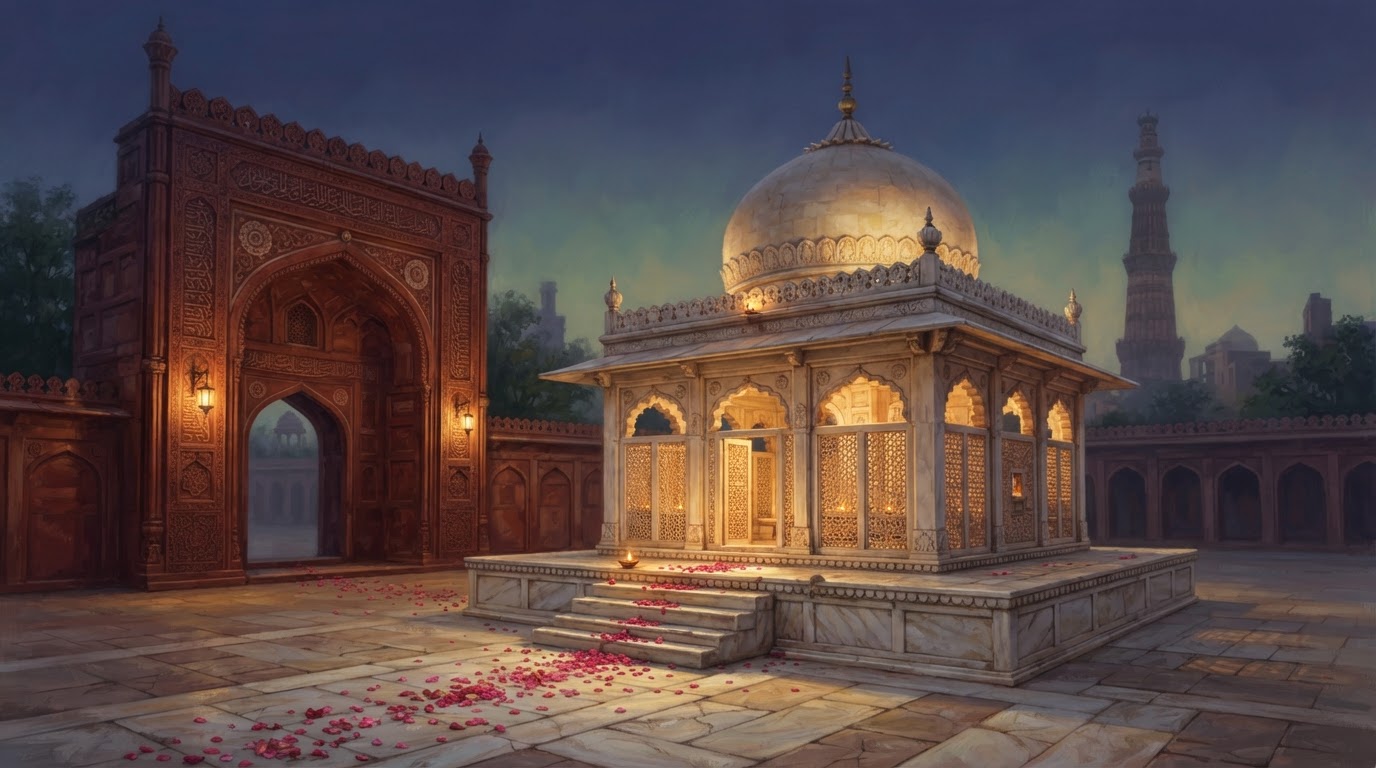
Ajodhan became Pakpattan, often explained as “the holy ferry”, because of him. His tomb is a small white marble chamber with two doors: the Nuri Darwaza (Gate of Light) and the Bahishti Darwaza (Gate of Paradise). Inside are two graves, his and his elder son’s, and space for barely ten people at a time.
The Bahishti Darwaza is made of silver with floral designs in gold leaf. It stays padlocked all year. During the Urs in Muharram, the shrine’s custodian unlocks it on the night of 5 Muharram after Isha, and it stays open at night until after Fajr on 10 Muharram. In 2017, The Express Tribune reported that more than 150,000 people passed through it on the first night alone. If you know the Jannati Darwaza at Ajmer, which opens just four times a year, you will notice how closely the two traditions mirror each other.
Did you know? The shrine has its own large generator, so it stays lit all night, every night of the year, even during power cuts.
From Pakpattan to the Mughal court
Baba Farid’s family line produced another famous saint: Shaikh Salim Chishti (1478–1572) of Fatehpur Sikri. Emperor Akbar, longing for a son, sought his prayers, and when a prince was born he was named Salim in the saint’s honour. That prince became Emperor Jahangir. Hyderabad’s noble Paigah family also traced its descent to Baba Farid.
His name lives on in places too: the city of Faridkot in Indian Punjab, where the Baba Farid University of Health Sciences was set up in 1998, and Faridpur in Bangladesh. For more saints of this chain, see our guide to the great Sufi saints of India.
The lesson: be the needle
Every age has plenty of scissors: words that divide, quarrels that cut families apart, hate that splits neighbours. Baba Farid’s choice is still open to anyone. Mend instead of cut. Forgive instead of hitting back. Feed people without asking who they are.
As the 815th Urs of Khwaja Gharib Nawaz approaches, that is a fitting way to honour the whole Chishti chain from Ajmer to Pakpattan. Check the latest flag, moon sighting and Chhati Sharif dates on our Ajmer Urs 2026 dates page.
Frequently asked questions
Why is Baba Farid called Ganj-e-Shakar?
Ganj-e-Shakar means “Treasure of Sugar”. The best-known story says his mother hid sugar under his prayer mat to encourage him to pray, and one day he found sugar there even though she had forgotten to put it.
Where is Baba Farid’s Dargah?
In Pakpattan Sharif, Punjab, Pakistan, formerly called Ajodhan. His chillas, places of retreat, are also visited in Ajmer, Delhi, Faridkot and Jerusalem.
When does Baba Farid’s chilla open in Ajmer?
Once a year in the Islamic month of Muharram, from the 4th, for about three days. It is inside the Ajmer Dargah complex, between the Jama Masjid and the Sandali Masjid.
Is Baba Farid’s poetry in the Guru Granth Sahib?
Yes. More than a hundred verses attributed to Shaikh Farid were included by Guru Arjan Dev Ji. Scholars still discuss whether some were composed by his later successor Ibrahim Farid.
Related: Ajmer Urs 2026 dates · Khwaja Bakhtiyar Kaki · Hazrat Nizamuddin Auliya · Khuldabad, the Valley of Saints · Great Sufi saints of India
Sources: Baba Farid (Wikipedia); The Sikh Encyclopedia: Farid, Shaikh; Punjab Auqaf Department: Hazrat Baba Fariduddin Masud Ganj Shakar; The Express Tribune: Bahishti Darwaza opens (2017); ANI: Baba Farid’s chilla opens in Ajmer; Rajasthan Patrika: Muharram at Ajmer Dargah
Follow Ruhani Dua on Facebook for short videos and reminders. / रूहानी दुआ को Facebook पर Follow करें।
Discover more from ImranJalna
Subscribe to get the latest posts sent to your email.





Leave a Reply