Khuldabad is a small hill town in Maharashtra, about 25 km from Chhatrapati Sambhajinagar (Aurangabad), known as the “Valley of the Saints” because it holds the dargahs of leading Chishti Sufis of the Deccan. It is also the burial place of the Mughal emperor Aurangzeb Alamgir, and from Jalna it is about 85 km by road, an easy day trip.
| Quick facts | Details |
|---|---|
| What | A hill town of Chishti Sufi dargahs; tradition says about 1,500 saints are buried in and around it |
| Where | Khuldabad, about 25 km from Chhatrapati Sambhajinagar and a few kilometres from the Ellora caves |
| When it became a Sufi centre | After 1327, when Muhammad bin Tughluq moved his capital to nearby Daulatabad |
| Who is buried here | Burhanuddin Gharib, Zainuddin Shirazi, Zar Zari Zar Baksh, and Emperor Aurangzeb |
| How to reach from Jalna | About 85 km by road, via Chhatrapati Sambhajinagar and the Ellora route |
Why is Khuldabad called the Valley of the Saints?
Khuldabad earned this name because many Chishti Sufis settled and were buried here in the 14th century, and local tradition counts about 1,500 saints in and around the town. The Quran describes the people of Allah’s special nearness in these words: “There will certainly be no fear for the close servants of Allah, nor will they grieve” (Surah Yunus 10:62). The next ayah describes them as those who are faithful and mindful of Allah (Surah Yunus 10:63). In Islamic teaching, then, sainthood is measured by faith and taqwa, not by title or tomb.
How did the Sufis come to Khuldabad?
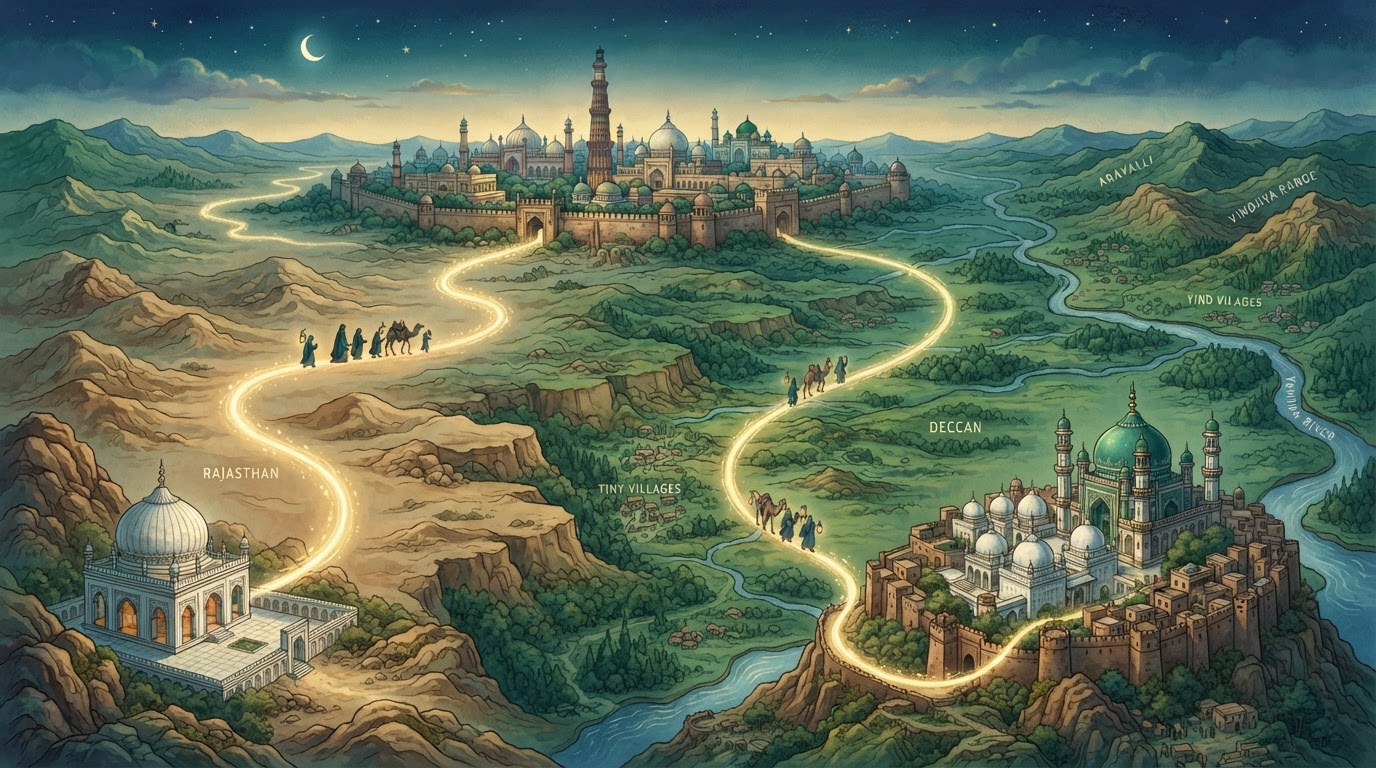
In 1327 the Delhi Sultan Muhammad bin Tughluq moved his capital from Delhi to Daulatabad, the great fort near Khuldabad, and ordered many of Delhi’s people to move with him. Among them were disciples of Hazrat Nizamuddin Auliya. Even after the capital returned to Delhi, several stayed, and Khuldabad became the spiritual centre of the Chishti order in the Deccan.
Which Sufi dargahs are in Khuldabad?
The main dargahs are those of Zar Zari Zar Baksh, Burhanuddin Gharib and Zainuddin Shirazi, along with the tombs of Amir Hasan Sijzi and Sayyid Yusuf al-Husaini. The table below lists each saint with the year of death and a short note.
| Saint | Passed away | About |
|---|---|---|
| Hazrat Zar Zari Zar Baksh (Muntajibuddin) | 1309 CE | One of the earliest Chishti Sufis in the area; an eight-day Urs is held at his dargah every year |
| Hazrat Burhanuddin Gharib | 1337 CE | A senior disciple of Hazrat Nizamuddin Auliya; he came with the move to Daulatabad and made Khuldabad his home |
| Hazrat Zainuddin Shirazi | 1369 CE | Born in Shiraz, he came via Makkah and Delhi, served as a Qazi at Daulatabad, and became the successor of Burhanuddin Gharib |
| Amir Hasan Sijzi Dehlavi | 1336 CE | Poet and disciple of Nizamuddin Auliya, who recorded his teacher’s discourses in Fawa’id al-Fu’ad |
| Sayyid Yusuf al-Husaini (Raju Qattal) | 1330 CE | Chishti Sufi and father of Khwaja Bande Nawaz Gesudaraz of Gulbarga |
Who was Hazrat Burhanuddin Gharib?
Hazrat Burhanuddin Gharib (d. 1337) was a close disciple of Nizamuddin Auliya in Delhi and the leading Chishti Sufi of the Deccan in his time. He is said to have received his teacher’s permission to guide others. In the Deccan he taught a large circle of disciples, and his conversations were written down in several books, which are among the most important records of early Chishti teaching in India. After his death his dargah became the centre of Khuldabad. Some historians link the name of the nearby city of Burhanpur to him.
Where is Emperor Aurangzeb buried?
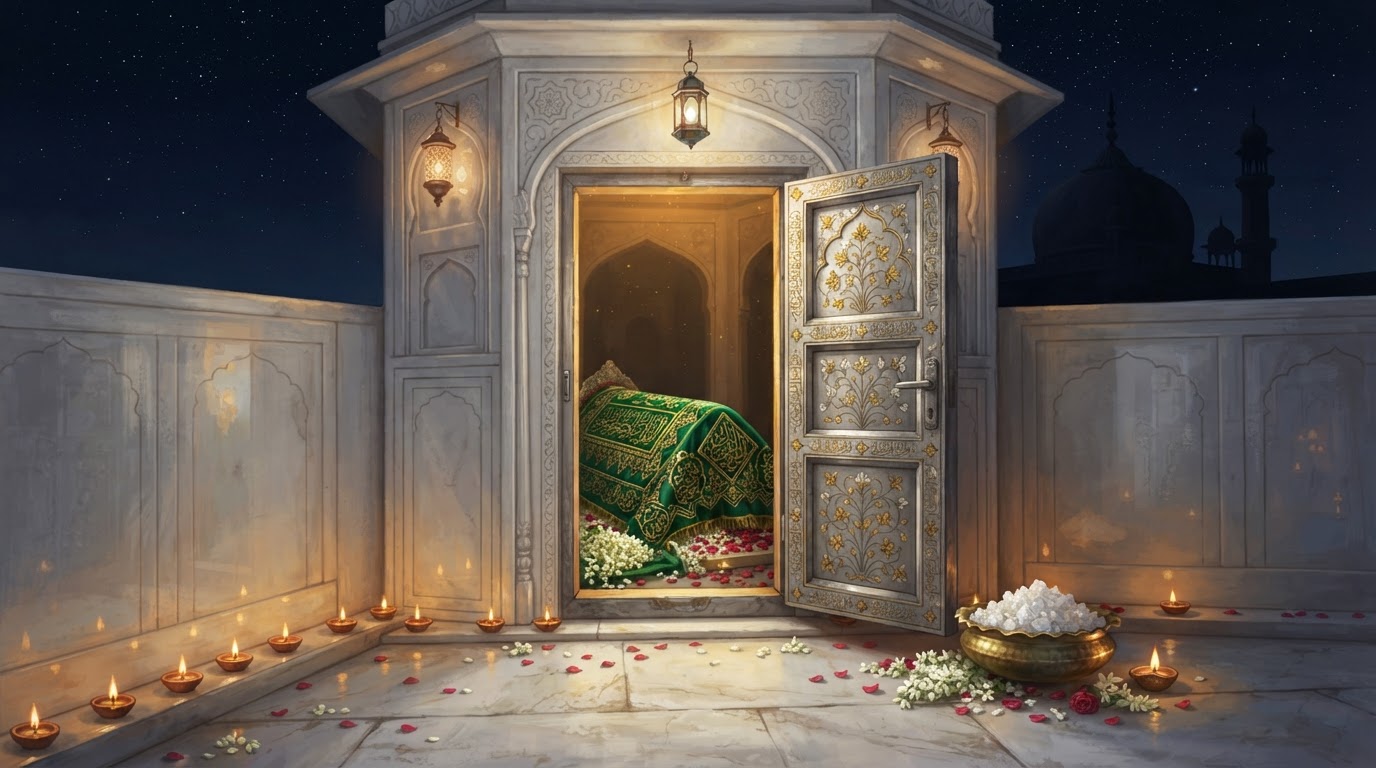
Aurangzeb Alamgir is buried in Khuldabad, in the dargah complex of Hazrat Zainuddin Shirazi, whom he deeply respected. He died in Ahmednagar in 1707 and was buried here at his own wish. His grave is remarkably simple: open to the sky, without a dome, and, according to tradition, paid for with money he earned by sewing caps and copying the Quran. The marble screen around it was added by the Nizam in 1911.
Nearby are the tombs of Malik Ambar of Ahmednagar (d. 1626), Abul Hasan Tana Shah, the last Qutb Shahi king of Golconda (d. 1699), and Nizam-ul-Mulk Asaf Jah I (d. 1748), founder of the Hyderabad state.
Is it permissible in Islam to visit graves and dargahs?
Yes, visiting graves is a Sunnah when done to remember death and to pray for the deceased. The Prophet Muhammad ﷺ said: “Visit the graves, for they will remind you of the Hereafter” (Sunan Ibn Majah 1569). In another narration he said, “I used to forbid you to visit the graves, but now visit them, for they will draw your attention away from this world and remind you of the Hereafter” (Sunan Ibn Majah 1571). Sulaiman bin Buraidah narrated from his father that the Prophet ﷺ said he had prohibited visiting graves, then permitted it, as recorded in Jami` at-Tirmidhi 1054.
The Quran also reminds us: “Every soul will taste death” (Surah Ali ‘Imran 3:185). And it teaches a prayer for those who came before us: “Forgive us and our fellow believers who preceded us in faith” (Surah Al-Hashr 59:10).
Scholars differ on how far practices at dargahs may go. Many scholars, especially in the Sunni Sufi tradition, regard visiting the graves of the righteous as recommended. Others, such as many Salafi scholars, allow visiting graves only for dua and reflection, and warn against asking the dead for help, seeking blessings from the grave itself, or gatherings they consider innovations. All agree that worship and requests belong to Allah alone.
How to visit Khuldabad from Jalna
- By road: Jalna to Chhatrapati Sambhajinagar (about 60 km), then about 25 km towards Ellora. Buses and shared taxis run on the Ellora route.
- Combine with: Daulatabad Fort, the Ellora caves and Bibi ka Maqbara in Sambhajinagar.
- Etiquette: dress modestly, cover your head, and keep the Masjid times in mind for Salah.
What this means for you
If you visit Khuldabad, treat it as a chance to learn the history of the Chishti saints, to remember death and the Hereafter, and to make dua for the deceased. Keep your intention pure, offer your Salah on time, and direct every request to Allah alone. Plan a full day if you wish to see the dargahs together with Daulatabad Fort or the Ellora caves.
Frequently asked questions
Why is Khuldabad called the Valley of Saints?
Because it holds the dargahs of many Chishti Sufis who settled there in the 14th century, including Burhanuddin Gharib and Zainuddin Shirazi, and tradition says about 1,500 saints are buried in the area.
Where is Aurangzeb buried?
Aurangzeb is buried in Khuldabad, near Chhatrapati Sambhajinagar in Maharashtra, in the dargah complex of Hazrat Zainuddin Shirazi. His grave is a simple open-air grave, as he wished.
Can Muslims visit graves and dargahs?
Yes. The Prophet Muhammad ﷺ permitted visiting graves as a reminder of the Hereafter, as recorded in Sunan Ibn Majah 1569 and 1571. The purpose is dua for the deceased and reflection on death, and scholars differ only on the limits of related practices such as Urs gatherings.
Related: Great Sufi saints of India · Khwaja Gharib Nawaz · Ajmer Urs 2026 · Namaz timings Jalna
Sources: Quran 10:62–64; Quran 3:185; Quran 59:10; Sunan Ibn Majah 1569; Sunan Ibn Majah 1571; Jami` at-Tirmidhi 1054; Khuldabad; Burhanuddin Gharib; Sahapedia – Tomb complexes in Khuldabad; Carl W. Ernst, Eternal Garden: Mysticism, History, and Politics at a South Asian Sufi Center (1992).
Also read:
➤ Hazrat Shah Janullah of Jalna: The Qadiri Sufi Saint Aurangzeb Revered
➤ Khwaja Bande Nawaz Gesudaraz of Gulbarga: Life, Books and Urs
➤ Hazrat Nizamuddin Auliya (Mehboob-e-Ilahi): Life, Teachings and the Delhi Dargah
Follow Ruhani Dua on Facebook for short videos and reminders. / रूहानी दुआ को Facebook पर Follow करें।
Discover more from ImranJalna
Subscribe to get the latest posts sent to your email.