

Every year, on the sixth day of Shawwal, a small silver gate beside the tomb of Khwaja Gharib Nawaz in Ajmer swings open. Pilgrims queue before dawn to pass through it. Yet the man being remembered that day is not buried in Ajmer at all. He died more than 800 years ago, thousands of kilometres away, in Makkah.
His name is Hazrat Khwaja Usman Harooni, Rehmatullah Alaih (RA), the Pir-o-Murshid (spiritual master) of Hazrat Khwaja Moinuddin Chishti. Tradition says the young Moinuddin served him for about twenty years, travelling with him across Persia, Iraq and Arabia before being sent on his own mission. Without this teacher, there would be no Ajmer Dargah as we know it, and no 815th Urs this December.
Quick facts: Khwaja Usman Harooni
| Full name | Khwaja Usman Harooni (also written Harwani or Haruni) |
| Titles | Abu Noor, Abu Mansur |
| Born | Haroon (Harwan), a town near Nishapur in Khorasan, present-day Iran. The year is given variously as 1096, 1116 or 1131 CE (490, 510 or 526 AH) |
| His own master | Hazrat Haji Sharif Zandani (d. 612 AH / 1215 CE) |
| Most famous disciple | Hazrat Khwaja Moinuddin Chishti, Khwaja Gharib Nawaz (RA) |
| Passed away | 5 Shawwal 617 AH (1220 CE), in Makkah, according to most accounts |
| Remembered in India | A chillah (memorial site where a saint prayed) at Belchi near Bihar Sharif; Jannati Darwaza opens at Ajmer on 6 Shawwal |
Who taught the teacher?
Usman Harooni was himself a seeker before he was a master. As a young man in Khorasan, he went to Haji Sharif Zandani, a shaykh of the Chishti order, and asked to become his disciple.
According to the biographies, Zandani accepted him by placing a four-cornered cap on his head, and explained that each corner stood for something to give up:
- love of this world,
- attachment even to the rewards of the next world,
- the cravings of one’s own nafs (ego),
- everything other than Allah.
Usman Harooni is said to have stayed with his master for more than thirty years before being told to go out and guide others. He became, by the traditional count, one of the links in the Chishti chain that runs back through earlier masters to Hazrat Ali (RA).
How did Moinuddin find him?
By the time he reached Haroon, Moinuddin from Sistan had already lost his father, sold his small inheritance and studied in Samarkand and Bukhara. He had knowledge. What he was looking for was a guide.
The Dargah Committee’s own history says that in Haroon he met Khwaja Usman Harooni, who accepted him as a disciple, and that he served his master on tours and travels for about twenty years before being named his spiritual successor. Some biographers give a shorter period, so the exact length is uncertain. What every account agrees on is the spirit of that service: Moinuddin is said to have carried his master’s bedding and belongings on his own head on their journeys, out of respect.
Did you know? Khwaja Qutbuddin Bakhtiyar Kaki, who later served Khwaja Gharib Nawaz the same way, is reported to have said that in twenty years he never once heard his master pray for his own health. That habit of putting others first was learned on the road with Usman Harooni.
What happened on their journeys?
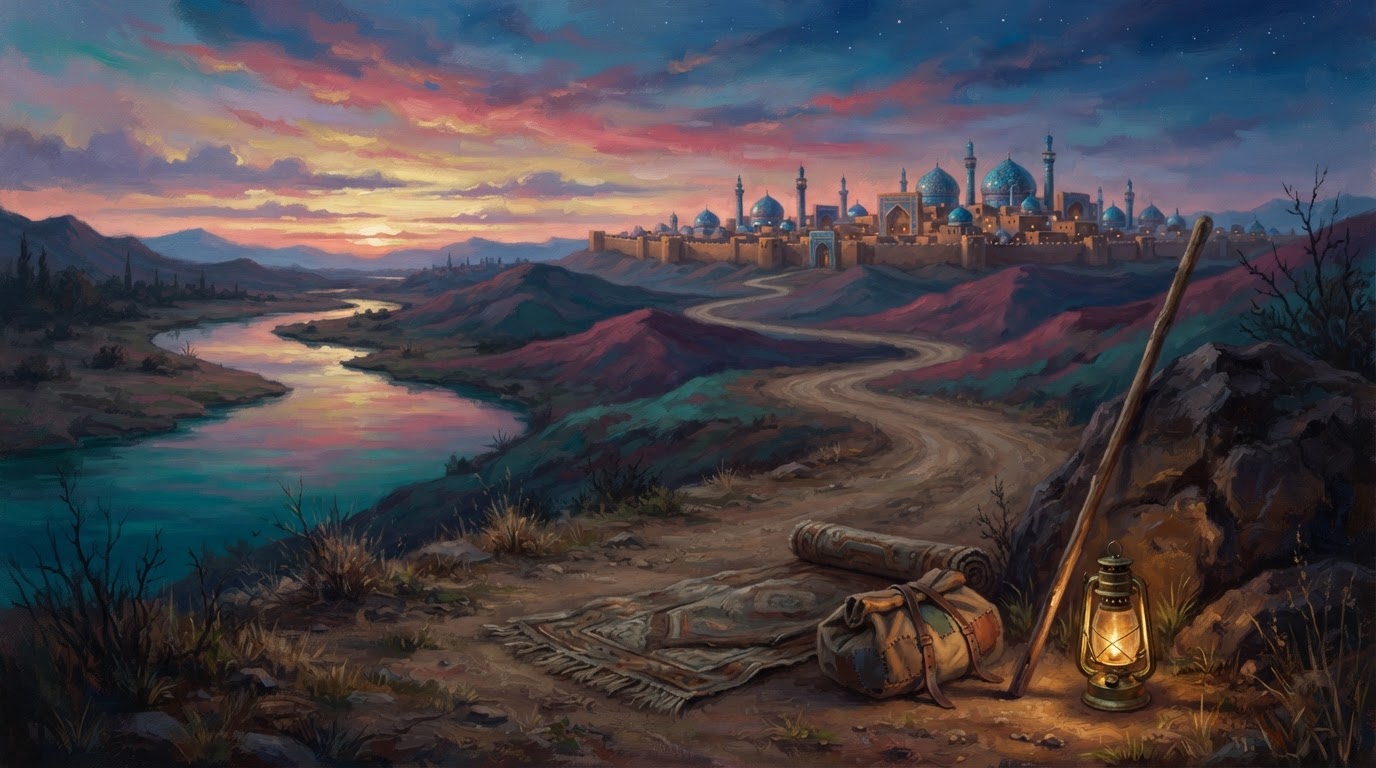
Master and disciple travelled through some of the great cities of the medieval Muslim world. The biographies name Bukhara, Baghdad, Fallujah, Damascus, Makkah and Madinah, and stops at the lodges of other saints along the way. Later Chishti books preserve several stories from these years. They come from devotional tradition rather than court chronicles, and are best read in that spirit:
- At the Kaaba: Usman Harooni is said to have held his disciple’s hand beneath the Mizab-e-Rahmat (the golden water-spout of the Kaaba) and made dua for him, entrusting him to Allah.
- In Madinah: at the Prophet’s ﷺ resting place, he told Moinuddin to offer his salaam, and afterwards told him his training was complete.
- A shaykh in Awash: an old saint they visited gave Moinuddin advice he would live by in Ajmer: give away whatever comes to you, hoard nothing, and feed the poor.
- The Tigris in flood: when a storm made the river impossible to cross, tradition says the master asked his disciple to close his eyes, recited Surah Al-Fatiha, and the two found themselves on the far bank.
Whatever one makes of the miracles, the pattern is clear. Usman Harooni was not only teaching prayers. He was showing a young scholar how a servant of Allah behaves among ordinary people.
The day the master gave everything away
After the years of travel, the two returned to Baghdad. Usman Harooni withdrew into seclusion, and asked his disciple to visit him every morning after sunrise to learn. Moinuddin came daily and wrote down what he heard.
On the last of those mornings, according to the Chishti accounts, the master handed over the relics of the order: his asa (staff), his khirqa (patched robe), his wooden sandals and his musalla (prayer mat). He told Moinuddin to guard them as earlier masters had, and to pass them on only to someone truly worthy. Then he embraced him, kissed his forehead and said, in the words the story preserves, “I have given you to Allah.”
Moinuddin left Baghdad with a heavy heart. The road from there led, eventually, to Lahore, Delhi and Ajmer. You can follow that journey in our full story of Khwaja Gharib Nawaz’s life and teachings.
What did Khwaja Usman Harooni teach?
The best-known record of his sayings is Anis al-Arwah (“Companion of Souls”), a Persian collection of his talks traditionally said to have been written down by Khwaja Gharib Nawaz himself. Some modern historians question whether such early collections were really compiled by the saints they are named after, so the exact wording should be treated with care. The themes, though, run through the whole Chishti tradition:
- Namaz on time. He is reported to have warned that on the Day of Judgment everyone will be asked about their prayers, and that those who delayed them carelessly would regret it.
- The ego is the real enemy. Pride, he taught, blocks clear thinking, wise action and a contented life.
- Love of people leads to love of Allah. A saying attributed to him holds that a person who does not love human beings cannot truly love God.
- A great person is marked by contentment, sincerity, self-sacrifice and detachment from worldly things, not by rank or wealth.
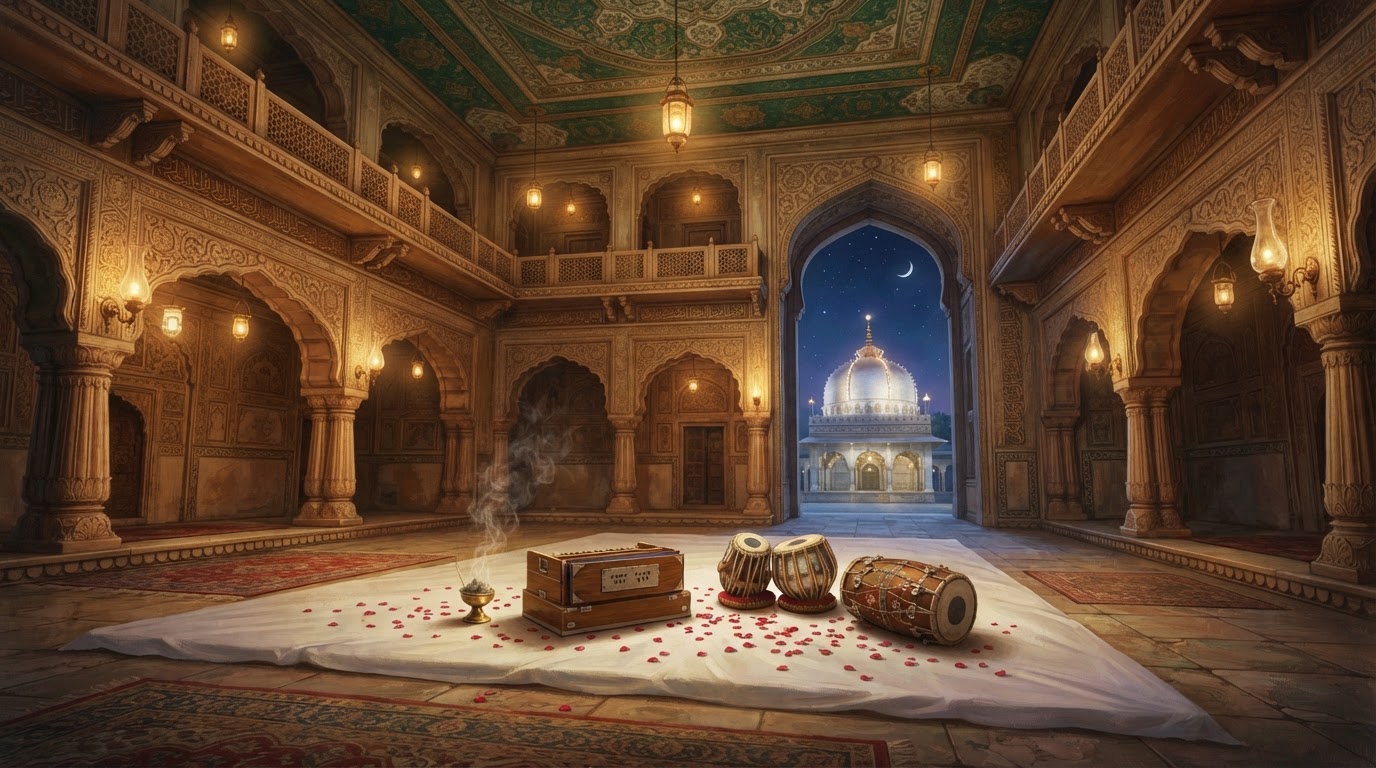
A famous Persian ghazal of longing and divine love is also attributed to him. Its refrain about dancing at the moment of seeing the Beloved is still sung by qawwals at Sufi gatherings, including at Ajmer. Read how those night-long gatherings work in our story on the Mehfil-e-Sama at Ajmer Dargah.
Where is Khwaja Usman Harooni buried?
In the last part of his life he lived in seclusion in Makkah, and most accounts say he passed away there on 5 Shawwal 617 AH (1220 CE). He is reported to have been buried in Jannat al-Mu’alla, the historic graveyard of Makkah. Like most graves there today, it is no longer marked.
India keeps his memory in two places:
- Belchi, Bihar: near Bihar Sharif in Nalanda district stands the Usmani Chillah, marking a place where he is said to have stayed and prayed during a visit to India in the time of Sultan Iltutmish. A local Urs is held there on 15 and 16 Shawwal.
- Ajmer: his Urs is marked at the Dargah of his disciple, and it is one of only four occasions a year when the silver Jannati Darwaza opens. The other three are the Urs of Khwaja Gharib Nawaz and the two Eids.
So when that gate opens in Shawwal, the disciple’s shrine is honouring the master. It is a quiet, beautiful piece of adab (respect) built into the calendar of Ajmer.
The chain that runs from him to India
Through one disciple, Usman Harooni’s teaching reached half a continent. From Khwaja Gharib Nawaz it passed to Khwaja Qutbuddin Bakhtiyar Kaki in Delhi, then to Baba Farid, then to Hazrat Nizamuddin Auliya, and from his circle to the Deccan, to Khuldabad and to Khwaja Bande Nawaz of Gulbarga. See more names in our guide to the great Sufi saints of India.
The lesson of a good teacher
We remember Khwaja Gharib Nawaz because he fed the hungry and welcomed everyone. But his generosity did not appear from nowhere. It was shaped by a master who taught him to serve before he led, to give before he kept, and to love people as a road to loving Allah.
That is a lesson for every parent, teacher and mentor. The good we put into one student can travel further than we will ever see. Usman Harooni never built a great shrine in India. He built a person, and that person changed India.
Frequently asked questions
Who was the murshid of Khwaja Gharib Nawaz?
Hazrat Khwaja Usman Harooni (RA), a Chishti shaykh from Haroon near Nishapur in present-day Iran. Khwaja Moinuddin Chishti became his disciple there and later his spiritual successor.
How long did Moinuddin Chishti stay with Usman Harooni?
Most traditional accounts, including the Dargah Committee’s, say about twenty years. Some biographies give a shorter period.
Where is Khwaja Usman Harooni’s grave?
Most accounts say he died in Makkah in 617 AH (1220 CE) and was buried in Jannat al-Mu’alla. His memorial chillah is at Belchi near Bihar Sharif, India.
Why does the Jannati Darwaza open for his Urs?
Because he was Khwaja Gharib Nawaz’s spiritual master. Ajmer honours him by opening the silver gate on his Urs in Shawwal, one of only four openings each year.
Related: Ajmer Urs 2026 dates · Khwaja Gharib Nawaz: life and teachings · Jannati Darwaza · The Mughal cauldrons of Ajmer · Sufi saints of India
Sources: Dargah Committee, Ministry of Minority Affairs: About Gharib Nawaz; Usman Harooni (Wikipedia); Raza-e-Khushtar: Khwaja Muinuddeen Chishti and his travels with his Murshid; Sufinama: Profile of Khwaja Usman Harooni; Dawat-e-Islami: Who was Sultan ul Hind?
Follow Ruhani Dua on Facebook for short videos and reminders. / रूहानी दुआ को Facebook पर Follow करें।
Discover more from ImranJalna
Subscribe to get the latest posts sent to your email.






Leave a Reply