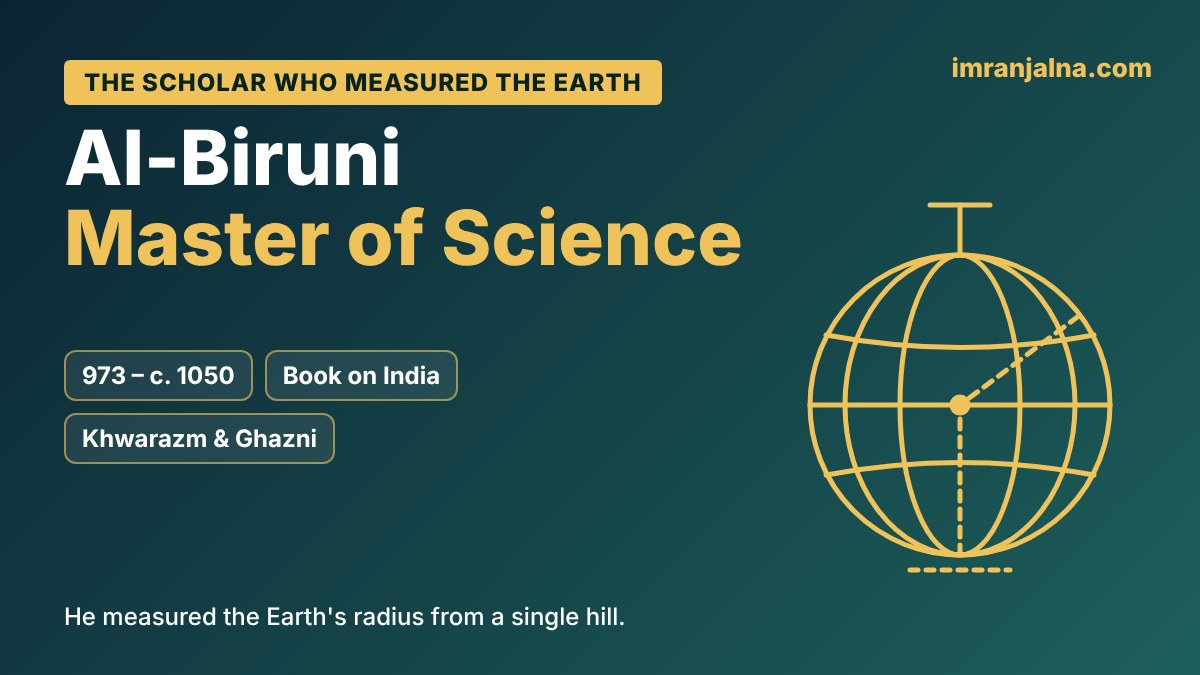
Abu Rayhan al-Biruni (973–c. 1050) was a Muslim polymath of the Islamic Golden Age who devised a way to calculate the Earth’s radius from a single hilltop using trigonometry. He also wrote a detailed, fair-minded book on India, which is why many scholars call him a founder of Indology and even “the first anthropologist”. Britannica describes him as perhaps the most original polymath the Islamic world produced.
Quick facts
| Full name | Abu al-Rayhan Muhammad ibn Ahmad al-Biruni |
| Born | 4 September 973, Kath, Khwarazm (in today’s Uzbekistan) |
| Died | c. 1048–1052 (sources differ), Ghazni (in today’s Afghanistan) |
| Fields | Astronomy, mathematics, geography, geodesy, physics, mineralogy, pharmacology, history, comparative religion |
| Most famous works | The Chronology of Ancient Nations; Tahqiq ma li-l-Hind (India); Al-Qanun al-Mas’udi (The Mas’udic Canon); Kitab al-Jamahir (Gems); Kitab al-Saydana (Pharmacology) |
| Known for | Measuring the Earth’s radius, his study of India, measuring the density of gems and metals |
| Patrons | Qabus of Gurgan; Sultan Mahmud of Ghazni and his son Mas’ud |
Who was al-Biruni and where did he grow up?
Al-Biruni was born in Kath, an old city of Khwarazm near the Amu Darya river. His mother tongue was Khwarezmian, a now-extinct Iranian language, but he wrote mainly in Arabic, the language of science in his time. He also knew Persian and later learned Sanskrit. He studied under a scholar from the ruling family of Khwarazm and was already making careful astronomical observations as a young man.
His early years were unsettled. A civil war in Khwarazm in the 990s forced him to move from court to court in search of a patron. At the court of Qabus in Gurgan, near the Caspian Sea, he wrote his first major book, The Chronology of Ancient Nations, which compares the calendars and festivals of Persians, Greeks, Jews, Christians, Muslims and others. According to Britannica, it was in Gurgan that he met the young philosopher-physician Ibn Sina.
How did al-Biruni study India at the court of Mahmud of Ghazni?
In 1017, Sultan Mahmud of Ghazni conquered Khwarazm and took al-Biruni with him to Ghazni. He spent the rest of his life serving Mahmud and later Mahmud’s son Mas’ud, mostly as a court astronomer. He travelled with Mahmud’s campaigns into north-western India. Rather than only observing, he learned Sanskrit, read Indian books and talked with Indian scholars.
The result, finished around 1030, was Tahqiq ma li-l-Hind. It describes Indian religion, philosophy, astronomy, mathematics, calendars, geography and customs. Its distinctive quality is its tone: al-Biruni tried to present Indian beliefs on their own terms, often comparing them with Greek ideas, instead of simply condemning them. For this reason modern scholars regard him as a pioneer of comparative religion and of the scientific study of other cultures.
How did al-Biruni measure the Earth?
Al-Biruni measured the Earth by finding the height of a hill and the angle of the horizon’s dip from its summit, then solving a right-angled triangle to the Earth’s centre. His most famous experiment took place near Nandana, in the Pind Dadan Khan area of today’s Pakistan. Earlier scholars had measured the Earth by walking long distances across a desert; he did it from one hill:
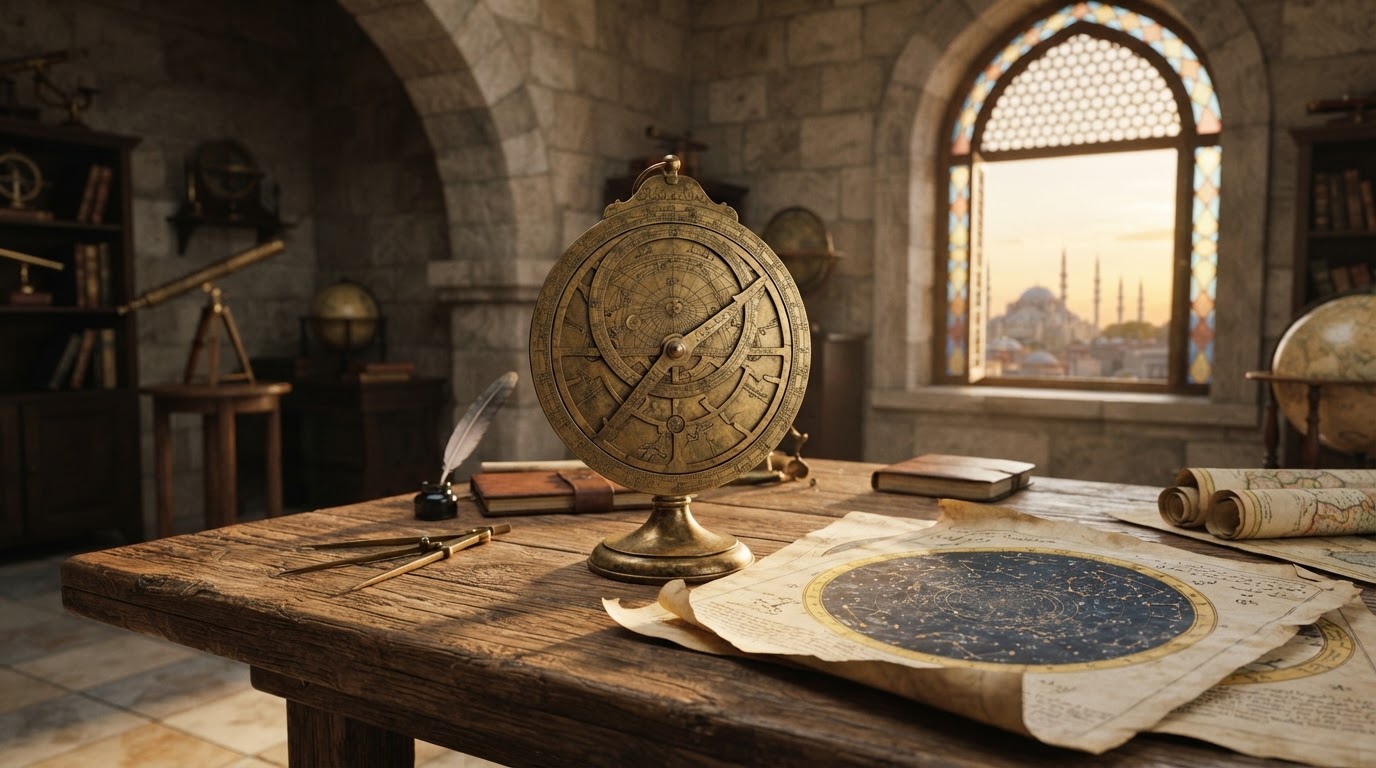
- First, he measured the height of the hill. From two points on flat ground a known distance apart, he measured the angle up to the top of the hill with an astrolabe, and used triangles to work out the height.
- Next, he climbed the hill and measured how far the horizon dipped below the true horizontal line. Because the Earth is curved, the horizon seen from a height sits slightly below eye level.
- Finally, he used the height and the dip angle in a right-angled triangle that reaches to the Earth’s centre, and calculated the Earth’s radius.
His answer, about 12.8 million cubits, is often converted to roughly 6,340 km, very close to the modern value of about 6,371 km. Historians urge caution, though. The exact length of his cubit is uncertain, he could not correct for the bending of light in the atmosphere, and the tiny angle was very hard to measure. The method was brilliant, but the closeness of his final number may be partly luck.
What did al-Biruni contribute to astronomy and mathematics?
Al-Biruni’s great astronomy encyclopedia, Al-Qanun al-Mas’udi (The Mas’udic Canon), was dedicated to Sultan Mas’ud. He worked within the Earth-centred model of his day but questioned parts of Ptolemy’s system. He discussed whether the Earth turns on its axis and concluded that he could neither prove nor disprove it, an open-minded position for the time. Britannica notes that he also distinguished the motion of the solar apogee from the precession of the equinoxes.
He was a strong mathematician too. He worked on methods for third-degree (cubic) equations and used spherical trigonometry to solve a practical religious problem: finding the exact qibla, the direction of Makkah, from Ghazni. This served the command in the Quran: “So turn your face toward al-Masjid al-Haram. And wherever you [believers] are, turn your faces toward it [in prayer]” (Surah Al-Baqarah 2:144). His book Tahdid nihayat al-amakin explains how to work out the latitude and longitude of cities.
Using his estimate of the Earth’s size, he also argued in the Mas’udic Canon that the known lands of Asia, Europe and Africa covered only part of the globe, and that more land might lie in the great ocean beyond them. Some writers link this to the Americas, but it was a reasoned guess, not a discovery.
How did al-Biruni measure gems, density and medicines?
In Kitab al-Jamahir (the Book of Gems), al-Biruni used a balance and the displacement of water to measure the specific gravity (density) of metals and precious stones. This let him tell real gems from imitations: his measurements separate sapphire, at roughly 4, from glass, at about 2.5. He argued that gems should be classified by physical properties such as density and hardness, not just by colour. He also suggested that fossils found in mountains showed that the land had once been under the sea.
Late in life he wrote Kitab al-Saydana, a book on drugs and medicines. It gives the name of each substance in many languages, including Arabic, Persian, Greek, Syriac and Indian languages, making it a useful dictionary for pharmacists.
Why did Muslim scholars like al-Biruni study the natural world?
Muslim scholars saw the study of nature as a form of reflection on Allah’s creation and as part of seeking knowledge, both of which the Quran and Sunnah encourage. The Quran says: “Indeed, in the creation of the heavens and the earth and the alternation of the day and night there are signs for people of reason” (Surah Ali ‘Imran 3:190). It also teaches the prayer “My Lord! Increase me in knowledge” (Surah Ta-Ha 20:114).
The Prophet Muhammad ﷺ said: “Whoever takes a path upon which to obtain knowledge, Allah makes the path to Paradise easy for him” (Jami` at-Tirmidhi 2646, graded hasan by al-Tirmidhi). The same teaching is also found in Sunan Ibn Majah 223 and in Sahih Muslim 2699. Scholars differ on which fields count as “knowledge” in this hadith: many classical scholars understood it mainly as religious knowledge, while others extend its spirit to beneficial sciences pursued with a sincere intention. Al-Biruni’s own motives are best judged from his works, which repeatedly stress accuracy and fairness.
What is al-Biruni’s legacy?
About 146 works are credited to al-Biruni, but only around 22 survive. Unlike Ibn Sina, his books were not widely translated into Latin, so his direct influence on medieval Europe was smaller. His fame grew in the 19th and 20th centuries, when European scholars such as Edward Sachau translated his Chronology and India. The historian of science George Sarton counted him among the very greatest scientists of Islam.
Today a crater on the Moon, the asteroid 9936 Al-Biruni and Biruni Island in Antarctica carry his name. The Soviet Union issued a stamp for his 1,000th birthday in 1973, and Google honoured him with a Doodle in 2012. In Uzbekistan, Iran, Afghanistan and Pakistan he is widely honoured as one of the region’s greatest minds.
What this means for you
Al-Biruni shows that careful observation, honest measurement and fairness toward other cultures can go hand in hand with faith. For students, his life is a reminder to pursue knowledge patiently, to question respectfully, and to admit what cannot yet be proven.
Frequently asked questions
What is al-Biruni famous for?
Al-Biruni is famous for calculating the Earth’s radius using a hill and trigonometry, for his fair-minded book on India, for measuring the density of gems and metals, and for his astronomy encyclopedia, the Mas’udic Canon.
How accurate was al-Biruni’s measurement of the Earth?
His result is often quoted as within 1–2% of the modern radius. However, the value depends on the length of the cubit he used, and he could not correct for atmospheric refraction, so many historians regard his real accuracy as uncertain. His method, though, was sound and original.
Why is al-Biruni called the founder of Indology?
He learned Sanskrit and wrote one of the earliest systematic studies of India’s religion, science, calendars and society, based on Indian texts and conversations with Indian scholars rather than on rumour.
Read more: 16 Great Muslim Scientists · Al-Khwarizmi: The Father of Algebra · Ibn al-Haytham: The Father of Optics
Sources: Britannica – al-Biruni · Muslim Heritage – The Science of Al-Biruni · ThatsMaths – Al-Biruni and the Size of the Earth · Quran 2:144 · Quran 3:190 · Quran 20:114 · Jami` at-Tirmidhi 2646 · Sunan Ibn Majah 223 · Sahih Muslim 2699
Also read:
➤ Al-Idrisi (Dreses): The Geographer Who Mapped the World for a King
➤ Al-Battani (Albategnius): The Astronomer of Raqqa Who Corrected Ptolemy
➤ Nasir al-Din al-Tusi: The Polymath of Maragheh Who Made Trigonometry a Science
Follow Ruhani Dua on Facebook for short videos and reminders. / रूहानी दुआ को Facebook पर Follow करें।