

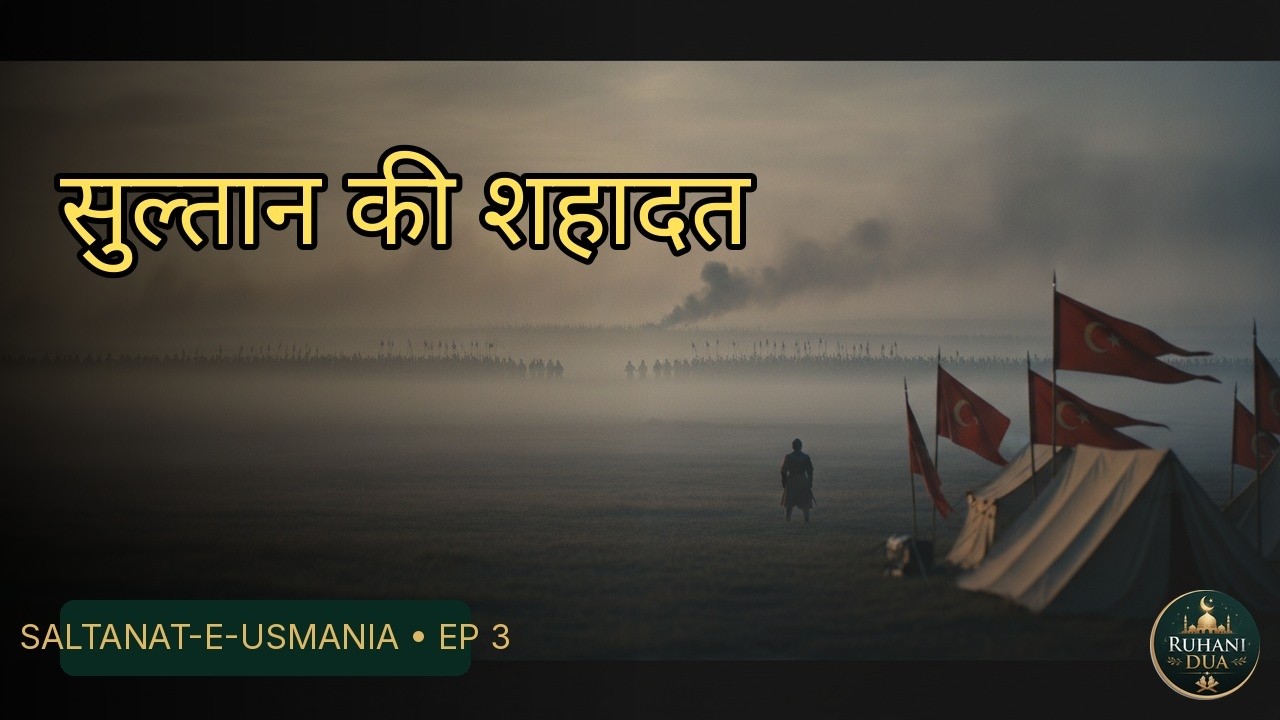
Murad I was the Ottoman sultan from 1362 until his death at the Battle of Kosovo on 15 June 1389. He moved Ottoman power into Europe by making Edirne (Adrianople) a base, and he is the only Ottoman sultan known to have been killed in battle.

Watch the full video: जब जंग में एक सुल्तान गिरा! | Entire History of the Ottoman Empire Ep. 3 | सल्तनत-ए-उस्मानिया on the Ruhani Dua YouTube channel.
| Quick facts | Details |
|---|---|
| Who | Murad I, son of Orhan Ghazi, nicknamed Hüdavendigâr |
| Reign | March 1362 to 15 June 1389 |
| Capital in Europe | Edirne (Adrianople), taken c. 1360s |
| Major victory | Maritsa, 26 September 1371 (some lists give 27 September) |
| Death | Kosovo Polje, 15 June 1389 |
| Successor | Bayezid I |
How did Murad I come to the throne?
Orhan Ghazi died in Bursa in March 1362, and Murad I took the throne that same month. He was born in 1326, the son of Orhan and Nilüfer Hatun, and he came to power after the death of his elder half-brother Süleyman Pasha. Some reference works, such as Britannica, date his accession to 1360, so you will see both years in print; the 1362 date is the one most timelines use.
Why did Edirne matter so much?
By moving his capital from Bursa in Anatolia to Edirne, Murad showed that the Ottomans meant to stay in Europe. Dates for the conquest vary by source: History Today says he moved the capital there about 1360, while a common timeline lists the conquest of Edirne in 1369. Treat the exact year as debated, and the strategic result as clear. Edirne became the base for campaigns across Thrace and the Balkans.
What happened at the Battle of Maritsa in 1371?
At Maritsa (also called Chernomen), an Ottoman army defeated Serbian forces led by King Vukašin and his brother Despot Uglješa. The battle was fought on 26 September 1371 near the Maritsa River, about 20 miles west of Edirne. The Serbian brothers hoped to surprise the Ottoman capital while Murad was in Asia Minor. The Ottoman force was led by Murad’s lieutenant Lala Şahin Pasha, who is described as the first beylerbey of Rumeli. The Serbian despots were killed, and several Balkan rulers became vassals afterwards. Army sizes in medieval sources are unreliable, so figures such as “70,000” should be read cautiously.
What institutions began under Murad I?
Britannica says the seeds of several basic Ottoman institutions were sown in his reign. The offices of military judge (kaziasker), commander-in-chief (beylerbeyi) and grand vizier took shape. The origins of the Janissary corps and the devşirme recruitment system are also traced to his time, and the timar land-grant system became a base of Ottoman military and administrative organisation as conquered European lands were organised.
Historians do not fully agree on the details. Some older accounts credit Orhan with the first Janissary corps, and some sources say the Janissaries became a famed force around 1383. The devşirme system has also been discussed critically by historians because it involved taking boys from Christian families. The safest summary is that these institutions developed gradually, and Murad’s reign is where many sources place their beginnings.
What happened at Kosovo on 15 June 1389?
On 15 June 1389, Murad’s army met a Serbian-led force under Prince Lazar at Kosovo Polje, the “Field of the Blackbirds”. Reliable accounts are scarce, and many details of the battle are uncertain. Most sources agree that both Lazar and Murad died. Some accounts say the battle went badly for the Ottomans at first before turning in their favour. Others describe it as tactically a draw, with losses that hurt the Serbs most. Murad’s son Bayezid took command and became the next sultan.
How Murad died is also told in different ways. A common account says a Serbian nobleman, Miloš Obilić, stabbed him, perhaps after posing as an informer. Wikipedia notes there are different accounts from different sources about when and how he was killed. History Today adds that both Christian and Muslim propaganda partly cloud the records. Ottoman documents describe the sultan as having drunk the “sherbet of martyrdom”, a phrase that shows how his death was remembered in Ottoman tradition.
How does Islam describe martyrdom (shahada)?
Murad’s death is remembered as martyrdom in Ottoman tradition. It helps to know what the Quran and authentic hadith actually say, and to remember that only Allah knows the sincerity of any person’s heart.
Surah Ali ‘Imran, ayah 169 says not to think of those killed in the cause of Allah as dead, for they are alive with their Lord and provided for:
وَلَا تَحْسَبَنَّ ٱلَّذِينَ قُتِلُوا۟ فِى سَبِيلِ ٱللَّهِ أَمْوَٰتًۢا ۚ بَلْ أَحْيَآءٌ عِندَ رَبِّهِمْ يُرْزَقُونَ
Surah Ali ‘Imran 3:169
Intention matters. In Sahih al-Bukhari 2816, a man asked the Prophet ﷺ whether fighting for booty, fame or show was in Allah’s cause. The Prophet ﷺ answered that whoever fights so that Allah’s Word is superior is in Allah’s cause. A related hadith in Sahih Muslim 1909 (narrated by Sahl ibn Hunayf, RA) says that whoever sincerely asks Allah for martyrdom will be raised to the rank of the martyrs, even if he dies in his bed. Both teach that Allah looks at sincerity, not at titles or battlefields.
What did Kosovo change in the Balkans?
Moravian Serbia became an Ottoman vassal state from 1390 until 1402. Kosovo’s memory lasted far longer: Serbs commemorate it each year on Vidovdan, 28 June, a date that follows the old calendar. For the Ottomans, the main immediate result was that Bayezid I took the throne, ruling until 1402. Murad’s body is buried in Bursa, and his internal organs are said to rest at a tomb on the battlefield.
Lessons for us today
- Read history with care. Medieval accounts of Kosovo are mixed with later memory, so honest writers say “according to many reports” when sources differ.
- Intention comes first. Sahih al-Bukhari 2816 ties the value of any struggle to its purpose: that Allah’s Word be upheld, not fame or gain.
- Leave final judgement to Allah. Surah Ali ‘Imran 3:169 gives hope about the martyrs, but we do not claim knowledge of any individual’s hidden sincerity.
- Build institutions, not just victories. Murad’s reign is remembered as much for administration as for battles.
FAQ
Was Murad I the only Ottoman sultan killed in battle?
Yes, according to Wikipedia’s article on the battle, Kosovo in 1389 is the only time an Ottoman sultan was killed in battle.
Who won the Battle of Kosovo in 1389?
Historians disagree. Some call it an Ottoman victory, others a tactical draw. Both leaders died, and the long-term effect favoured the Ottomans, as Serbia became a vassal by 1390.
When was Maritsa fought?
Most sources give 26 September 1371. One Wikipedia timeline lists 27 September, so small date differences exist.
Read more: Ulugh Beg: The Sultan of Samarkand Who Mapped 1,018 Stars and Why Mughal Emperors Walked to Ajmer: Akbar, Jahangir and Shah Jahan.
Sources: Quran 3:169 on quran.com; Sahih al-Bukhari, Book of Jihad (2816, 2817) on sunnah.com; Sunan an-Nasa’i 3162 on sunnah.com; Britannica, Murad I; History Today, The Battle of Kosovo, 1389; Murad I, Battle of Maritsa and Battle of Kosovo on Wikipedia.
Follow Ruhani Dua on Facebook for short videos and reminders. / रूहानी दुआ को Facebook पर Follow करें।
Discover more from ImranJalna
Subscribe to get the latest posts sent to your email.






Leave a Reply