

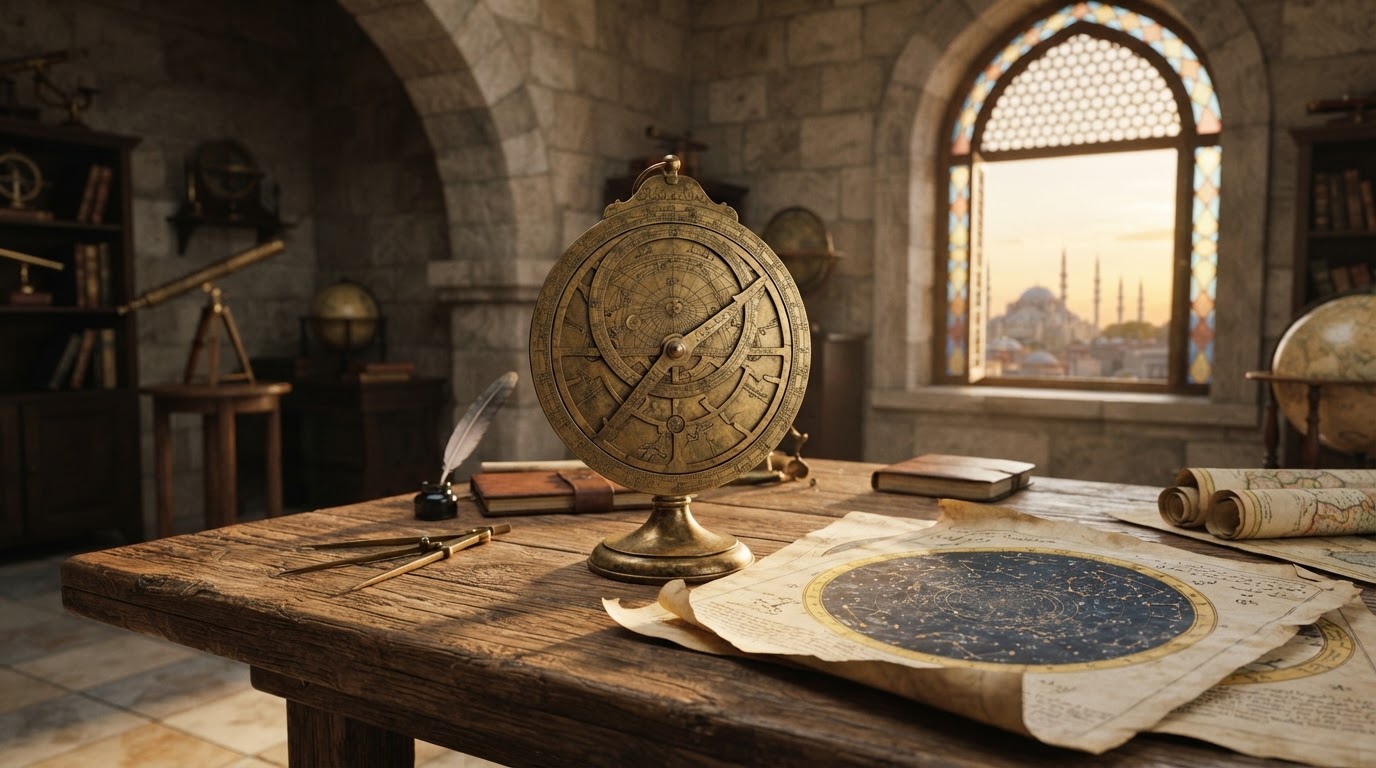
Taqi al-Din Muhammad ibn Ma’ruf (1526–1585), known as al-Rasid, “the observer”, was an Ottoman astronomer, mathematician and engineer from Damascus who founded the Istanbul Observatory around 1575–1577. He is remembered for precise astronomical instruments, decimal-fraction trigonometry, a mechanical observation clock, an early description of a steam-driven spit and a six-cylinder water pump.
He worked under Sultan Murad III, and his observatory was demolished in January 1580 after only a few years of work. His story combines real scientific achievement with court politics, so this article marks where historians disagree.
Quick facts
| Full name | Taqi al-Din Abu Bakr Muhammad ibn Qadi Ma’ruf al-Shami al-Asadi al-Rasid |
| Born | Damascus, 1526 (some sources say 1525/6, one says c. 1521) |
| Died | 1585, Istanbul |
| Fields | Astronomy, mathematics, mechanical engineering, optics, timekeeping |
| Most famous works | Sidrat al-Muntaha (zij of Murad III); al-Turuq al-saniyya (Sublime Methods of Spiritual Machines); al-Kawakib al-durriyya (clocks); Kitab Nur hadaqat al-ibsar (optics) |
| Known for | Founding the Istanbul Observatory; decimal fractions in trigonometry; observation clock; six-cylinder pump |
Where did Taqi al-Din come from and how was he trained?
Taqi al-Din was born in Damascus in 1526. He worked for a time as a judge and teacher in Nablus, Damascus and Cairo. One study adds that he was the son of a judge and became a judge himself. His birth year is not certain: one Muslim Heritage article gives “around 1521”, while others give 1525/6.
His probable teachers were Shihab al-Din al-Ghazzi in mathematics and Muhammad ibn Abi al-Fath al-Sufi in astronomy. His education began in theology, and he later turned to the rational sciences. He therefore belonged to the scholar-judge class that produced many Ottoman scientists.
How did he become chief astronomer in Istanbul?
In 1570 he came to Istanbul from Cairo, and in 1571–72 he was appointed chief astronomer (Munajjimbashi) after the death of Mustafa ibn Ali al-Muwaqqit. He built ties with leading scholars, especially Hoca Sadeddin, and Grand Vizier Sokullu Mehmed Pasha presented him to Sultan Murad.
Taqi al-Din argued that the tables of Ulugh Beg contained observational errors and that new observations could correct them. If you want to know who Ulugh Beg was, see our article on the Sultan of Samarkand linked below.
What was the Istanbul Observatory?
The Istanbul Observatory was the first observatory built in the Ottoman Empire. It stood on high ground at Tophane and consisted of two buildings, a large and a small one. It had a library, a workshop, and a staff of sixteen: eight observers, four clerks and four assistants.
Sources disagree on exact dates. Scholars generally agree that construction began in 1575 and finished in 1577, while Salim Ayduz gives 1579 as its completion. Before it was ready, Taqi al-Din worked at the Galata Tower.
Which instruments and methods made his astronomy special?
He rebuilt the instruments of older Islamic observatories and added new ones. Some examples:
- A mural quadrant made of two brass quadrants, each with a radius of six metres. Tycho Brahe’s equivalent was only two metres.
- The mushabbaha bi’l-manatiq, a sextant-like instrument he invented to measure distances between stars.
- The dhat al-awtar, another of his inventions, used to find the equinoxes.
- A mechanical observation clock showing hours, minutes and seconds, with each minute divided into five seconds.
He replaced sexagesimal fractions with a decimal system and prepared trigonometric tables in decimal fractions. His Jaridat al-durar (1581/82) is described as the first use of decimal fractions in trigonometric functions. He gave the ecliptic obliquity as 23° 28′ 40″, close to the modern value.
Observations were collected in the zij Sidrat al-Muntaha. One scholar calls his solar-motion calculations the most outstanding of their kind in the 16th century. Comparisons with Tycho Brahe, who worked in Denmark at the same time, are common in the literature, but they come from modern historians and are best read as comparisons, not a ranking.
Did he invent a steam turbine and a six-cylinder pump?
His engineering book is al-Turuq al-saniyya fi al-alat al-ruhaniyya (The Sublime Methods of Spiritual Machines). It has six chapters: water clocks, weight-lifting devices, water-raising devices, fountains and self-playing instruments, irrigation devices, and a self-moving spit. Its date varies by source: Muslim Heritage gives about 1551 and Damascus as the place of writing.
The spit uses steam. He describes a wheel with vanes at the end of the spit and a closed copper vessel of water heated beneath it, so that steam from the nozzle turns the wheel. It is a simple steam jet, not an engine as we know it today. Muslim Heritage says it predates Giovanni Branca’s steam turbine of 1629.
The same book describes a six-cylinder “monobloc” pump, a water-raising machine driven by cams on a water wheel. A modern engineering study concluded that the pump must have worked efficiently. Some websites claim dates such as 1559 for the pump; the sources I checked give about 1550 for the book.
What did he write on clocks and optics?
His al-Kawakib al-durriyya (The Brightest Stars for the Construction of Mechanical Clocks) was written in 1559 in Nablus and is described as the first Ottoman book on automatic machines. According to Yavuz Unat, he once built a clock showing prayer times, including dawn, afternoon, evening and bedtime prayers.
His optics book, Kitab Nur hadaqat al-ibsar, is dedicated to Murad III. Starting from Ibn al-Haytham’s theory, it explains vision as light reflected from an object into the eye. One scholar calls it probably the only Ottoman work on optics of its scope.
He also describes a lens-like device. Unat says it “may have been” a proto-telescope or sighting tube, not a true telescope. That caution matters: no source here proves he built a telescope.
Why was the observatory destroyed in 1580?
The observatory worked until 22 January 1580, the date of its destruction. The reasons are debated. Salim Ayduz says religious arguments were used, but the cause lay in political conflicts.
Yavuz Unat gives a fuller account. A plague struck Istanbul in 1578, and opposition to the observatory spread. The Sheikh ul-Islam wrote to the sultan that observing the heavens was ill-omened and would bring disaster. An imperial order then told the High Admiral Kilic Ali Pasha to demolish the observatory. His patron Hoca Saadettin Efendi is believed to have saved Taqi al-Din’s life. He died in 1585.
Legacy
The Istanbul Observatory is described as one of the largest in the Islamic world, although it lasted only a few years. After its destruction, Ottoman astronomical activity is said to have stagnated until Copernican ideas arrived in the 1660s. His manuscripts survive in libraries such as the Chester Beatty Library in Dublin, the Topkapi Palace Museum and Kandilli Observatory, and are still studied today.
Frequently asked questions
Who was Taqi al-Din?
He was a 16th-century Ottoman scholar from Damascus (1526–1585) who served as chief astronomer in Istanbul and founded the city’s first observatory.
Did Taqi al-Din invent the steam turbine?
He described a steam-driven rotating spit in about 1551, an early steam-jet device. Calling it a “steam turbine” is common but loose, since it was a small kitchen machine, not a power engine.
Why was his observatory destroyed?
It was demolished in January 1580 by imperial order. Religious objections were cited, but historians such as Salim Ayduz point to political conflicts as the real cause.
Read more: Great Muslim Scientists · Ulugh Beg: The Sultan of Samarkand Who Mapped 1,018 Stars · Banu Musa Brothers: The Three Baghdad Brothers Behind the Book of Ingenious Devices
Sources: Salim Ayduz, “Taqi al-Din Ibn Ma’ruf: A Bio-Bibliographical Essay”, Muslim Heritage · Yavuz Unat, “Development of Astronomy in Ottomans”, Muslim Heritage · “The Six-Cylinder Water Pump of Taqi al-Din”, Muslim Heritage
Follow Ruhani Dua on Facebook for short videos and reminders. / रूहानी दुआ को Facebook पर Follow करें।
Discover more from ImranJalna
Subscribe to get the latest posts sent to your email.









Leave a Reply