

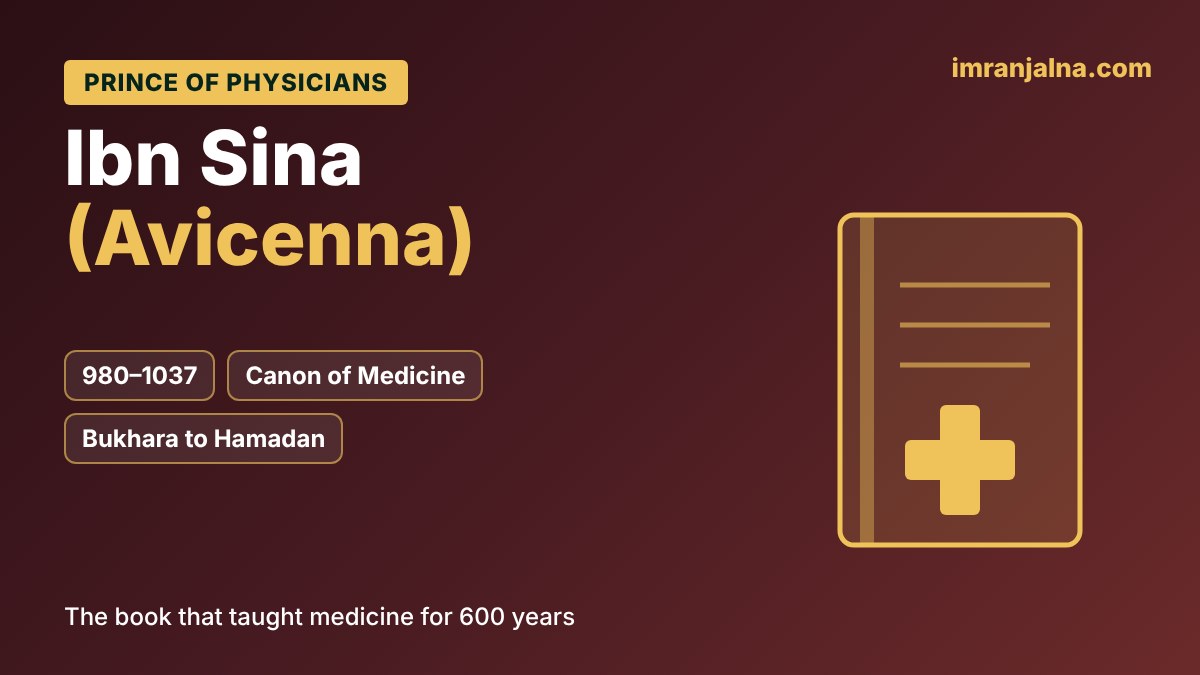
Ibn Sina, known in Europe as Avicenna, was a Persian Muslim physician and philosopher who lived from 980 to 1037 CE. His medical encyclopedia, Al-Qanun fi al-Tibb (The Canon of Medicine), was taught in universities across the Muslim world and Europe for around six centuries, which is why he is often called the “Prince of Physicians”.
Quick facts
| Full name | Abu Ali al-Husayn ibn Abd Allah ibn Sina |
| Born | 980 CE, Afshana, near Bukhara (in today’s Uzbekistan) |
| Died | 1037 CE, Hamadan (in today’s Iran) |
| Fields | Medicine, philosophy, astronomy, chemistry, psychology |
| Most famous works | The Canon of Medicine; Kitab al-Shifa (The Book of Healing) |
| Books written | Around 450 works are attributed to him; about 240 survive |
A child prodigy from Bukhara
In his autobiography, Ibn Sina wrote that he had memorised the Quran by the age of ten and then studied logic, mathematics and philosophy. He turned to medicine as a teenager and found it “not difficult”. By about 18 he was treating patients, and after he helped cure the Samanid ruler Nuh ibn Mansur, he was allowed to study in the royal library of Bukhara, one of the richest collections of books of its time.
His adult life was spent moving between the courts of Central Asia and Iran, often in difficult and dangerous times. He served as a physician and even as a minister, and he frequently wrote at night, after a full day’s work.
The Canon of Medicine
Completed around 1025, the Canon brought together the medical knowledge of the Greek, Persian, Indian and Arab worlds with Ibn Sina’s own clinical experience. It is organised into five books:
- General principles of medicine, anatomy and the causes of disease.
- Simple medicines (materia medica), describing about 800 substances.
- Diseases of each part of the body, from head to toe.
- Diseases that affect the whole body, such as fevers.
- Compound medicines and how to prepare them.
Among its insights, the Canon discussed how some diseases spread through contact, water and soil, recognised the importance of diet, exercise, sleep and mental state for health, and gave detailed guidance on reading the pulse.
Rules for testing medicines
One of the most modern parts of the Canon is its set of rules for testing whether a medicine really works. Ibn Sina said a drug should be tested on a simple, uncomplicated case of a disease; that its effect should be the same every time it is used; that it should be tested on people, because results in animals may differ; and that the timing and strength of its effect should be carefully observed. Historians see these rules as an early step towards today’s clinical trials.
Philosopher as well as doctor
Ibn Sina’s Kitab al-Shifa (The Book of Healing), despite its name, is not a medical book but a vast encyclopedia of logic, natural science, mathematics and metaphysics. In it he described his famous “floating man” thought experiment, which asks the reader to imagine a person created floating in the air, with no sensations at all, and argues that such a person would still be aware of his own existence. His philosophy shaped later Muslim thinkers and European scholars such as Thomas Aquinas.
His legacy
- The Canon was translated into Latin by Gerard of Cremona in the 12th century and remained a core textbook in European medical schools until the 17th century.
- His mausoleum in Hamadan, Iran, is a well-known landmark.
- A lunar crater (Avicenna) and the genus of mangrove trees Avicennia are named after him.
Frequently asked questions
Why is Ibn Sina called the father of modern medicine?
Because his Canon of Medicine organised medical knowledge systematically, introduced careful rules for testing drugs and diagnosing disease, and was the standard medical textbook in Europe and the Muslim world for about 600 years.
What is the Canon of Medicine?
It is Ibn Sina’s five-book medical encyclopedia, completed around 1025 CE, covering anatomy, the causes of disease, hundreds of medicines, and the diagnosis and treatment of illnesses throughout the body.
Where is Ibn Sina buried?
He died in 1037 CE and is buried in Hamadan, in western Iran, where a mausoleum and museum stand in his honour.
Read more: 16 Great Muslim Scientists of the Islamic Golden Age · Ibn al-Haytham · Al-Khwarizmi
Sources: Encyclopædia Britannica – Avicenna; Stanford Encyclopedia of Philosophy – Ibn Sina; Muslim Heritage.
Discover more from ImranJalna
Subscribe to get the latest posts sent to your email.










Leave a Reply