

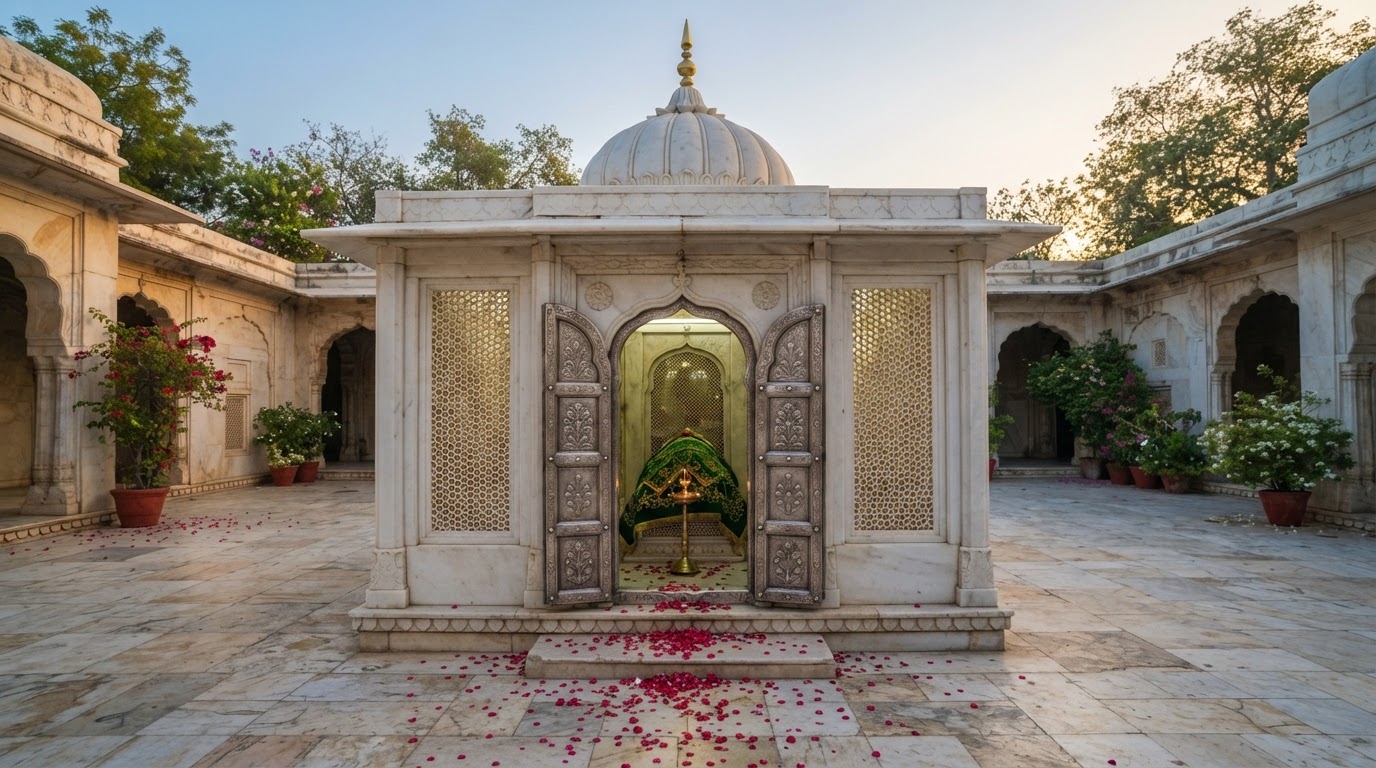
Most pilgrims walk straight past it.
They come in through Nizam Gate with baskets of red roses, pass the great cauldrons and the Buland Darwaza, and the crowd carries them towards the silver doors of the main shrine. Yet just to the south of that shrine stands a much smaller tomb: a little white dome with a kalash (finial) on top and doors plated with silver. The woman who rests inside has a name that already tells you something about her. Hafiz: one who carries the whole Quran in memory.
In short: Bibi Hafiz Jamal (Rehmatullah Alaiha) was, according to traditional accounts, the only daughter of Hazrat Khwaja Moinuddin Hasan Chishti, Khwaja Gharib Nawaz (Rehmatullah Alaih). Her father is said to have granted her khilafat (authority to guide others on the spiritual path), and she spent her life guiding the women of Ajmer. She is buried inside the Ajmer Dargah complex, on the southern side of her father’s tomb. If you are going for the 815th Urs in December 2026, her tomb is one of the quietest and most moving stops in the Dargah.
Bibi Hafiz Jamal: quick facts
| Name | Bibi Hafiz Jamal, also written Bibi Hafiza Jamal or Syeda Bibi Hafiz Jamal |
| Father | Hazrat Khwaja Moinuddin Chishti, Khwaja Gharib Nawaz (RA) |
| Brothers | Khwaja Fakhruddin, Khwaja Hisamuddin and Khwaja Ziauddin Abu Saeed (traditional list) |
| Era | 13th century CE |
| Known for | Khilafat from her father; guiding the women of Ajmer |
| Husband | Shaikh Raziuddin, according to most accounts |
| Resting place | Ajmer Dargah, south of the main shrine, in an enclosure set apart for women |
A family that came late in life
Khwaja Gharib Nawaz did not come to Ajmer to start a family. He came, after decades of travel from Sistan, to serve the poor and call people to Allah. For years he lived simply, with a few companions, and no wife.
Tradition says that changed with a dream. Khwaja Sahib saw the Prophet Muhammad ﷺ gently reminding him that marriage, too, is part of the Sunnah. Soon after, a pious man of Ajmer, Saiyad Wajihuddin Mashhadi, offered his daughter in marriage. According to one well-known account, Khwaja Sahib replied that at his age he had little need to marry, but that following the Prophet ﷺ mattered more, and he accepted. Wikipedia, drawing on historical sources, dates this marriage to around 1209–10 CE, when he was already an old man.
Traditional biographies name two wives: Bibi Asmat, daughter of Saiyad Wajihuddin, and Bibi Ummatullah, who some writers say was the daughter of a local ruler who accepted Islam. From these marriages came three sons and one daughter. The accounts do not agree on which wife was Bibi Hafiz Jamal’s mother, and it is wiser to leave that question open.
Did you know? Her eldest brother, Khwaja Fakhruddin, earned his living as a farmer. His own Dargah is at Sarwar, about 40 miles (65 km) from Ajmer, where his Urs is held every year in Shaban.
What does “Hafiz” in her name tell us?
In Muslim usage, a Hafiz (or Hafiza, for a woman) is someone who has memorised the entire Quran, all 114 Surahs. When the title is attached to a name, it is usually because the person was known for exactly that. Jamal means beauty or grace.
So her name, as it has come down to us, reads almost like a short description: the lady of grace who carried the Quran in her heart. In the 13th century, long before printed books, memory was how knowledge was kept and passed on. A woman who held the whole Quran in memory in the household of Khwaja Gharib Nawaz would naturally become a teacher.
Why did Khwaja Gharib Nawaz give his daughter khilafat?
In a Sufi order, khilafat is a trust. A Shaikh gives it to a student he believes is ready to guide others: to teach, to give advice, to take people’s hands on the path of remembering Allah. Khwaja Sahib gave khilafat to famous men such as Khwaja Qutbuddin Bakhtiyar Kaki, who carried the Chishti path to Delhi.
Traditional accounts say he also gave it to his daughter, and that she guided thousands of women. Think about what that meant in practice. In 13th-century Ajmer, many women would not sit in a gathering of men, however holy. Bibi Hafiz Jamal could sit with them, teach them the Quran, answer their questions about Namaz and family life, and pray with them. She opened the door of her father’s teaching to half of the city.
She was not alone in Sufi history. From Hazrat Rabia of Basra in the 8th century onwards, Muslim tradition has remembered women of deep worship. Within the Chishti circle itself, Delhi remembers Bibi Fatima Sam, a woman saint whom, by report, Hazrat Nizamuddin Auliya spoke of with great respect. Bibi Hafiz Jamal belongs to that quiet line.
Who was her husband?
Most traditional accounts say she was married to Shaikh Raziuddin, described as a son of Hazrat Hamiduddin Nagauri. One Hamiduddin of Nagaur, remembered as Sultan-ut-Tarikin (king of those who renounced the world), was among the best-known disciples of Khwaja Gharib Nawaz, so the marriage would have tied two Chishti households together.
Some tellings, however, link her husband to the family of Khwaja Fakhruddin Gardezi, the cousin who, according to historians, travelled with Khwaja Sahib to India. Differences like this are normal in family histories that are eight centuries old, and both versions agree on the main point: she married within the circle of her father’s companions and stayed in Ajmer.
Where is her tomb in Ajmer Dargah?
Her Mazar (tomb) stands to the south of the main shrine. It is easy to recognise once you know what to look for: a small dome with a kalash on top and doors plated with silver. A Dawn writer who visited described her resting place as a tiny white room beside one of the doors of the main tomb, with the grave of Khwaja Sahib’s wife a little further on.
The Wikipedia entry on the Dargah, citing the scholar Qamar-ul Huda, says the enclosure on the southern side, called the Arhat-i-Noor, is set apart for women and holds the tombs of Khwaja Sahib’s daughter and granddaughter. Travel writers note that the same path leads on to the tomb of Nizam Sikka, the water-carrier who saved the Mughal emperor Humayun’s life, and to the silver Jannati Darwaza.
- Finding it: after the main shrine, ask a Dargah volunteer or khadim for “Bibi Sahiba ka mazar”. During the Urs, follow the crowd lines; do not push against them.
- For women: this part of the Dargah is especially associated with women pilgrims, many of whom stop here to pray quietly after leaving the main shrine.
- Adab: keep the same manners as at the main tomb: head covered, voice low, no photos inside, and every Dua made to Allah alone. Our guide to the quiet rules of Ajmer Dargah explains them.
Did you know? Besides Khwaja Sahib’s own tomb, the Dargah complex holds eight more tombs, most of them of his family members. You can see how they fit into the whole complex in our walk through Ajmer Dargah.
The women of Ajmer, then and now
Four centuries after Bibi Hafiz Jamal, another woman left her mark on this Dargah. Jahanara Begum, the eldest daughter of Emperor Shah Jahan, was a devoted follower of the Chishti path. In 1640 she wrote Mu’nis al-Arwah, a book about the life of Khwaja Gharib Nawaz. She gave the Dargah the Begumi Dalaan (a pillared hall beside the tomb), the railing around it, and a small raised platform still called the Begumi Chabutra.
Today, women are welcome at Ajmer in a way that surprises many visitors. They can enter the Dargah, and during the Urs they may sit in the Mehfil-e-Sama in the Mehfil Khana, which the American scholar Kelly Pemberton notes is not common at Sufi shrines. Somewhere in that welcome, you can still feel the daughter who once taught the women of this city.
What her life teaches us today
We know very little about Bibi Hafiz Jamal, and that itself is a lesson. She did not build gates or donate cauldrons. Her work was the kind that leaves no inscriptions: learning the Quran by heart, teaching it to others, and guiding women through the ordinary questions of faith and life.
Her father taught that the people closest to Allah have the generosity of a river, the kindness of the sun and the humility of the earth. His daughter lived the third of those quietly. The next time you stand at Ajmer Dargah, walk a few steps south of the crowd. Make a Dua for the daughter who chose service over fame, and for every mother and teacher who still does the same. Read more about her father’s life in Khwaja Gharib Nawaz: life, teachings and the Ajmer Dargah.
Frequently asked questions
Who was Bibi Hafiz Jamal?
She was the only daughter of Khwaja Moinuddin Chishti (Khwaja Gharib Nawaz), according to traditional accounts. She was a Hafiza of the Quran, received khilafat from her father and guided the women of Ajmer.
Where is the tomb of Khwaja Gharib Nawaz’s daughter?
Inside the Ajmer Sharif Dargah complex, to the south of the main shrine. It has a small dome with a finial and silver-plated doors, in an enclosure set apart for women.
How many children did Khwaja Gharib Nawaz have?
Traditional biographies name three sons, Khwaja Fakhruddin, Khwaja Hisamuddin and Khwaja Ziauddin Abu Saeed, and one daughter, Bibi Hafiz Jamal. Some accounts differ in the details.
Can women visit the tomb of Bibi Hafiz Jamal during the Urs?
Yes. Women can visit the Dargah and her tomb, which lies in an area associated with women pilgrims. During the 815th Urs in December 2026, expect heavy crowds and follow the queue arrangements.
Related: Ajmer Urs 2026 dates · Khwaja Usman Harooni, his teacher · Great Sufi saints of India
Sources: Shrine of Mu’in al-Din Chishti (Wikipedia); Mu’in al-Din Chishti (Wikipedia); Kanzul Islam: Khawaja Garib Nawaz; Dawn: The hopescape of Ajmer Sharif.
Read Next
 Ana Sagar to Akbar’s Fort: Old Ajmer Every Urs Pilgrim Should SeeNov 28, 2026
 Ibn al-Baitar (Ibn al-Bayṭār): The Málaga Herbalist Who Wrote a Giant Book on 1,400 RemediesNov 27, 2026
 Haji Ali Dargah, Mumbai: History, Timings, Urs and How to Reach the Sea ShrineNov 27, 2026
 The Hilltop Martyr Above Ajmer Dargah: Miran Sahib of TaragarhNov 27, 2026
Most Read
Follow Ruhani Dua on Facebook for short videos and reminders. / रूहानी दुआ को Facebook पर Follow करें।
Discover more from ImranJalna
Subscribe to get the latest posts sent to your email.








Leave a Reply