

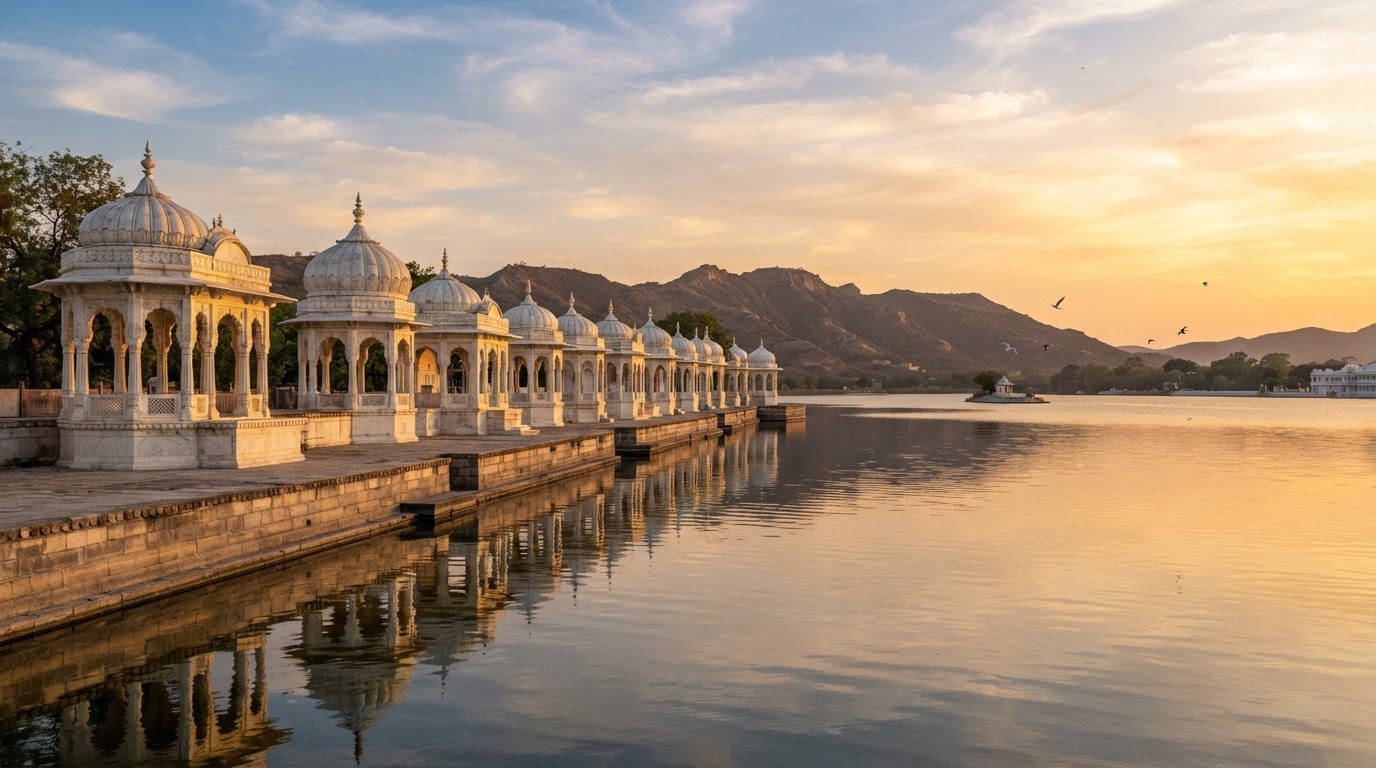
There is an old story they tell in Ajmer, and it begins with a jug of water.
A tired traveller from Persia had just arrived with a small band of followers and camped by the city’s great lake. When they went down to fill their vessels, the guards turned them away. According to tradition, the traveller asked one companion to fill just one small water-skin. As it filled, the whole lake ran dry. Only when the people of Ajmer came asking for mercy did he pour it back.
The traveller was Hazrat Khwaja Moinuddin Hasan Chishti, Khwaja Gharib Nawaz (Rehmatullah Alaih). The lake was Ana Sagar. In short: Ana Sagar is a man-made lake built by the Chauhan king Arnoraja around 1135–1150 CE, about 2 km from Ajmer Junction. Around it lie the Mughal marble pavilions of Shah Jahan, the hillside cave where Khwaja Sahib first prayed, and, a short ride away, an 800-year-old mosque and Akbar’s fort. If you come for the 815th Urs in December 2026, these are the places that turn a pilgrimage into a journey through Ajmer’s history.
Old Ajmer at a glance
| Place | Built | Why go |
|---|---|---|
| Ana Sagar lake | c. 1135–1150 CE, by Arnoraja Chauhan | Sunsets, boat rides, the oldest landmark of the city |
| Baradari pavilions | 1637 CE, by Shah Jahan | White marble arches over the water |
| Daulat Bagh | Laid out by Jahangir (r. 1605–1627) | A Mughal pleasure garden, now a city park |
| Chilla of Khwaja Sahib | Early 13th century (tradition) | The cave where he is said to have first prayed in Ajmer |
| Adhai Din Ka Jhonpra | 1192–1199 CE | One of India’s oldest surviving mosques, 500 m from the Dargah |
| Akbari Fort and Museum | 1570 CE, by Akbar | Where Jahangir received England’s first ambassador |
Who built Ana Sagar, and why does it matter?
Long before Ajmer was famous for its Dargah, it was a Chauhan capital in a dry land. Its rulers needed water. So in the first half of the 12th century, Arnoraja, also called Anaji, the grandfather of the better-known Prithviraj Chauhan, raised an embankment across a small river. Some sources name it the Luni; the historian Har Bilas Sarda identified it with the Bandi, which becomes the Luni further down. The water that collected behind the dam became Ana Sagar, “the sea of Ana”.
It is not a deep lake, only about 4.4 metres at its deepest, but it is wide, spreading over roughly 13 km of shoreline with the Aravalli hills around it. India’s tourism ministry calls it one of Asia’s oldest artificial lakes. For nearly nine centuries it has been the city’s main pool of water, and it still fills with the monsoon rains.
The water story: what tradition says, and what historians ask
The story of the jug is one of the best-loved in Ajmer. Versions differ in the details. Some say the guards were posted by the ruler’s men; others say local priests complained. One telling names the companion who carried the water-skin as Shadi Dev, later known as Saadi. In every version, the lake empties into a small vessel and is returned only when the people ask for forgiveness.
It is fair to read this as a story of tradition, not a record of history. Some historians question whether Khwaja Sahib even reached Ajmer while Prithviraj Chauhan was still ruling. But the early Chishti biography Siyar al-Auliya does say he took up residence by the Ana Sagar when he arrived. The lesson the story has always carried is the one Khwaja Sahib lived by: he did not punish the city that turned him away. He gave the water back.
Did you know? On the bank of the same lake is Rishi Udyan, where, according to his wishes, the ashes of the Hindu reformer Swami Dayanand Saraswati were scattered after he died near Ajmer. One lake, many faiths: very Ajmer.
The cave where Khwaja Gharib Nawaz first prayed
On a hill in the Rishi Valley near the lake is a small cave known as the Chilla of Khwaja Sahib (a chilla is a place of spiritual retreat, often of forty days). According to popular belief, this is where Khwaja Gharib Nawaz first stayed and prayed after his long journey from Sanjar, before settling where the Dargah stands today.
Its custodian, Syed Iqbal Chishti, told ETV Bharat that the saint chose the cave near Ana Sagar for his prayers when he reached the city. The entrance is so low that every visitor has to bow to get in, which pilgrims say feels like a lesson in humility. Inside, there are stone formations shaped like falling drops. Local tradition calls it the “weeping mountain”, saying the hill shed tears when Khwaja Sahib left it for the city below.
It is a quiet place compared with the Dargah, and many Urs pilgrims never hear of it. If you go, keep the same adab (good manners) you would keep at the Dargah, and remember that every Dua is made to Allah alone.
Shah Jahan’s marble pavilions on the water
The Mughals loved Ajmer because of Khwaja Sahib, and they left their mark on the lake. Emperor Jahangir, who lived in Ajmer for about three years, laid out a royal garden on the lakeside called Daulat Bagh. His son Shah Jahan went further. In 1637 he built a row of five white marble pavilions, the Baradari, on the old embankment between the garden and the water.
Stand under those arches at sunset and you understand why. The light turns the marble gold, the hills go blue, and the whole lake glows. It is the same emperor who gave the Dargah its Shahjahani Masjid and gate; you can read about that in why Mughal emperors walked to Ajmer.
- Timings: the Incredible India site lists 8 am to 8 pm.
- Boats: boats and water scooters leave from the east side of Daulat Bagh for the small island in the lake.
- Best light: the last hour before sunset.
Adhai Din Ka Jhonpra: the mosque 500 metres from the Dargah
Walk up from the Dargah bazaar and within about 500 metres you reach one of the oldest mosques in India. Its name is a puzzle: Adhai Din Ka Jhonpra, “the shed of two and a half days”.
Here are the facts historians agree on. Work began in 1192 CE under Qutbuddin Aibak, after Muhammad Ghori’s victory, and an inscription dates its completion to 1199 CE. Another inscription, from Dhu al-Hijjah 596 AH (1200 CE), names Abu Bakr of Herat as the man who supervised the building. Around 1213 CE, Sultan Iltutmish added the great screen of arches carved with Quranic calligraphy that visitors photograph today. The Archaeological Survey of India notes it was built from the remains of earlier temples, and it is now the oldest surviving monument in Ajmer.
And the name? A popular legend says part of it was raised in two and a half days. The ASI’s explanation is plainer: a fair, or an Urs, once lasted two and a half days at the site. Some Sufis give it a third meaning, that a human life on earth is itself only two and a half days long. Of the three, that is the one worth carrying home.
Akbar’s Fort: where England first met the Mughals
In the middle of the old city stands a squat, strong building that locals still call the “Magazine”. It was built by Emperor Akbar in 1570 as a place to stay on his journeys to the Dargah. His son Jahangir lived here from 1613 to 1616.
It was here, according to the Archaeological Survey of India, that Sir Thomas Roe, ambassador of King James I of England, presented his credentials to Jahangir on 10 January 1616. Roe’s talks with the emperor opened the door to English trade in India, and, in time, to everything that followed. When the British took Ajmer in 1818 they turned the fort into an arsenal, which is where the name “Magazine” comes from. Since 1908 it has housed a museum, now called the Government Museum or Rajputana Museum, with sculpture, coins and old armour.
Did you know? The journey that ended with the British Raj arguably began in a room built so that a Mughal emperor could visit Khwaja Gharib Nawaz.
A simple half-day route for Urs pilgrims
- Morning: Fajr and ziyarat at the Dargah, when the crowds are thinnest.
- Mid-morning: walk up to Adhai Din Ka Jhonpra (entry is free).
- Late morning: auto-rickshaw to Akbar’s Fort and the museum in the old city.
- Afternoon: the Chilla of Khwaja Sahib near the lake.
- Sunset: the Baradari on Ana Sagar, then back to the Dargah for the evening qawwali.
With more time, add the hilltop shrine of Miran Sahib on Taragarh and the quieter Foy Sagar lake, built in the late 19th century. December is the best season, with warm days and cold nights; our Ajmer Urs travel guide covers trains, stays and crowd tips. On the busiest Urs days, especially Chhati Sharif, save the sightseeing for before or after.
The lesson by the lake
Ajmer is a city of layers. A Chauhan king’s lake, a Sultan’s mosque, an emperor’s fort, an English ambassador’s audience. Kings built all of them, and kings came and went. The one name that still draws lakhs of people to this city every Rajab belongs to a man who owned almost nothing, slept in a cave by the water and, the story goes, gave back the lake to those who had refused him a drink. That is the heritage of Ajmer worth taking home. Read more about his life in Khwaja Gharib Nawaz: life, teachings and the Ajmer Dargah.
Frequently asked questions
Who built Ana Sagar lake in Ajmer?
Arnoraja (Anaji) Chauhan, the grandfather of Prithviraj Chauhan, built it around 1135–1150 CE by damming a small river. The marble Baradari pavilions were added by Shah Jahan in 1637.
How far is Ana Sagar from Ajmer Dargah?
It is a short auto-rickshaw ride, roughly 2 km from Ajmer Junction railway station and a little further from the Dargah through the old city.
What is the Chilla of Khwaja Gharib Nawaz?
It is a small cave on a hill near Ana Sagar where, according to tradition, Khwaja Gharib Nawaz first stayed and prayed after reaching Ajmer, before settling at the site of today’s Dargah.
Why is it called Adhai Din Ka Jhonpra?
The name means “shed of two and a half days”. Legend says part of it was built in that time; the ASI links the name to a two-and-a-half-day fair once held there.
Related: Ajmer Urs 2026 dates · A walk through Ajmer Dargah · Great Sufi saints of India
Sources: Ana Sagar Lake (Wikipedia); Incredible India: Ana Sagar Lake; ETV Bharat: Khwaja Garib Nawaz’s Chilla; Adhai Din Ka Jhonpra (Wikipedia); ASI Jaipur Circle: Magazine Building, Ajmer; Britannica: Ana Sagar.
Read Next
 Bibi Hafiz Jamal: The Only Daughter of Khwaja Gharib NawazNov 29, 2026
 Ibn al-Baitar (Ibn al-Bayṭār): The Málaga Herbalist Who Wrote a Giant Book on 1,400 RemediesNov 27, 2026
 Haji Ali Dargah, Mumbai: History, Timings, Urs and How to Reach the Sea ShrineNov 27, 2026
 The Hilltop Martyr Above Ajmer Dargah: Miran Sahib of TaragarhNov 27, 2026
Most Read
Follow Ruhani Dua on Facebook for short videos and reminders. / रूहानी दुआ को Facebook पर Follow करें।
Discover more from ImranJalna
Subscribe to get the latest posts sent to your email.







Leave a Reply