

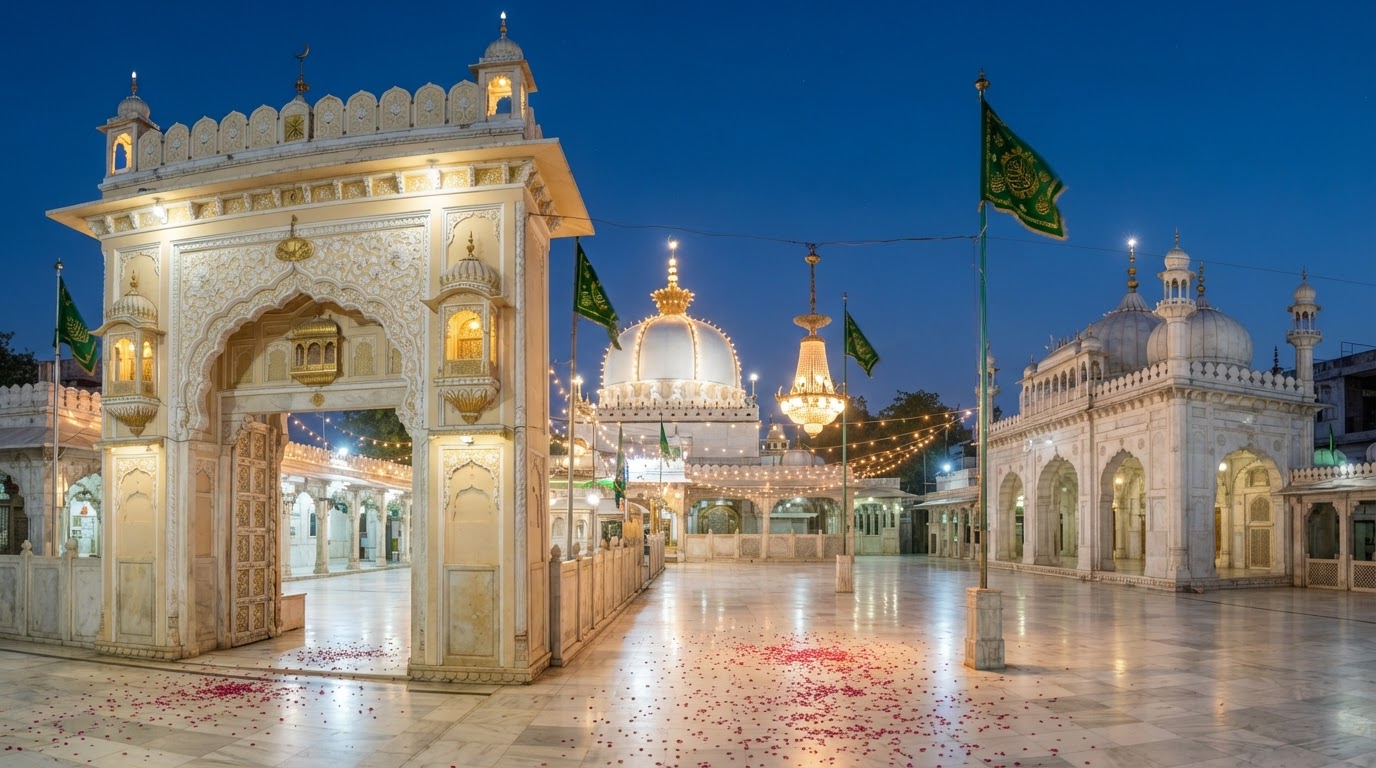
You hear the Dargah before you see it. Somewhere in the narrow lanes of old Ajmer a qawwal’s harmonium starts up, flower sellers call out over baskets of red roses, and the air smells of rosewater and itr (attar perfume). Then the lane opens out, and a tall pale-yellow gateway rises above the bazaar, covered in white floral plasterwork.
That is the Nizam Gate, the front door of the shrine of Hazrat Khwaja Moinuddin Chishti, Khwaja Gharib Nawaz, Rehmatullah Alaih (RA). The Ajmer Dargah was not built in one go. It began in 1236 as a simple grave, and over eight centuries sultans of Malwa, Mughal emperors, a Mughal princess, a Nizam of Hyderabad and even a British queen added gates, mosques, halls and tanks around it. This guide walks you through it in the order most pilgrims do, and tells you who built what.
Quick facts: who built what at Ajmer Dargah
| Structure | Built or gifted by | Date |
|---|---|---|
| Nizam Gate | Mir Osman Ali Khan, 7th Nizam of Hyderabad | 1911 (some guides say 1915) |
| Shahjahani Gate | Emperor Shah Jahan | 17th century |
| Akbari Masjid | Emperor Akbar | c. 1571 |
| Buland Darwaza | Sultan Mahmud Khalji of Malwa | 15th century |
| Badi and Chhoti Deg | Akbar and Jahangir | 1568 and 1614 |
| Mehfil Khana | Gift from Hyderabad | 1888 |
| Dome over the tomb | Recorded in a gold inscription | 1532 |
| Jami (Shahjahani) Masjid | Emperor Shah Jahan | 1637 |
| Begumi Dalan | Princess Jahanara | 1643 |
| Sandali Masjid | Emperor Aurangzeb | 17th century |
Stop 1: The Nizam Gate and the drum house
The complex has eight gates, but only three are in regular use, and the main one is the Nizam Gate. It was gifted by Mir Osman Ali Khan, the seventh and last Nizam of Hyderabad, in the early 20th century. Outlook Traveller puts its height at about 70 feet above the bazaar. Its yellow face and floral designs make it the most photographed spot in Ajmer.
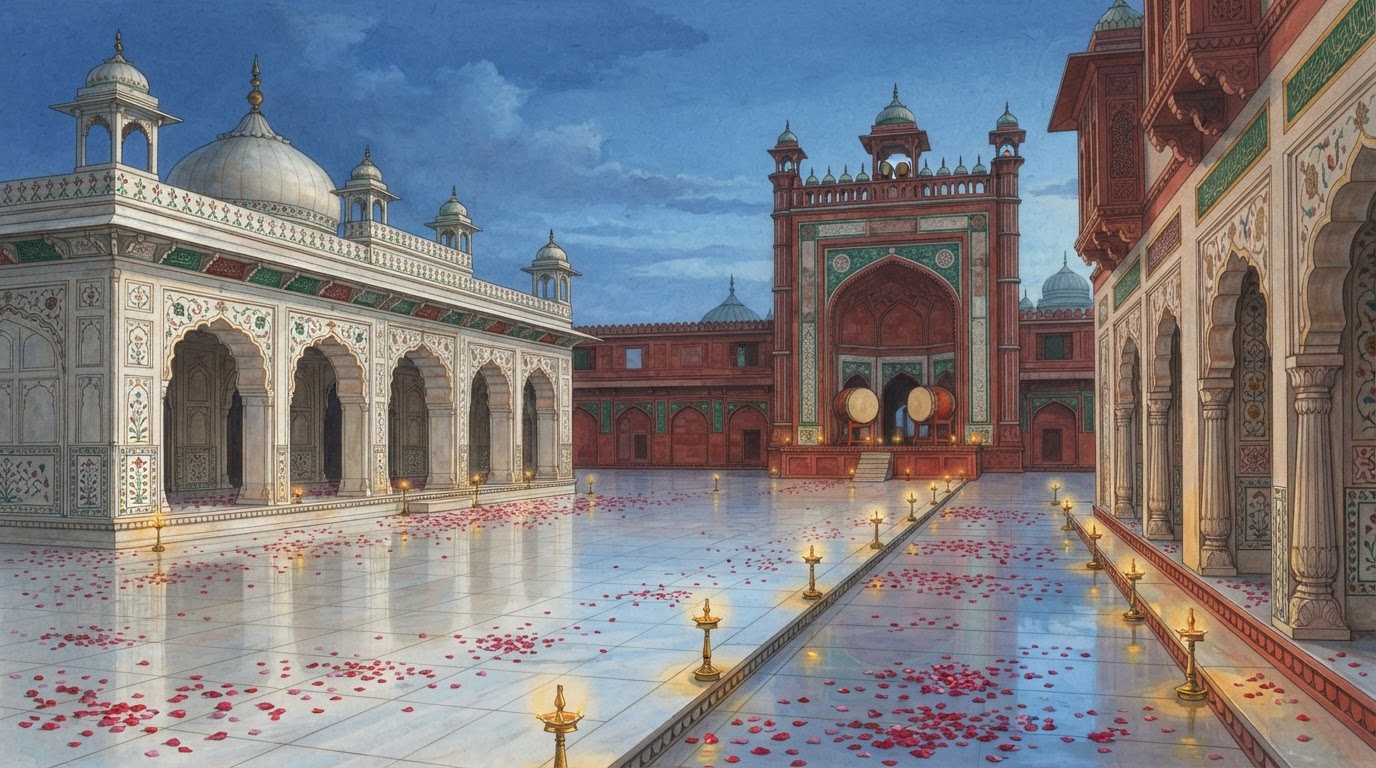
Just inside is the Naqqar Khana (drum house). In earlier centuries, music was played from here to welcome visitors. The big ceremonial drums still sound on special occasions, including moments of the Urs. Before you go in, you leave your shoes at a stall near the entrance, as at any Masjid.
Stop 2: Shah Jahan’s gate and Akbar’s red Masjid
The Nizam Gate leads to the older Shahjahani Gate, a gift of Emperor Shah Jahan. It marks the point where the shrine grew outward in Mughal times, beyond its original entrance.
To the right, steps climb to the Akbari Masjid, built around 1571 in red sandstone with green and white touches. Emperor Akbar built it during the years he kept walking from Agra to Ajmer. Today it is a madrasa (Islamic school) for Arabic and Persian. Read why the Mughals loved this place in Why Mughal Emperors Walked to Ajmer.
Stop 3: The Buland Darwaza, older than the Mughals
Straight ahead stands the Buland Darwaza (High Gate). Many visitors assume it is Mughal. It is not. It was built by Sultan Mahmud Khalji of Mandu, ruler of the Malwa Sultanate, in the 15th century. Live History India dates his major additions to the shrine to 1455.
This is the gate where the Urs begins. Every year a flag is raised on top of it by the Gauri family of Bhilwara, a tradition we told in The Flag That Opens the Ajmer Urs. On either side of the gate sit the two giant cauldrons gifted by Akbar and Jahangir, still used to cook sweet rice for thousands. Their story is in The Mughal Cauldrons That Still Feed Thousands.
Did you know? In front of the cauldrons hangs the Sahn Chirag, a great courtyard lamp commissioned by Akbar. Another large silver chandelier in the complex is said to be a gift from the Golden Temple in Amritsar.
Stop 4: The hall of qawwali and the kitchen of the poor
Past the Buland Darwaza, two buildings face each other like a lesson in Chishti values. On the right is the Mehfil Khana, a square hall built in 1888 with a beautifully patterned ceiling. It opens only for the Urs, when the qawwals sing until dawn. Step inside it with us in The Hall Where Ajmer’s Urs Qawwali Plays Until Dawn.
On the left is the Langar Khana, where free food is served. Music for the soul on one side, bread for the body on the other: both were at the heart of Khwaja Gharib Nawaz’s way.
Did you know? When Queen Mary visited the Dargah in 1911, she gave Rs 1,500 to repair and roof the water tank in front of the Mehfil Khana. Pilgrims still call it the Victoria Tank.
Stop 5: Aurangzeb’s Masjid and the graves around the saint
The inner compound begins with the Sandali Masjid, built by Emperor Aurangzeb. From here a path leads past several graves of people who lived close to the saint or loved him.
- Bibi Hafiz Jamal (RA), the daughter of Khwaja Gharib Nawaz, rests in the women’s enclosure to the south of the tomb.
- Nizam Sikka, a water-carrier, is buried here too. Popular history says he saved Emperor Humayun from drowning, and was rewarded with the throne for half a day.
- Princess Gaiti Ara, a young daughter of Shah Jahan, lies beside the silver Jannati Darwaza, the gate that opens just four times a year.
In all, eight tombs stand around the saint’s own, and more than forty graves lie behind the Jami Masjid.
Stop 6: Under the dome with the golden crown
Now you reach the heart of it all, the Ihaata-e-Noorani (the Enclosure of Light). Above the Mazar rises the white marble dome that you saw from the lanes. On the northern wall, an inscription in golden letters records the year 1532, the first firm date historians have for building work at the tomb. The dome is topped by a lotus and a gold crown, gifted by Nawab Haider Ali Khan of Rampur.
Inside, the grave sits under a silver chaparkhat (canopy) inlaid with mother-of-pearl, gifted by Emperor Jahangir and held up by four silver posts. A silver railing surrounds it, and a second silver railing stands about two feet further out. Akbar rebuilt the sanctum in 1579, and the walls were gilded in 1888. The ceiling is hung with velvet. Pilgrims enter with roses and chadars (ceremonial cloths), offer them, make Dua and move on, gently guided by the khadims (hereditary attendants).
East of the tomb is the Begumi Dalan, the porch Princess Jahanara built in 1643 so that Mughal women could pray close to the saint. Her full story is in our Mughal article.
Did you know? During the Urs, the rose petals offered at the Mazar can reach as much as seven tonnes in a single day.
Stop 7: Shah Jahan’s white marble Masjid
West of the tomb stands the Jami Masjid, better known as the Shahjahani Masjid. Shah Jahan commissioned it in 1637 in white marble. It is the most elegant building in the complex: long, low, calm, with a Persian inscription along its facade. On a Friday during the Urs, the courtyard in front of it fills wall to wall for Namaz-e-Jumma.
Stop 8: Aulia Masjid and the Jhalra
Before you leave, look for the Aulia Masjid, one of the smaller Masjids of the complex, and walk down to the Jhalra on the southern side. The Jhalra is a natural water tank, and pilgrims have used its water for wudu (the washing before prayer) for centuries. Shah Jahan also gave a tank to the complex.
Behind it all rises Taragarh Hill. The whole Dargah sits at its foot, which is why the lanes climb as you walk deeper into the old city.
Practical tips for your visit
- Cover your head. Men and women both cover their heads inside. Scarves and caps are sold everywhere outside.
- Leave bags behind. Bags and large items go to a cloakroom near the gate for a small fee.
- Women are welcome inside the Dargah, unlike at some shrines.
- Go early during the Urs. Crowds near the Nizam Gate are heaviest after Maghrib and on Chhati Sharif.
- Check the dates first. Our Ajmer Urs 2026 dates page has the latest flag, moon and Chhati Sharif dates.
The lesson: everything grew around a simple grave
Walk the whole complex and one thing stands out. The gates got taller, the marble got finer, the gifts got richer. But at the centre there is still just the grave of a man who owned almost nothing, ate simple food and spent his life serving the poor of Ajmer.
Sultans and emperors came and went. Their palaces are museums now. What they built at Ajmer has survived because they built it for him. Read more about his life and teachings in our profile of Khwaja Gharib Nawaz.
Frequently asked questions
Who built the Ajmer Dargah?
No single ruler built it. The saint’s grave dates from 1236. The Malwa sultans built the Buland Darwaza in the 15th century, the dome dates to 1532, the Mughals added mosques, gates and the cauldrons, and the Nizam of Hyderabad gifted the main gate in the 20th century.
How many gates does Ajmer Dargah have?
Eight, of which three are in regular use. The main entrance is the Nizam Gate. Others include the Shahjahani Gate, the Buland Darwaza, the Madar Gate, the Delhi Gate and the silver Jannati Darwaza.
Is the Buland Darwaza at Ajmer the same as the one at Fatehpur Sikri?
No. Fatehpur Sikri’s Buland Darwaza was built by Akbar. The one at Ajmer is older, built by Sultan Mahmud Khalji of Malwa in the 15th century, and it is where the Urs flag is raised.
When is the Mehfil Khana open?
Only during the Urs, when it hosts the nightly Mehfil-e-Sama (qawwali gatherings). For the rest of the year it stays closed.
Related: Ajmer Urs 2026 dates · The Jannati Darwaza · The Badi Deg and Chhoti Deg · The Mughals at Ajmer · Great Sufi saints of India
Sources: Live History India: Dargah Ajmer Sharif, A Shrine for Kings and Commoners; Ajmer Sharif Dargah (Wikipedia); Outlook Traveller: Ajmer, A Matter of Faith; Rana Safvi: In the Chishti Dargah in Ajmer (The Hindu); Incredible India: Ajmer Sharif
Follow Ruhani Dua on Facebook for short videos and reminders. / रूहानी दुआ को Facebook पर Follow करें।
Discover more from ImranJalna
Subscribe to get the latest posts sent to your email.








Leave a Reply