

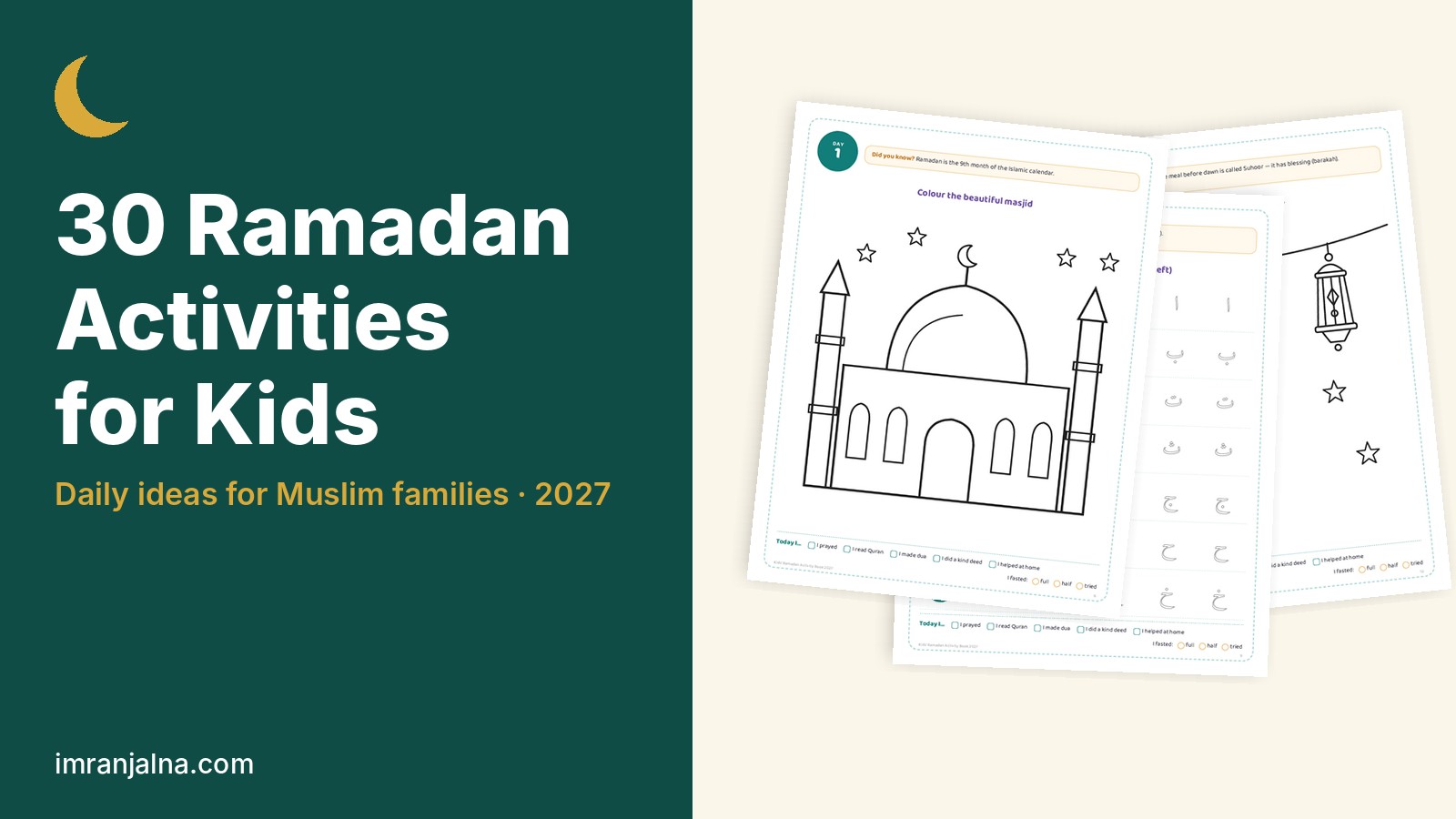
Ramadan 1448 AH is expected to begin around 8 February 2027, depending on the sighting of the moon. For children, Ramadan is not only about fasting. It is the month when they first fall in love with the masjid, the Quran, iftar with the family and the excitement of Eid. The best way to help them is to give them one small, joyful thing to do every day.
Below are 30 simple Ramadan activities for kids, one for each day of the month. Most need nothing more than paper, crayons and a little time after Asr or before iftar. They work for children aged 4 to 12; younger children can do the easier half of each idea with a parent.
Before Ramadan: set up three things
- A good-deeds chart on the fridge with 30 boxes. Your child adds a star every day they finish the day’s activity.
- A Ramadan corner: a small table or shelf with a prayer mat, a children’s Quran or story book, and a jar for sadaqah coins.
- A fixed time: 15 to 20 minutes each day, for example after Asr. Children love routines more than surprises.

Week 1 (Days 1–7): Learning what Ramadan is
- Moon watching. On the evening before Ramadan, go outside and look for the new crescent together. Explain that the Islamic months begin with the new moon.
- Why we fast. Read the meaning of Quran 2:183 together: fasting was prescribed so that we may gain taqwa (consciousness of Allah). Ask, “What does taqwa mean to you?”
- Colour a masjid. Print or draw a masjid with a dome and minarets and let your child colour it. Talk about your local masjid and who they see there.
- The month of the Quran. Explain that the Quran was revealed in Ramadan (Quran 2:185). Show them a mushaf and let them hold it with clean hands.
- Make a paper lantern. Fold coloured paper into a simple fanoos (lantern) and hang it in the Ramadan corner.
- Learn the meaning of suhoor. The Prophet ﷺ said: “Take suhoor, for in suhoor there is blessing” (Sahih al-Bukhari 1923). Let your child help set the suhoor table once this week.
- Fasting from dawn to sunset. Draw a sun rising and setting. Explain that fasting lasts from Fajr until Maghrib (Quran 2:187). Younger children can try a “half fast” until Zuhr.
Week 2 (Days 8–14): Kindness and good deeds
- The smile challenge. The Prophet ﷺ said that smiling at your brother is charity (Jami at-Tirmidhi 1956). Count how many people your child smiles at today.
- Iftar helper. Your child sets out the dates and water for iftar.
- Food for a neighbour. Pack a small plate of iftar food and carry it to a neighbour together.
- The sadaqah jar. Every coin they put in the jar this month will go to someone in need before Eid.
- Thank-you cards. Make cards for the imam, the muezzin, a teacher or the watchman of your building.
- A tidy-up deed. Help clean the Ramadan corner or the prayer area at home without being asked.
- Kind words day. No complaining for one whole day. Every time they catch themselves, they say “Alhamdulillah” instead.
- Count your blessings. Write or draw ten things they are grateful for, and talk about children who do not have them.
Week 3 (Days 15–21): Duas, Arabic letters and the Quran
- Dua when breaking the fast. Teach: “Dhahaba al-zama’ wabtallatil-‘urooq wa thabatal-ajru in sha Allah”, meaning “The thirst has gone, the veins are moistened and the reward is confirmed, if Allah wills” (Sunan Abi Dawud 2357).
- Trace the Arabic letters. Practise Alif, Ba, Ta, Tha and Jeem, writing from right to left.
- Surah Al-Ikhlas. Learn or revise its four short verses and their meaning: Allah is One.
- Dua before sleeping. Teach “Bismika Allahumma amutu wa ahya”. (See our post on the dua before sleep.)
- Story of Prophet Yunus (AS). Tell the story of the whale and his dua: “La ilaha illa anta, subhanaka, inni kuntu minaz-zalimin” (Quran 21:87).
- Word search. Hide Ramadan words (suhoor, iftar, Quran, masjid, dua, Eid) in a grid for your child to find.
- Dua when leaving home. Teach “Bismillah, tawakkaltu ‘alallah”. Read our short note on the dua for leaving home.

Week 4 (Days 22–30): The last ten nights and getting ready for Eid
- Laylat al-Qadr explained. Read Surah Al-Qadr: this night is better than a thousand months (Quran 97:3).
- The Laylat al-Qadr dua. Teach “Allahumma innaka ‘afuwwun tuhibbul-‘afwa fa’fu ‘anni”, meaning “O Allah, You are Pardoning and love to pardon, so pardon me” (Jami at-Tirmidhi 3513).
- A special night. Let older children stay up a little longer on one of the odd nights for a short prayer and dua with the family.
- Colour the Kaaba. Draw the Kaaba and talk about the people from every country who pray towards it.
- Zakat al-Fitr. Explain that it is given before the Eid prayer so that everyone can celebrate (Sahih al-Bukhari 1503). Let your child hand it over or count the amount with you.
- Open the sadaqah jar. Count the coins together and decide who will receive them.
- Make an Eid card for grandparents, cousins or a friend.
- Eid gift bags. Fill small bags with sweets or stickers for younger cousins or children in the neighbourhood.
- Ramadan Champion certificate. Celebrate everything your child has done this month with a certificate and the full star chart, and pray that Allah accepts it.
Tips for parents
- Keep it short. Fifteen happy minutes are better than an hour of pressure.
- Praise effort, not perfection. A crooked lantern made with love is a good deed.
- Fasting for children is a gentle practice, not a test. Children are not obliged to fast before puberty; let them try part-day fasts if they are healthy and willing, and stop if they feel unwell.
- Do it together. Children copy what they see. Let them see you reading the Quran, making dua and giving charity.
Want all 30 days ready in one book?
If you would rather not prepare pages every day, we have put these ideas into a printed activity book: My Ramadan Activity Book 2027 (Little Noor Series, Rashmi Media House). It has one page for each day of Ramadan with colouring, mazes, word searches, Arabic letter tracing, a 30-day star chart, good-deeds cards, an Eid card and a Ramadan Champion certificate, for ages 5 to 10. Disclosure: this book is published by Rashmi Media House, which is connected to this website.
Looking for story books as well? See our list of the best Islamic books for kids.
Frequently asked questions
When does Ramadan 2027 start?
Astronomical calculations expect Ramadan 1448 AH to begin around 8 February 2027, with Eid al-Fitr around 9 or 10 March 2027. The exact dates in India and other countries depend on the local moon sighting.
At what age should children start fasting?
Fasting becomes obligatory at puberty. Before that, many families let children practise with half-day or weekend fasts so they get used to it gently. Always consider your child’s health, and ask a doctor if your child has any medical condition.
What are easy Ramadan activities for a 4-year-old?
Colouring a masjid or lantern, putting coins in a sadaqah jar, setting out dates for iftar, looking for the moon and learning one short dua are all easy and fun for very young children.
How can I keep my child interested for all 30 days?
Use a visible star chart, keep each activity short, change the type of activity every day (craft, dua, kindness, story) and plan a small celebration with a certificate at the end of Ramadan.
May Allah make this Ramadan a month our children remember with love, and make them among those who love the Quran and the masjid. Ameen.
Follow Ruhani Dua on Facebook for short videos and reminders. / रूहानी दुआ को Facebook पर Follow करें।
Discover more from ImranJalna
Subscribe to get the latest posts sent to your email.








Leave a Reply