

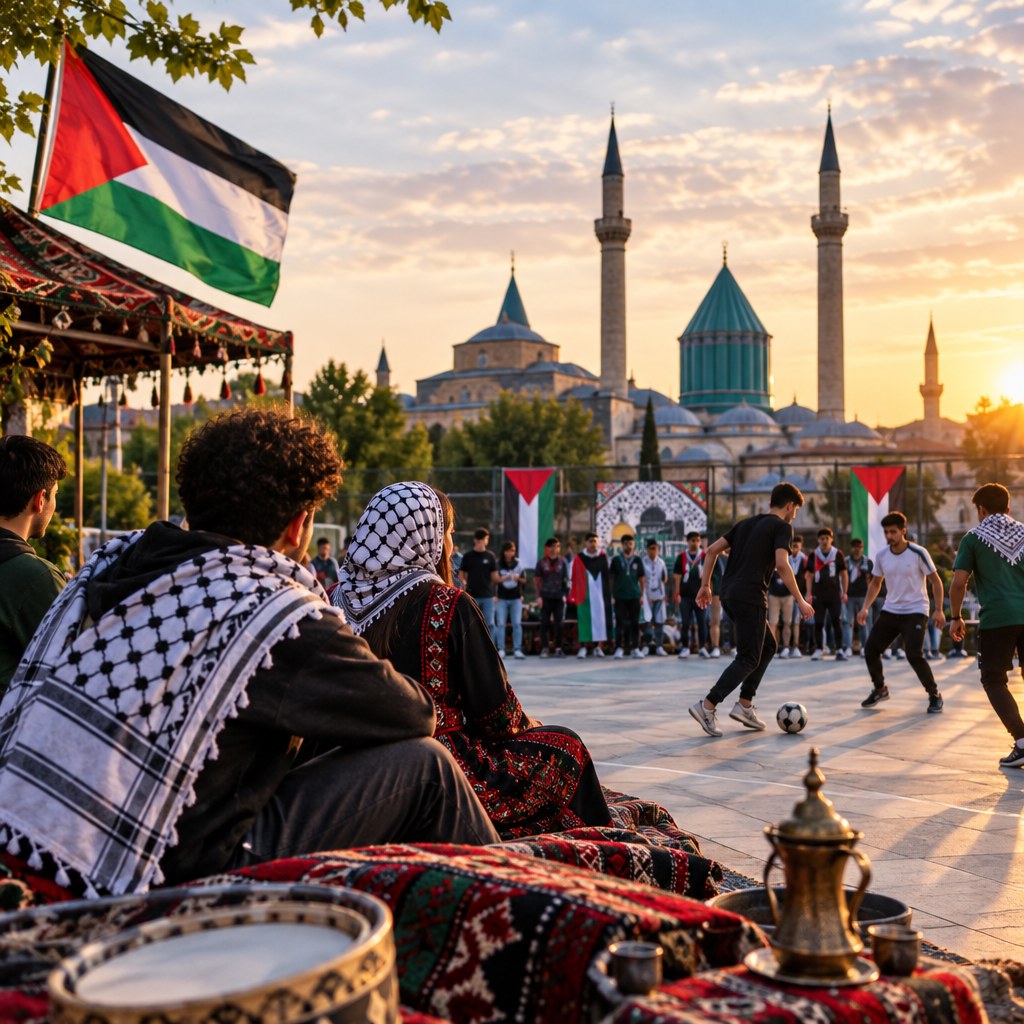
KONYA: The Organisation of Islamic Cooperation has participated in “Palestine Days” in Türkiye’s Konya, bringing Palestinian youth, culture and identity into focus as part of the Konya Youth Capital 2026 programme.
The events ran from September 28 to October 2 under the slogan “Our Home is Your Home,” according to the OIC.
Youth at the centre of the programme
The programme was organised with involvement from Türkiye’s Ministry of Youth and Sports, Konya Metropolitan Municipality and the Islamic Cooperation Youth Forum. Ministers, officials, youth leaders and athletes attended the opening.
The OIC used the platform to underline the importance it attaches to the Palestinian cause and Jerusalem while also focusing on practical issues affecting younger Palestinians.
Entrepreneurship and cultural identity
According to the OIC, its message included support for Palestinian youth empowerment and entrepreneurship, efforts to counter disinformation and the preservation of cultural identity.
These themes are increasingly connected. Young Palestinians use digital platforms for education, business, culture and advocacy, but the same platforms are also arenas for misinformation and contested narratives.
Football as a symbolic element
A friendly match involving the Palestinian national team and Konyaspor formed part of the wider programme. The OIC described the match as symbolically connected to the Palestinian team’s right to play on its homeland.
Sport can give youth-focused diplomacy a public dimension that formal conferences often lack. It can also create cultural contact between communities outside official political negotiations.
Why Konya Youth Capital matters
Youth Capital programmes are designed to bring together young people from different OIC member states around education, culture, leadership and cooperation. Hosting a Palestine-focused programme within that framework connects Palestinian concerns with a wider generation of Muslim youth.
Combating disinformation
The OIC’s reference to disinformation is especially relevant in the current media environment. Images, casualty claims, political statements and videos related to Palestine can spread globally within minutes, sometimes stripped of their original context.
For readers, the practical lesson is to check dates, locations and primary sources before forwarding viral material, even when a post appears to support a cause they care about.
Culture alongside politics
Palestine is often covered internationally mainly through war and diplomacy. Cultural programmes offer a different perspective by highlighting identity, sport, entrepreneurship and youth aspirations.
That does not remove the political reality, but it can prevent Palestinian society from being represented only through conflict.
What comes next
The OIC delegation also held bilateral meetings on the sidelines to discuss cooperation on youth empowerment among member states. The long-term impact will depend on whether cultural events lead to sustained educational, entrepreneurial and institutional opportunities.
Why youth diplomacy matters
Palestinian politics is often discussed through governments, armed groups and international negotiations. A youth programme changes the frame by focusing on education, entrepreneurship, sport and cultural identity. Those areas affect how a younger generation imagines its future even when the political environment remains deeply unstable.
The event’s slogan, “Our Home is Your Home,” was designed to emphasise solidarity. The friendly football match gave that message a public and accessible form, reaching audiences who may not follow formal OIC meetings.
Entrepreneurship as resilience
Supporting entrepreneurship can give young Palestinians tools to build livelihoods, especially where movement restrictions and economic disruption make conventional employment difficult. Training, digital commerce and professional networks can help, although no youth programme can substitute for broader political and economic stability.
The disinformation challenge
The OIC explicitly included combating disinformation among its priorities. Related reading: eight Muslim-majority nations’ joint position on Gaza, Jerusalem and Palestinian statehood. That is significant because Palestine-related content is among the most intensely shared material online. Old videos can be relabelled, casualty claims can circulate before verification, and emotionally powerful posts can outrun corrections.
Young creators therefore need more than advocacy skills; they also need verification habits. Checking the original uploader, date, location and independent reporting protects credibility and prevents supporters from unintentionally spreading false information.
Preserving identity through culture
Cultural identity is not limited to political slogans. Language, food, music, embroidery, literature, family memory and sport all carry Palestinian heritage. Youth-focused cultural programmes can preserve those traditions while allowing younger Palestinians to present their own stories rather than being represented only by outsiders.
What would make the programme meaningful
The real measure will come after the ceremonies. Scholarships, business networks, mentoring, exchanges and sustained institutional partnerships would give the event longer-term value. The bilateral meetings held on the sidelines suggest that organisers want youth empowerment to continue beyond a single week in Konya.
Why international exposure can matter
For young participants, international programmes can create contacts that continue after the event through universities, civil-society organisations, sports networks and businesses. Those relationships may be particularly valuable for Palestinian youth whose mobility and economic opportunities can be constrained.
At the same time, organisers should avoid reducing participants to symbols of conflict. Youth empowerment is strongest when young people are treated as students, entrepreneurs, athletes and creators with agency of their own. The Konya programme’s combination of sport, culture and entrepreneurship offers a broader frame than crisis-focused discussion alone.
Source: Organisation of Islamic Cooperation.
Discover more from ImranJalna
Subscribe to get the latest posts sent to your email.








Leave a Reply