

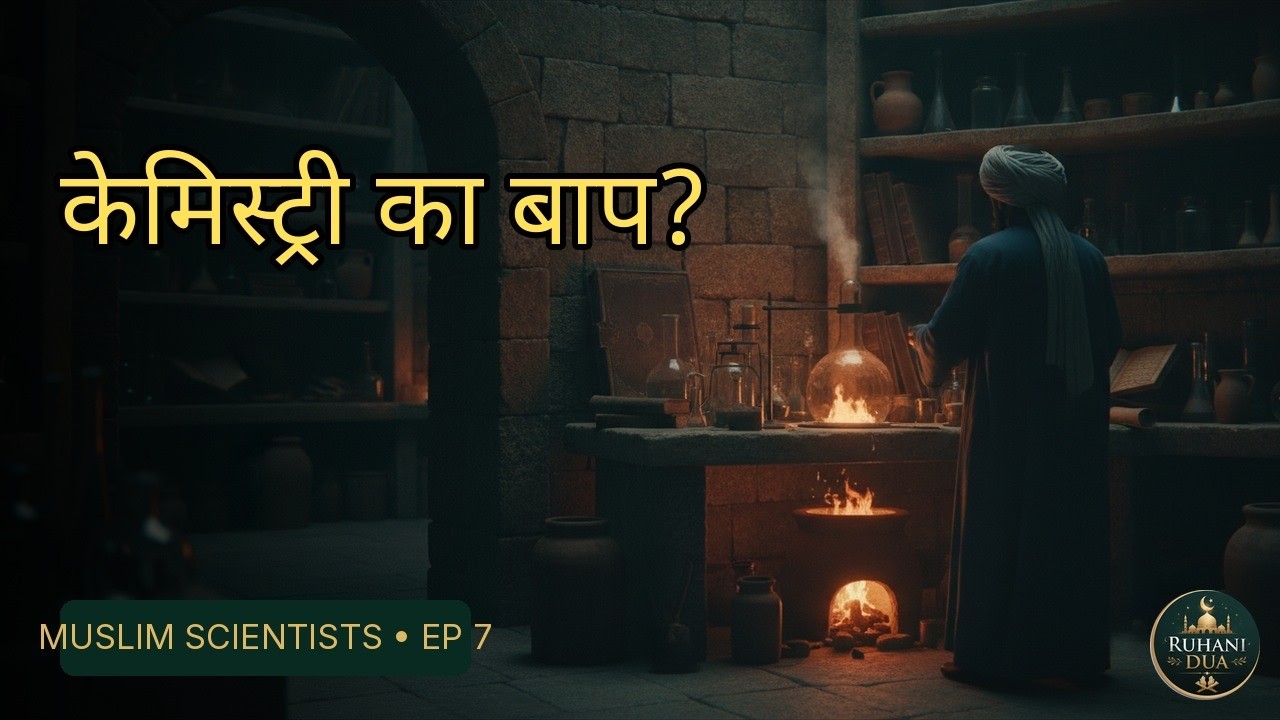
Jabir ibn Hayyan (died c. 806–816) is traditionally called the “father of chemistry” because the Arabic works attributed to him contain some of the oldest known systematic classifications of chemical substances and laboratory methods. However, modern historians doubt that one man wrote all of them: many believe the “Jabirian corpus” was composed or edited between c. 850 and c. 950, and some question whether Jabir existed at all.
| Quick facts | Details |
|---|---|
| Who | Abu Musa Jabir ibn Hayyan, Latinised as “Geber” |
| When | Died c. 806–816 according to late reports; works tentatively dated c. 850–950 by many modern scholars |
| Where | Said by Ibn al-Nadim to be from Khurasan but to have spent most of his life in Kufa (Iraq) |
| What | About 600 Arabic works are attributed to him by name; roughly 215 survive |
| Main ideas | Sulfur-mercury theory of metals, “science of the balance,” early organic chemistry |
| Key debate | Single author, a school of writers, or a core text expanded later? |

Watch the full video: जाबिर इब्न हय्यान: केमिस्ट्री के जनक | Jabir ibn Hayyan Documentary | Muslim Scientists Ep 7 on the Ruhani Dua YouTube channel.
What do we actually know about Jabir ibn Hayyan’s life?
Very little can be confirmed. The Baghdad bibliographer Ibn al-Nadim compiled a list of Jabir’s works in his Fihrist, written in 987, and he is the first author to write about Jabir from a biographical angle. According to Ibn al-Nadim, Jabir came from Khurasan but spent most of his life in Kufa. Jabir was generally known by the kunya Abu Musa and by attributive names such as al-Azdi, al-Kufi and al-Tusi, which hint at Kufa, the Azd tribe and the city of Tus.
Because independent biographical sources are scarce, it is not clear whether Jabir ever existed as a historical person. Later stories about him, such as being a favourite of Caliph Harun al-Rashid, first appear centuries afterwards, and historians treat them as traditional rather than proven. Even in Ibn al-Nadim’s own time some people said Jabir never existed, though Ibn al-Nadim disagreed.
Why is he called the father of chemistry?
The title rests on the content of the Jabirian writings. According to the scholarship summarised on Wikipedia, the works attributed to Jabir contain the oldest known systematic classification of chemical substances, and the oldest known instructions for making an inorganic compound (sal ammoniac, or ammonium chloride) from organic substances such as plants, blood and hair.
Three ideas stand out:
- Sulfur-mercury theory. Metals were thought to form in the earth from sulfur and mercury, with the quality of the sulfur deciding which metal results. The theory was first attested in an earlier Arabic text and adopted by the Jabirian authors; it shaped ideas about metals until the 18th century.
- The science of the balance (ʿilm al-mizan). An attempt to reduce all phenomena to measures and quantitative proportions.
- Organic substances in the lab. Greek alchemical texts focused almost entirely on minerals, whereas Jabirian alchemy pioneered the use of vegetable and animal substances.
It is important to be precise: this was alchemy as well as early chemistry. The same corpus also deals with the search for an “elixir” to transform metals, and with talismans and other topics that modern chemistry does not accept. Calling Jabir the “father of chemistry” is a popular summary, not a settled scholarly verdict.
Who really wrote the Jabirian books?
This is the heart of the debate the video raises. Paul Kraus, whose pioneering work on the corpus began in the early twentieth century, showed that the several hundred works ascribed to Jabir were probably a mixture from different hands, mostly dating to the late ninth and early tenth centuries. His catalogue and analysis, Jabir ibn Hayyan: Contribution à l’histoire des idées scientifiques dans l’Islam (1942–1943), remains the standard reference.
Others push back. Syed Nomanul Haq has warned that arguments for many authors that lean on Kraus’s large estimate of the corpus’s size deserve suspicion. Another point in the debate: many Jabirian treatises show signs of being edited more than once, so the texts we have may rest on an earlier 8th-century core, and it is not impossible that some began with a real Jabir. Historians therefore disagree, and a careful summary is that the corpus is real and important, while its authorship and dating remain debated.
How did “Geber” reach Europe?
Some Arabic Jabirian works were translated into Latin under the name Geber. One example is the Book of Seventy, which Gerard of Cremona (c. 1114–1187), a prolific translator at Toledo, rendered as the Liber de Septuaginta. Separately, historians use “pseudo-Geber” for the later 13th–14th century Latin writings issued under Jabir’s name, so not every book labelled “Geber” goes back to the Arabic corpus. Researchers such as Ahmad al-Hassan argue that more of the Latin works have Arabic roots than most scholars accept, which is another open question.
What does Islam say about seeking knowledge?
Whatever the answer to the authorship puzzle, the Muslim scientific tradition grew in a culture that valued learning. The Quran teaches the believer to ask Allah directly for more knowledge:
وَقُل رَّبِّ زِدْنِى عِلْمًا
“…and say, ‘My Lord, increase me in knowledge.'” (Surah Taha 20:114)
In Surah Az-Zumar, Allah asks: “Are those who know equal to those who do not know?” (Surah Az-Zumar 39:9), and the same ayah says that only people of understanding take heed.
The Prophet ﷺ also encouraged the search for knowledge. Abu Hurayrah (RA) reported that he said, “Whoever travels a path in search of knowledge, Allah will make easy for him a path to Paradise.” (Sahih Muslim 2699). In Sahih al-Bukhari 71, Muawiya (RA) heard him say that when Allah wants good for a person, He makes him understand the religion. These texts honour sincere learning in general. They do not say that any particular scientist or discovery is guaranteed to be correct.
What this means for you
When you meet a famous claim about Muslim history, check it the way Muslim scholars checked reports: ask who first said it, when, and on what evidence. Ibn al-Nadim himself recorded the doubts of his day. That habit of honest verification is itself part of the tradition.
Lessons for us today
- Make dua for knowledge. Surah Taha 20:114 gives a short supplication you can say before study or work.
- Respect evidence. Say plainly what is known (the corpus exists, its methods influenced later science) and what is disputed (who wrote it).
- Intend your learning for Allah. Sahih Muslim 2699 links the journey of learning with Allah easing the path to Paradise.
- Learn without overclaiming. Admiring Muslim scientists does not require exaggerating them.
Frequently asked questions
Was Jabir ibn Hayyan a real person?
Historians are divided. Ibn al-Nadim (c. 932–995) treated him as a real figure, but he is not mentioned in any historical source before c. 900, and many modern scholars doubt that one man wrote the works. Some think a real Jabir may stand behind an early core of the writings.
Did Jabir discover distillation?
The video explains distillation and crystallisation as laboratory methods used in this tradition, but it is safer not to credit a single person with “discovering” them. The Jabirian texts describe many processes and equipment, and they build on earlier Greek and other alchemical traditions as well as adding new ideas.
Is alchemy compatible with Islamic teaching?
Studying the history of alchemy is a matter of understanding the past. The Quran and sahih hadith, however, are the standards for belief and practice, and magic or talismans cannot be justified by Jabirian books. Some medieval thinkers, such as al-Sijistani and al-Tawhidi, rejected alchemy altogether. The video also notes that its narration and visuals are AI-generated.
Read more:
- Thabit ibn Qurra (Thebit): The Harran Scholar Who Found Amicable Numbers
- Al-Farabi (Alpharabius): The Second Teacher Who Built Philosophy in Arabic
Sources:
- Quran 20:114 (Surah Taha) – quran.com
- Quran 39:9 (Surah Az-Zumar) – quran.com
- Sahih Muslim 2699 – sunnah.com
- Sahih al-Bukhari 71 – sunnah.com
- Jabir ibn Hayyan – Wikipedia (summarising Kraus, Delva, Forster, Lory)
- Jabir – Dictionary of Scientific Biography (encyclopedia.com)
Follow Ruhani Dua on Facebook for short videos and reminders. / रूहानी दुआ को Facebook पर Follow करें।
Discover more from ImranJalna
Subscribe to get the latest posts sent to your email.








Leave a Reply