

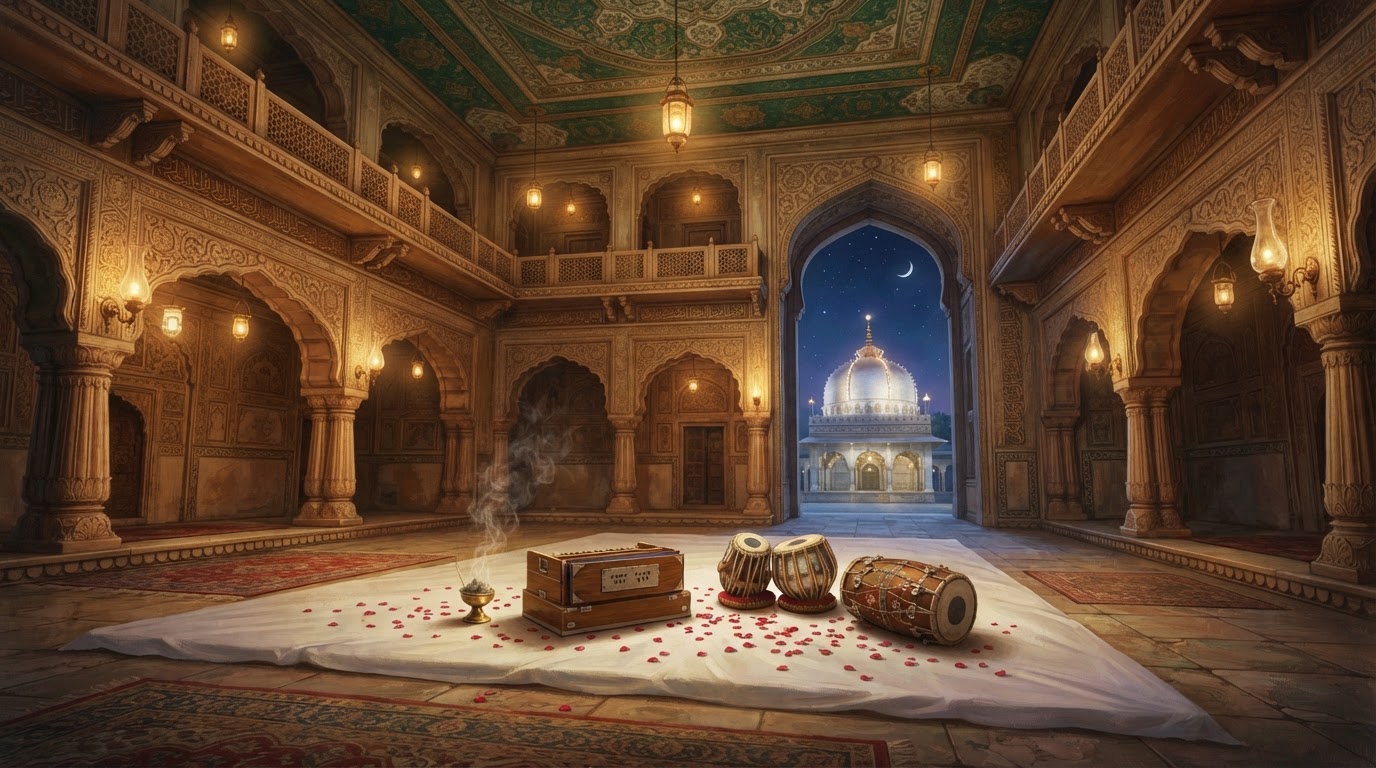
It is close to midnight in Ajmer, and the December air is cold. Inside the Dargah of Hazrat Khwaja Moinuddin Chishti, a hall glows with lamplight. A harmonium breathes its first note, a tabla answers, and a line of qawwals begins to clap. The crowd on the carpets goes quiet. Somewhere at the back, an old man closes his eyes and starts to sway.
This is the Mehfil-e-Sama (a gathering for listening to devotional music) of the Ajmer Urs. On each night of the Urs, the main mehfil is held in the Mehfil Khana, a royal hall built in 1888–91, and runs until Fatiha in the early hours, around 4 am. The Dewan, the hereditary spiritual head of the shrine, presides. For the 815th Urs, these nights are expected from the Rajab moon (around 9 or 10 December 2026) to Chhati Sharif.
Quick facts: qawwali at the Ajmer Urs
| Main venue | Mehfil Khana, also called the Sama Khana (hall of listening) |
| Built by | Nawab Bashir-ud-Daula Sir Asman Jah of Hyderabad, 1888–91 |
| Size | A hall about 46 feet square, with a 14-foot gallery running round it |
| When | Every night of the Urs (1 to 6 Rajab), from late night until Fatiha around 4 am |
| Presided by | The Dewan (Sajjada Nashin) of the Dargah |
| Other venues | The Ahata-e-Noor courtyard and the sitting places (gaddis) of the Khadims |
| Women | Allowed, with separate places set aside |
What is Mehfil-e-Sama, and why does it matter to the Chishtis?
Sama is an Arabic word that simply means “listening”. In Sufi practice it means listening to poetry, often sung, in praise of Allah, the Prophet ﷺ and the Auliya (friends of Allah), so that the heart softens and remembers its Creator. Qawwali is the South Asian form of this, sung by trained singers called qawwals.
Among the great Sufi orders, the Chishti Silsila founded in India by Khwaja Gharib Nawaz (RA) is the one most closely tied to Sama. According to Chishti tradition, the Khwaja himself loved these gatherings, and his successors carried the custom from Ajmer to Delhi and beyond.
For them, the music was never the goal. The aim was wajd (a state of spiritual rapture), a moment when a line of poetry strikes the heart so deeply that the listener forgets himself and remembers only Allah.
The saint who died listening to a couplet
No story shows the power of Sama in the Chishti memory better than that of Hazrat Khwaja Qutbuddin Bakhtiyar Kaki (RA), the Khwaja’s chief Khalifa (spiritual successor) in Delhi.
In 633 AH (1235 CE), the same year the Khwaja passed away in Ajmer, Khwaja Qutb attended a mehfil in Delhi. A qawwal sang a Persian couplet by the poet Shaikh Ahmad-e Jam. Its meaning, roughly: those who are slain by the dagger of surrender to Allah receive a new life from the unseen at every moment.
The words overwhelmed him. According to the accounts, each time he came back to his senses he asked for the same couplet again, and fell back into rapture. After three or four days in this state, he passed away. His Dargah stands in Mehrauli, near the Qutub Minar.
Did you know? The Chishti line that runs from Ajmer through Khwaja Qutb, Baba Farid and Hazrat Nizamuddin Auliya produced Amir Khusrau, who is widely credited with shaping qawwali as we know it.
Inside the Mehfil Khana: a hall from Hyderabad
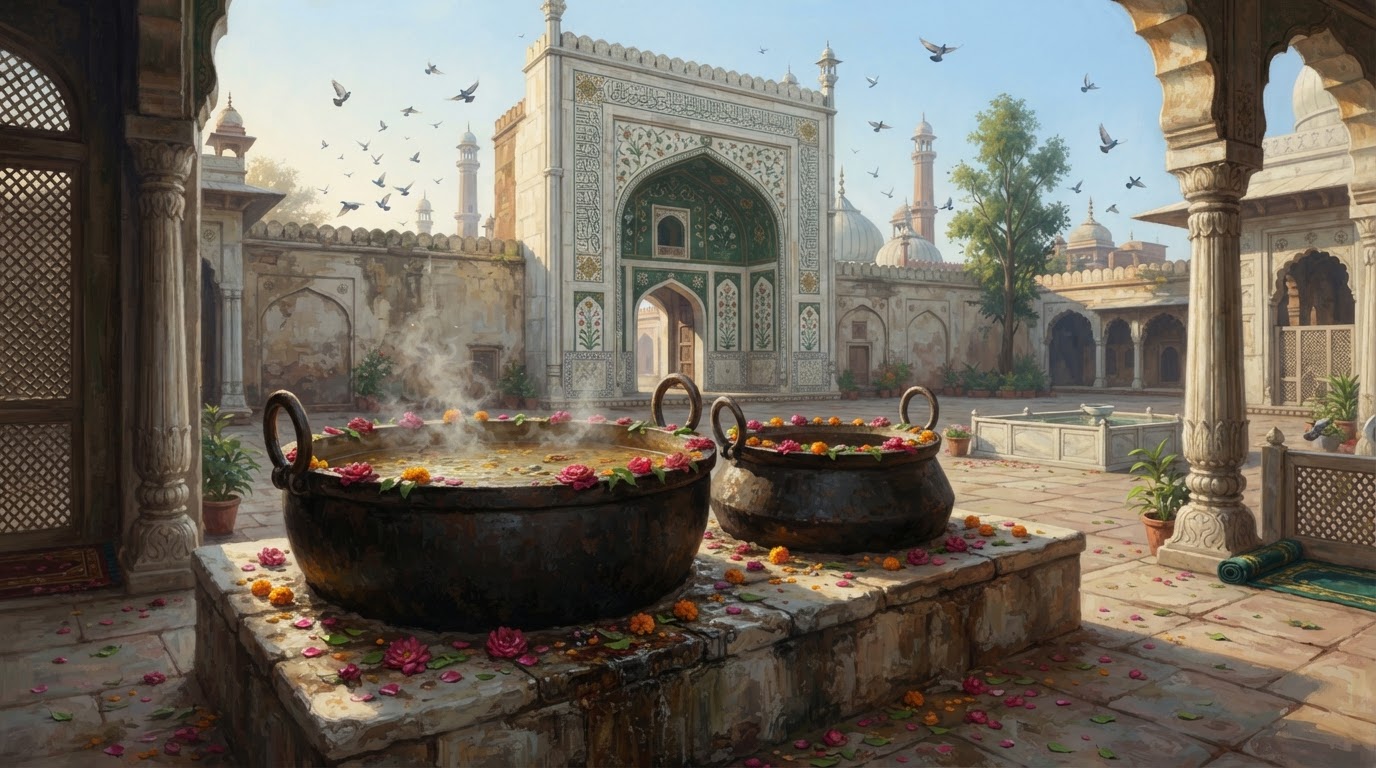
Walk past the Buland Darwaza and the two giant Mughal cauldrons, and the Mehfil Khana stands near the Sahn Chiragh (the courtyard lamp). It was a gift from Hyderabad: Nawab Bashir-ud-Daula Sir Asman Jah, a Hyderabad nobleman, built it between 1888 and 1891.
It is a square hall, about 46 feet on each side, with a gallery 14 feet deep running round it. The ceiling and arches carry arabesque and geometric patterns. Through most of the year it is quiet, kept for special gatherings. During the Urs, it becomes the heart of the night.
How does an Urs night unfold?
The mehfil in the Mehfil Khana follows an old court etiquette. Travel writers who have attended describe it like this:
- The Dewan arrives. Dressed in ceremonial robes and escorted by torch bearers and mace bearers, he takes his seat on a cushion under a canopy.
- Seating by protocol. Khadims (traditional servants of the shrine), scholars and guests sit in a fixed order. The seating and even the way cash gifts are handed to the qawwals follow the etiquette of the Mughal court.
- The qawwali begins. The music usually starts late, after 10 or 11 pm. Harmonium, tabla and rhythmic clapping carry the poetry.
- The kalam flows. Hereditary qawwals, including the Shahi (royal) qawwals of the Dargah, sing Persian and Braj Bhasha poetry, some of it two to four centuries old, alongside Urdu kalam.
- Fatiha at dawn. The mehfil ends around 4 am with Fatiha and a collective Dua for the soul of the Khwaja and for all humanity.
The Mehfil Khana is not the only stage. All through the Urs, qawwali rings out in the Ahata-e-Noor (the “courtyard of light” in front of the tomb) and in the rooms and gaddis of the Khadims. Walk through the complex at 2 am and you may hear three groups singing at once.
Two Ajmer traditions you won’t hear anywhere else
- The Karka. Every night, after the last visitor leaves the tomb chamber, qawwals recite the Karka, a verse in a mix of Sanskrit, Braj and Persian. Only then is the shrine locked until the pre-dawn prayer.
- The Badhawa. On Chhati Sharif (6 Rajab), just before the Qul ceremony, qawwals sing the Badhawa, a poem of praise, at the main entrance of the shrine. It is performed with clapping only, no instruments at all.
That mix of languages in the Karka says a great deal about Ajmer: a shrine of a saint from Sistan, in the heart of Rajasthan, praised in the languages of the people who came to him.
What did the Chishti masters say about the rules of Sama?
The Chishti saints loved Sama, but they did not treat it as entertainment. Hazrat Nizamuddin Auliya, as recorded in his discourses and in Siyar al-Auliya, laid down conditions. The listener must listen only in the remembrance of Allah. The singer and the poetry must be decent and free of anything vulgar. Some of his recorded sayings also disapprove of musical instruments, a point on which Sufis and scholars have long held different views.
Chishti etiquette names three things that make Sama proper: the right time, the right place and the right people. A mehfil should never clash with the time of Namaz. That is why, at Ajmer, the music waits until well after Isha.
Whatever one’s view on music, the core message is shared across Islamic teaching: what matters is the heart. A gathering that turns hearts to Allah and to kindness is the spirit the Chishtis were after.
Tips if you want to attend a mehfil at the Urs
- Cover your head and dress modestly. Leave shoes and bags at the cloakrooms near the gates.
- Arrive early. The Mehfil Khana fills fast, especially on the last nights before Chhati Sharif.
- Sit quietly and do not film unless clearly allowed. Many people are in Dua or deep emotion.
- Bring a warm shawl. December nights in Ajmer can drop close to single digits Celsius.
- Pray on time. Isha and Fajr come before and after the mehfil; the Shahjahani Masjid and Akbari Masjid are inside the complex.
Check the expected dates on our Ajmer Urs 2026 dates page, which we update as soon as the Rajab moon is sighted.
The lesson of listening
Sama means listening, and that may be its simplest lesson. Khwaja Gharib Nawaz (RA) spent his life listening: to the poor at his door, to travellers, to people of every faith who came to Ajmer with a burden. His khanqah was a place where people were heard before they were taught.
Most of us will never sit in the Mehfil Khana at 3 am. But we can listen better: to Allah’s word, to our parents, to a friend who is struggling. A heart that has learned to listen is already halfway to remembering its Lord.
Frequently asked questions
What time does qawwali start at Ajmer Dargah during the Urs?
The main mehfil in the Mehfil Khana usually begins late at night, after 10 or 11 pm, and ends with Fatiha around 4 am. Qawwali is also sung through the day and night in the courtyards.
Who built the Mehfil Khana at Ajmer Dargah?
Nawab Bashir-ud-Daula Sir Asman Jah of Hyderabad built it between 1888 and 1891. It is a square hall about 46 feet wide with a gallery around it.
Can women attend the qawwali mehfil at Ajmer?
Yes. Women can attend the mehfil in the Mehfil Khana, where separate places are reserved for them. This is less common at other Dargahs.
What is the Badhawa at the Ajmer Urs?
It is a poem of praise sung by qawwals at the main entrance of the shrine on Chhati Sharif, just before the Qul. It is accompanied only by clapping, with no instruments.
Related: Ajmer Urs 2026 dates · The silver gate that opens 4 times a year · The flag that opens the Urs · Khwaja Bande Nawaz of Gulbarga · Great Sufi saints of India
Sources: Outlook Traveller: The Ajmer Urs; khawajagharibnawaz.com: monuments of the Dargah; Shrine of Mu’in al-Din Chishti (Wikipedia); Urs festival, Ajmer (Wikipedia); Qutbuddin Bakhtiar Kaki (Wikipedia); New Age Islam on the 813th Urs.
Follow Ruhani Dua on Facebook for short videos and reminders. / रूहानी दुआ को Facebook पर Follow करें।
Discover more from ImranJalna
Subscribe to get the latest posts sent to your email.








Leave a Reply