

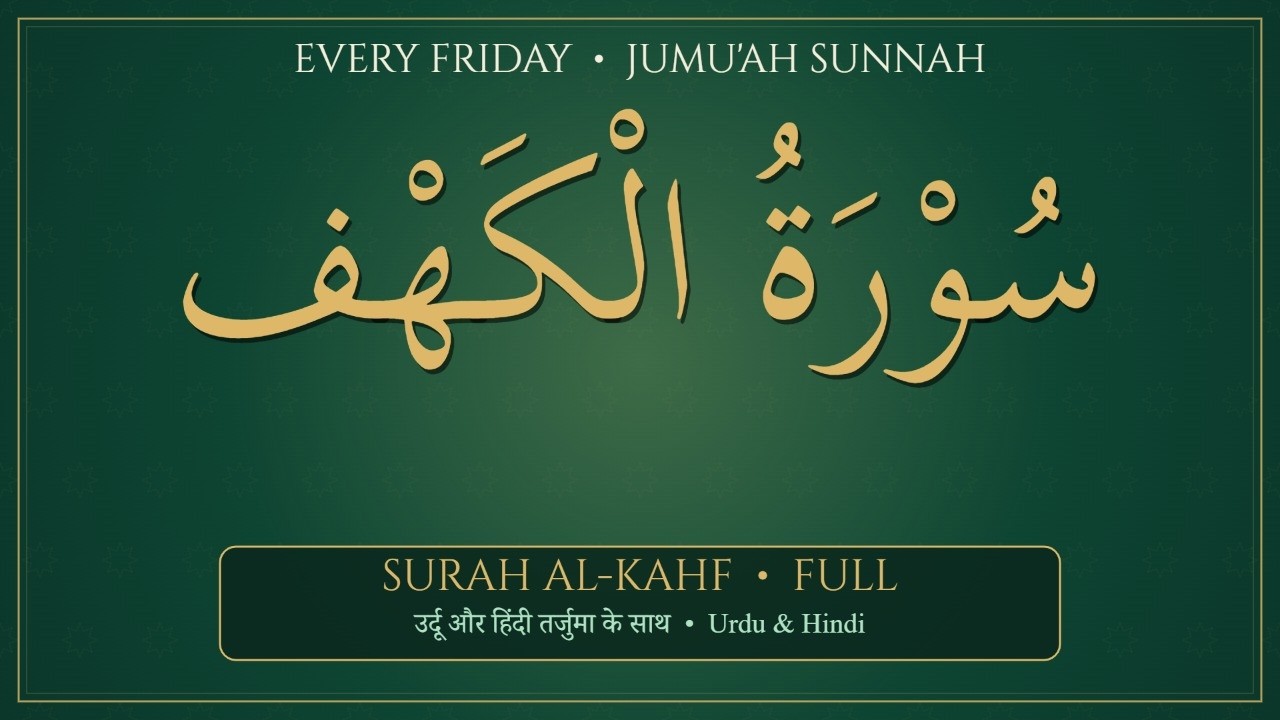
Why do Muslims around the world make a habit of reciting Surah Al-Kahf every Friday? The short answer is that the Prophet ﷺ is reported to have encouraged it, and that the Surah itself is a guide to surviving four great trials of life: trial of faith, trial of wealth, trial of knowledge and trial of power. This article walks through the Surah’s structure, its key ayahs, and the authentic reports about its virtues, based on the full recitation with Urdu and Hindi translation on the Ruhani Dua channel.

Watch the full video: Surah Al-Kahf Full | Jumu’ah ki Tilawat | Urdu & Hindi Translation on the Ruhani Dua YouTube channel.
Quick facts about Surah Al-Kahf
| Name | Al-Kahf (“The Cave”) |
| Order in the Quran | Surah 18 |
| Number of ayahs | 110 |
| Revelation | Makki |
| Location | Spans Juz 15 and 16 |
| Four narratives | The People of the Cave; the owner of two gardens; Musa (AS) and Khidr; Dhul-Qarnayn |
How the Surah begins: a Book without crookedness
The Surah opens by praising Allah, who sent down the Book to His servant and placed no crookedness in it. According to a scholarly explanation, its stated purpose is twofold: to warn (indhar) and to give good news (tabshir). Everything that follows, including the four stories, can be read as examples of that warning and good news in action. In the video, the first section covers ayahs 1–8.
Story 1: The People of the Cave (18:9–26) and the trial of faith
The first narrative tells of a group of young believers who held on to their faith in an environment hostile to it and took refuge in a cave, trusting Allah to arrange their affairs. The Qur’an describes their sleep and awakening and ends by saying that Allah knows best how long they stayed. The Surah also discourages endless argument over details such as their number, pointing instead to what is clearly established by revelation. Many commentators see this as the lesson: hold fast to faith, and do not waste energy on debates that bring no benefit.
“If Allah wills” (18:23–24)
Inside this story sits a short, powerful instruction in Surah Al-Kahf 18:23–24: never say “I will do this tomorrow” without adding “if Allah wills.” According to a report from Ibn Abbas (RA) quoted in the Ma’arif al-Qur’an tafsir, these ayahs are linked to the occasion when the Makkans asked the Prophet ﷺ about the People of the Cave and he promised an answer the next day without saying “insha’Allah”. Some commentaries mention a delay of fifteen days before revelation came. This is reported in tafsir literature rather than in the Qur’an itself, so it is best presented as “according to commentators.”
Story 2: The owner of two gardens (18:32–44) and the trial of wealth
The second narrative contrasts two men. One, proud of his gardens, boasts of greater wealth and more followers than his companion and doubts the Hour. The other reminds him to be grateful to the One who created him. Ayahs 45 onward then give the wider picture, comparing this worldly life to rain that nourishes plants which later become dry stubble. The lesson is not that wealth is evil, but that forgetting the Giver while enjoying the gift is the real loss.
Story 3: Musa (AS) and Khidr (18:60–82) and the trial of knowledge
In the third narrative, Prophet Musa (AS) travels to learn from a servant of Allah whom the Qur’an does not name; the Prophet ﷺ and classical tafsir identify him as Khidr. Khidr tells Musa he will not be able to remain patient with what he does not fully comprehend. The journey that follows teaches that human knowledge is limited, and that events whose wisdom is hidden from us may carry a purpose known to Allah. For students and teachers alike, it is a reminder to remain humble and patient in seeking knowledge. This account is found only in this Surah.
Story 4: Dhul-Qarnayn (18:83–98) and the trial of power
The fourth narrative presents Dhul-Qarnayn as a ruler given means by Allah who travels and deals with different peoples. The Qur’an focuses on his character, not on a historian’s details: he uses authority to help the weak and credits Allah for his success. Scholars have discussed his historical identity for a long time and do not agree, so the safest approach is to take the lesson the Qur’an itself stresses: power is a trust, not a licence for pride.
The ending: meeting the Lord (18:99–110)
The final section turns to the Hereafter and closes with a summary of the whole message. Surah Al-Kahf 18:110 (Sahih International):
“Say, ‘I am only a man like you, to whom has been revealed that your god is one God. So whoever would hope for the meeting with his Lord – let him do righteous work and not associate in the worship of his Lord anyone.'”
This single ayah gives the formula that answers all four trials: pure tawhid and righteous action.
Authentic virtues of Surah Al-Kahf
- Protection from the Dajjal’s trial. Abu Darda’ (RA) reported that the Prophet ﷺ said whoever memorises the first ten ayahs of Surah Al-Kahf will be protected from the Dajjal (Sahih Muslim 809a). Another wording in the same chapter of Sahih Muslim mentions the last ten ayahs.
- Tranquility (sakinah) with recitation. Al-Bara’ (RA) narrated that a man was reciting Surah Al-Kahf with his horse tied beside him when a cloud covered him and the horse became restless. The Prophet ﷺ said it was the sakinah that descends because of the Qur’an (Sahih al-Bukhari 5011).
- Light between two Fridays. A report from Abu Sa’id al-Khudri (RA), recorded by al-Hakim and al-Bayhaqi, says that whoever recites Surah Al-Kahf on Friday will have light shine for him between the two Fridays. It is not in Bukhari or Muslim; Ibn Hajar graded it hasan and al-Albani graded it sahih (Sahih al-Jami’ 6470). This is the hadith mentioned in the video description.
According to IslamQA, the time for reading it extends from sunset on Thursday to sunset on Friday, since some narrations say “the night of Jumu’ah” and others “the day.” These are reports about reward and light; they are not a promise that any particular worldly problem will vanish, and Allah knows best.
Lessons for us today
- Faith: Seek companions and environments that protect your deen, as the youths of the cave did.
- Wealth: Be grateful and humble; everything we own is a loan from Allah.
- Knowledge: Stay patient and teachable. We do not see the whole picture.
- Power: Use any authority to serve people, and give credit to Allah.
- Plans: Say “insha’Allah” sincerely when speaking about the future.
- Habit: Understanding the meaning makes the weekly recitation more than a ritual. Following the Urdu and Hindi translation on screen can help families read it with comprehension.
Frequently asked questions
When is the best time to read Surah Al-Kahf on Friday?
According to IslamQA, it may be read at night or during the day of Jumu’ah, from sunset on Thursday until sunset on Friday. Ibn Hajar is also quoted as saying the “night” and “day” narrations do not conflict.
Do I need to read the whole Surah, or are the first ten ayahs enough?
The Friday hadith refers to reciting the Surah, while the protection from Dajjal in Sahih Muslim 809a refers to memorising the first ten ayahs. Many scholars recommend doing both: recite the Surah on Friday and memorise its opening ayahs. The Surah takes roughly 30 to 40 minutes to read at a steady pace, and the video’s chapters allow you to follow it in sections.
Is it sunnah to read it from the mushaf or can I listen?
The reports speak of reciting it. Listening with attention and following along is a good practice, especially for those learning, but reciting it yourself, from the mushaf or from memory, is the clearest way to act on the hadith. Consult a trusted scholar for any detailed ruling.
Read more:
- Prophet Ibrahim (AS): The Story of Allah’s Khalil in the Quran
- How to Pray Witr: Rakats, Dua Qunut and Timing
Sources:
- Quran 18:110 – quran.com
- Ma’arif al-Qur’an on Al-Kahf 18:24 – quran.com
- Sahih Muslim 809a – sunnah.com
- Sahih al-Bukhari 5011 – sunnah.com
- IslamQA 10700: When to read Surat al-Kahf on Friday
Discover more from ImranJalna
Subscribe to get the latest posts sent to your email.




Leave a Reply