

Guest post: This article was written by Sitara Gul, who writes for Muslims Holy Travel, a UK-based Hajj and Umrah operator. Links to the operator’s website are marked as sponsored. Always compare licensed operators before booking.
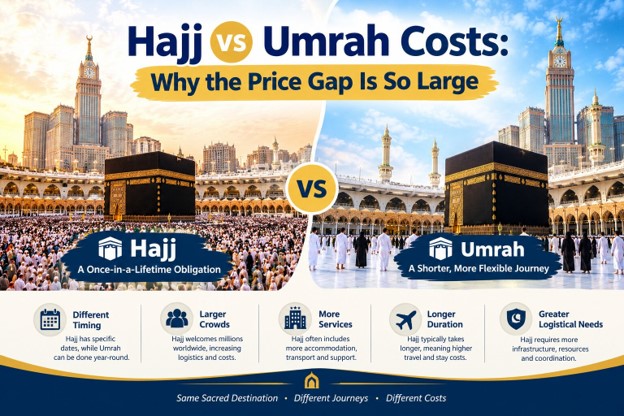
Hajj and Umrah are two of the most important journeys in a Muslim’s life, yet their prices differ enormously. Both pilgrimages lead to the same destination, Makkah, and share several rituals, so the gap can seem strange at first. In reality, Hajj often costs several times more than Umrah, and the reasons are religious, logistical and administrative. If you are new to the topic, start with our guide to the key differences between Hajj and Umrah. In this article, we explain why the costs are so far apart.
Why Is There Such a Big Price Gap?
Many people assume Hajj is simply a longer version of Umrah. It is not. Hajj is a completely different operation. It takes place on fixed dates, so millions of pilgrims need flights, hotels and transport at exactly the same time, and when demand rises this sharply, prices follow. On top of that, Saudi Arabia allocates Hajj quotas to each country, and only a limited number of licensed operators can sell packages. With so few places available, there is very little room for price cuts.
Then there are the services. Hajj requires tents, catering and transport in Mina, Arafat and Muzdalifah, along with longer stays and strict compliance rules. Umrah has none of these demands and can be booked in quieter months when better deals are available. Put these factors together and the gap starts to make sense. Let’s look at each one in more detail.
A Fixed Window vs a Flexible Year
Timing is one of the biggest reasons behind the price gap between the Hajj and Umrah pilgrimages. Hajj can only be performed on specific dates in the Islamic month of Dhul Hijjah, while Umrah can be performed at almost any time of the year. During Hajj, flights, hotels and transport are limited and demand is extremely high, so prices reach their peak.
Because Umrah is flexible, pilgrims can choose quieter months when flights are cheaper and hotels are less crowded. An off-season Umrah can cost much less than an Umrah during Ramadan or school holidays, let alone Hajj. Even the same hotel near the Haram can cost far less outside peak seasons. In short, Umrah lets you wait for a good deal, while Hajj leaves you no choice but to pay the price of the season.
Quotas and Licensing
This factor is rarely discussed, but it plays a big role. Hajj is not an open market the way Umrah is. The Saudi government allocates a fixed quota of Hajj visas to each country, so only a limited number of pilgrims from the UK, the US, India, Malaysia, Indonesia or any other country can perform Hajj in a given year. In addition, only licensed and approved operators are allowed to sell Hajj packages, so the number of providers is small.
With fewer providers and more people competing for the same limited places, operators face little pressure to lower prices. Umrah has no such quota. Many more travel agencies can offer it, and that competition keeps prices in check. You can compare Umrah packages from several agencies, but always check an operator’s credentials first, because scams are common. Official visa and permit information is available on Saudi Arabia’s Nusuk platform.
Length of Stay and Flights
There is also a clear logistical difference between the two journeys. A typical Umrah trip lasts around 7 to 14 days, which keeps hotel nights and meals within a limit. Hajj usually takes several weeks, because pilgrims must arrive well before the rituals begin and stay until they are complete.
That extra time means more hotel nights, more meals and more ground transport, all added to the total cost. Flights are another big factor: airlines charge peak-season fares during Hajj because everyone travels at the same time, leaving little room for discounts. Longer stays and costlier flights make Hajj a much heavier expense. Travellers on long journeys may also find our guide on how to pray Salah while traveling useful.
Services in Mina, Arafat and Muzdalifah
From a practical point of view, Umrah is a fairly simple journey. It has a few main rites, and pilgrims mostly need services in Makkah, and sometimes Madinah. Hajj is different: millions of pilgrims move between Mina, Arafat and Muzdalifah, and every one of them needs shelter, food and transport.
Operators must arrange all of this for their groups, including tents, catering, bus transfers and on-ground staff, and these services are expensive. The tent category also affects the price, as better tents closer to the Jamarat cost more than basic ones. Umrah is cheaper partly because it does not involve these services at all.
Concluding Thoughts
Hajj and Umrah differ in price because of fixed dates, quotas, licensing, longer stays and the large-scale services Hajj requires. Saudi authorities manage the two pilgrimages very differently, and this has a huge effect on the market. Before booking either journey, compare several licensed operators, read the terms carefully and check what is included. For travel updates that may affect your plans, see our report on Saudi flight suspensions and Umrah pilgrims.
About the author: Sitara Gul is a UK-based writer who researches and writes about Hajj, Umrah and halal travel for Muslims Holy Travel.
Discover more from ImranJalna
Subscribe to get the latest posts sent to your email.










Leave a Reply