

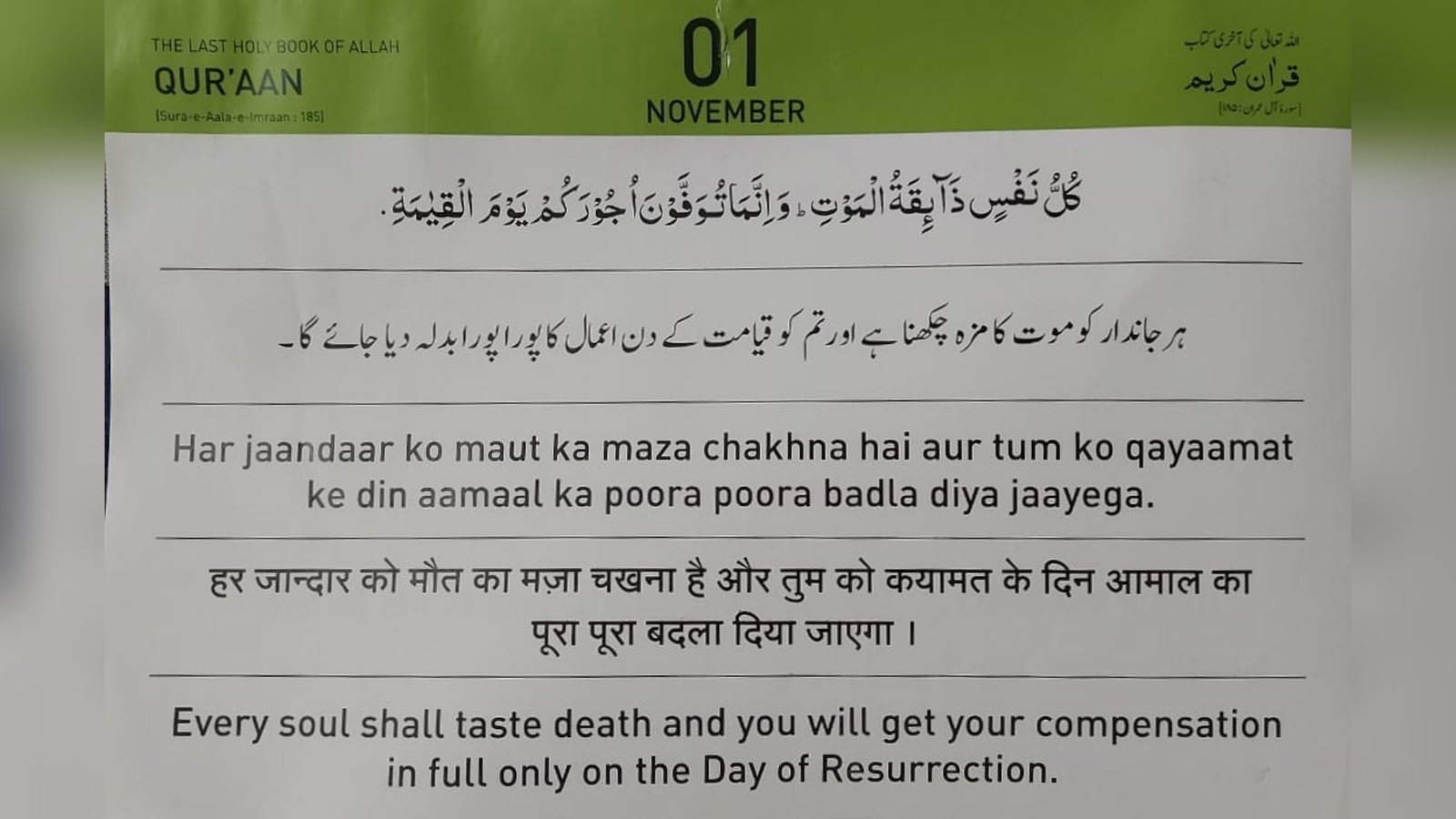
Jalna, 1 November 2026 — Today’s Islamic Quran Verse of the Day is one of the most quoted and most sobering lines of the Holy Qur’an: “Every soul shall taste death.” It comes from Surah Aal-e-Imran, Ayah 185, and in a single sentence it reminds every human being of two certainties — that life on this earth will end, and that the full reward for our deeds will be given on the Day of Resurrection (Qayamat).

Surah Aal-e-Imran 3:185 — Arabic Text and Translation
كُلُّ نَفْسٍ ذَآئِقَةُ الْمَوْتِ ۗ وَإِنَّمَا تُوَفَّوْنَ أُجُورَكُمْ يَوْمَ الْقِيَامَةِ
- English: Every soul shall taste death, and you will get your compensation in full only on the Day of Resurrection.
- Urdu: ہر جاندار کو موت کا مزہ چکھنا ہے اور تم کو قیامت کے دن اعمال کا پورا پورا بدلہ دیا جائے گا۔
- Hindi: हर जान्दार को मौत का मज़ा चखना है और तुम को कयामत के दिन आमाल का पूरा पूरा बदला दिया जाएगा।
- Roman Urdu: Har jaandaar ko maut ka maza chakhna hai aur tum ko qayaamat ke din aamaal ka poora poora badla diya jaayega.
The ayah continues beyond the part printed on the calendar. Allah Ta’ala goes on to say that whoever is kept away from the Fire and admitted into Jannah has truly succeeded, and that the life of this world is nothing but an enjoyment of deception. You can read the complete verse with several translations on Quran.com (Surah Aal-e-Imran 3:185).
What “Every Soul Shall Taste Death” Teaches Us
The words “kullu nafsin dha’iqatul mawt” are short, but they carry a complete lesson for life. Death is described as something to be “tasted” — an experience every soul will personally go through, whether king or labourer, young or old, believer or not. No wealth, power or medicine can postpone it beyond its appointed time.
The second half of the sentence changes how we look at success and failure. The word “innama” (only) tells us that the full and final reward is not given in this world. Some good people suffer here, and some wrongdoers seem to prosper — but the real accounting, complete and perfectly just, happens on Yawm al-Qiyamah.
Key lessons at a glance
- Death is certain for everyone — it is the one appointment no one can cancel.
- Deeds are recorded and rewarded in full — nothing good or bad is lost, however small.
- Final justice is in the Akhirah — so a believer stays patient when the world seems unfair.
- Real success is safety from the Fire and entry into Jannah — not worldly status.
- Worldly life is temporary — enjoy it within halal limits, but do not be deceived by it.
The Context of This Ayah in Surah Aal-e-Imran
Surah Aal-e-Imran (“The Family of Imran”) is the third surah of the Qur’an. It is a Madani surah with 200 ayahs, revealed after the Hijrah to Madinah. Its later part speaks about the trials the early Muslims faced, including the Battle of Uhud, and comforts the believers that losses and hardships in this world are not the end of the story.
The same opening phrase, “Every soul shall taste death,” also appears in Surah Al-Anbiya (21:35) and Surah Al-Ankabut (29:57). Its repetition in three places shows how strongly the Qur’an wants this reminder to stay alive in the heart of a believer.
Also read
- Writing a Will in Islam: A Practical Guide to Wills, Debts, Bequests and Family Planning
- Sadaqah Explained: Everyday Charity Beyond Money
How to Live by This Verse Every Day
Remembering death is not meant to make a Muslim sad or fearful. The Prophet Muhammad ﷺ advised the believers to remember often “the destroyer of pleasures,” meaning death (Jami at-Tirmidhi). This remembrance keeps the heart soft and the priorities right. In practical terms, this ayah can guide daily life in simple ways:
- Guard the five daily Namaz and do not delay Tawbah (repentance).
- Clear debts and return what belongs to others; keep your affairs and family records in order.
- Ask forgiveness from people you may have hurt, and forgive others.
- Give Sadaqah regularly — even a smile or a kind word counts.
- Spend time with the Qur’an daily, even if only a few ayahs with meaning.
Frequently Asked Questions
Where is “Every soul shall taste death” in the Quran?
The phrase appears three times: Surah Aal-e-Imran 3:185, Surah Al-Anbiya 21:35 and Surah Al-Ankabut 29:57. The 1 November calendar verse is from Surah Aal-e-Imran 3:185.
What does “you will be paid in full on the Day of Resurrection” mean?
It means the complete reward or punishment for a person’s deeds is given on the Day of Qiyamah. Whatever a person receives in this world is partial; the full, perfectly just recompense comes in the Akhirah.
What is “kullu nafsin dha’iqatul mawt” in Urdu?
In Urdu it is translated as “ہر جاندار کو موت کا مزہ چکھنا ہے” — every living being has to taste death.
Read more Quranic reflections in our Quran section.
Report: Imran Siddiqui, Jalna
Discover more from ImranJalna
Subscribe to get the latest posts sent to your email.













Leave a Reply