

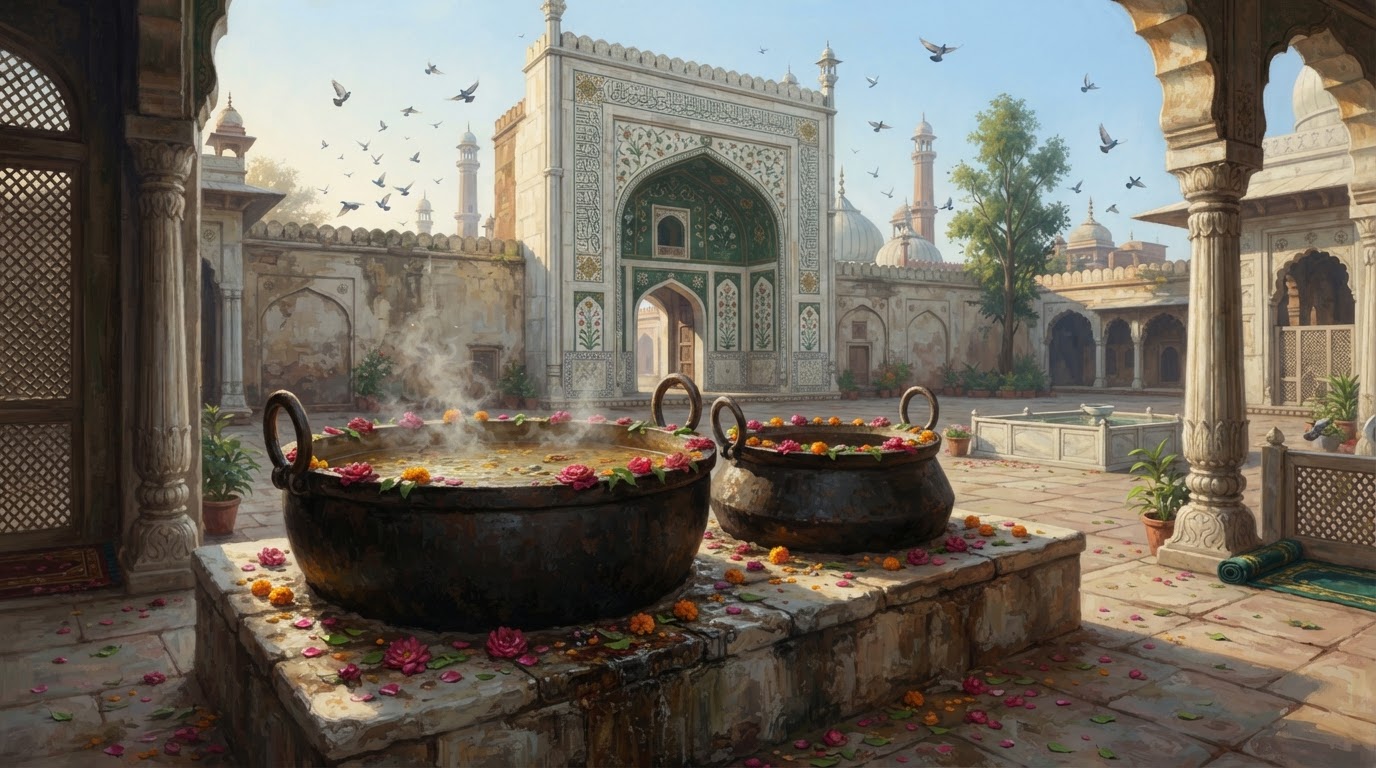
Late at night, when the courtyard of Ajmer Dargah finally grows quiet, a fire is lit under a cauldron so big that a grown man could stand inside it. Into it go sacks of rice, sacks of sugar, tins of ghee and baskets of almonds and raisins. By dawn, the air near the Buland Darwaza smells of saffron and rosewater, and a crowd is already waiting with bowls.
This is the Badi Deg, the great cauldron of the Dargah of Hazrat Khwaja Moinuddin Chishti, Khwaja Gharib Nawaz (RA). It was gifted by the Mughal emperor Akbar in 1568, and its smaller partner, the Chhoti Deg, by his son Jahangir in 1614. More than four centuries later, both are still cooking tabarruk (blessed food) that is shared with anyone who comes, whatever their faith.
Quick facts: the two degs of Ajmer
| Badi Deg (big cauldron) | Chhoti Deg (small cauldron) | |
|---|---|---|
| Gifted by | Emperor Akbar | Emperor Jahangir |
| Year | 1568 | 1614 |
| Capacity | About 120 maunds, roughly 4,480–4,800 kg | About 60 maunds, roughly 2,240–2,400 kg |
| Feeds (Dargah Committee estimate) | About 5,000 people | About 2,500 people |
| When cooked | Only at night | Usually at night, sometimes in the morning |
| What is cooked | Vegetarian sweet rice, with no onion or garlic | |
| Where | On either side of the Buland Darwaza, inside the Dargah | |
Why did Akbar give a cauldron to a Sufi shrine?
Akbar’s bond with Ajmer is one of the great stories of Mughal history. Historians record that he visited the Dargah at least fourteen times, and that in 1566 he made the journey on foot with his queen, Mariam-uz-Zamani, praying to be blessed with sons. When Prince Salim (the future Jahangir) was born, Akbar’s devotion only grew.
The Badi Deg came two years later. According to tradition, Akbar vowed to make an offering at Ajmer if he won the hard-fought siege of Chittorgarh. After the victory in early 1568, he kept his word. Local accounts say the cauldron was so heavy that it was carried to Ajmer by elephants in three separate pieces and then joined together at the Dargah. Akbar is said to have cooked the very first dish in it himself, tasted it, and shared it with the fakirs sitting near the shrine.
Picture the scene: the most powerful ruler in India, sleeves rolled up beside a cooking fire, serving food to the poor at the tomb of a man known as Gharib Nawaz, “the one who cherishes the poor.” It is hard to imagine a gift that fitted the saint better.
And Jahangir’s smaller cauldron?
Jahangir, the son born after Akbar’s prayers, kept up the family bond. He lived in Ajmer for long stretches and visited the Dargah many times. In 1614 he presented the Chhoti Deg. In her book on food and faith, writer Shoba Narayan recounts that Jahangir had food from it distributed to thousands of people, taking the first portion himself before Empress Nur Jahan and the ladies of the court.
The Mughal link did not end there. Shah Jahan’s children Dara Shikoh and Jahanara were both born in Ajmer, and Jahanara later added a beautiful marble porch near the tomb. You can read more about the gates that lead to the degs in our story on the Buland Darwaza and the Urs flag.
What actually goes into the Badi Deg?
The recipe is not left to chance. The Dargah keeps a fixed list of ingredients, and the dish is a rich, saffron-coloured sweet rice, close to a kesari bhat or a sweet khichdi. A report in Rajasthan Patrika listed what goes into one full Badi Deg:
- Rice: about 1,000 kg
- Sugar: about 1,000 kg
- Ghee: about 100 kg
- Dry fruits (almonds, cashews, raisins): about 100 kg
- Kewra water and rose essence: about 20 kg each
- Smaller amounts of saffron, turmeric, wheat and urad flour, jaggery and fenugreek flour
The food is always vegetarian. Not even onion or garlic is added. The Anjuman (the body of the Dargah’s khadims) says people of every religion can eat it, and they do: Hindu, Sikh, Jain and Christian visitors stand in the same line as Muslim pilgrims.
Did you know? The degs are built so that their rim stays cool even while the food inside is boiling. Khadims say you can rest your hand on the edge of a cooking deg without being burned.
Who pays for the food today?
Akbar paid for the first meal. Today, ordinary pilgrims follow his example. When a mannat (a vow or heartfelt prayer) is fulfilled, many devotees book a deg as a way of saying shukr (thanks) to Allah and sharing their joy with strangers.
- Bookings are made months ahead through the khadims.
- In 2022, the Anjuman put the cost at roughly ₹50,000 to ₹1 lakh for the Chhoti Deg and about ₹1.2 to 2 lakh for the Badi Deg. Prices today may be higher.
- During the Urs, only the Chhoti Deg is cooked at night, and bookings for the Badi Deg are usually closed because of the crowds.
- All day long, pilgrims drop offerings into the empty degs: cash, rice, even jewellery.
Visitors often notice small objects tied on strings near the cauldrons: a tiny metal house, a cradle, a hand. Each one is a silent prayer, for a home, a child or a job. Whatever one’s view of such customs, they show how deeply ordinary people trust this place with their hopes.
What was the famous “looting of the deg”?
For centuries, the most dramatic sight at Ajmer was the deg lootna. Once the food was ready and a share had been set aside for travellers from far away, the people of Ajmer’s Andarkot neighbourhood and the Dargah’s hereditary servants had the right to empty the cauldron. Old reports describe men in thick cloth climbing right into the still-hot deg, scooping out the rice in buckets and handing it to the jostling crowd.
Nobody can say for certain when this custom began. Accounts from the early 2000s say it was later discontinued in its old form, and today the food is distributed in a more orderly way. The rush around the degs during the Urs, though, is still something to see.
Visiting the degs during the 815th Urs
- Where to find them: walk in through the Nizam Gate and the Shahjahani Gate. The degs sit on raised platforms on either side of the Buland Darwaza.
- Best time to receive tabarruk: early morning, when the night’s cooking is shared out.
- Expect a crush: the Urs runs from the Rajab moon, expected around 9 December 2026, to Chhati Sharif on 6 Rajab. Check our Ajmer Urs 2026 dates page before you travel.
- Keep children and valuables close near the platforms, where the crowd is thickest.
- Don’t miss the Jannati Darwaza, which opens for the Urs. Here is the story of the silver gate that opens just four times a year.
The lesson inside a cooking pot
Khwaja Gharib Nawaz (RA) is remembered for one thing above all: he fed people. His teaching, as handed down by the Chishti masters, was that a seeker should have generosity like a river and hospitality like the sun, which shines on everyone without asking who they are.
The degs turn that teaching into iron and fire. An emperor gave the first one. Today a labourer from Bihar or a businessman from Dubai can pay for the next. And the person who eats from it might be a Hindu farmer, a Sikh family or a Muslim traveller, all sitting on the same stone floor. That is the same spirit his successors carried to Delhi, as you can read in the story of Hazrat Nizamuddin Auliya’s famous langar. You don’t need a cauldron to follow it. A plate of food shared with a hungry neighbour is enough.
Frequently asked questions
Who gave the Badi Deg to Ajmer Dargah?
The Mughal emperor Akbar gave the Badi Deg in 1568, after his victory at Chittorgarh. His son Jahangir gave the smaller Chhoti Deg in 1614.
How much food does the Badi Deg cook?
About 120 maunds, roughly 4,480 to 4,800 kg, of sweet rice in one cooking. The Chhoti Deg holds about half that.
Is the food from the degs vegetarian?
Yes. It is a vegetarian sweet rice made without onion or garlic, so people of every faith can eat it.
Can I book a deg during the Urs?
Usually only the Chhoti Deg is cooked at night during the Urs, and Badi Deg bookings are closed. Pilgrims book through the khadims, often months in advance.
Related: Ajmer Urs 2026 dates · Khwaja Gharib Nawaz: life and teachings · The Urs flag and the Gauri family · Jannati Darwaza · Great Sufi saints of India
Sources: Dargah Committee, Ministry of Minority Affairs: About Dargah Khwaja Saheb; Rajasthan Patrika, February 2022; Shrine of Mu’in al-Din Chishti (Wikipedia); Khaleej Times: Where food meets faith (Shoba Narayan); Incredible India: Ajmer Sharif Dargah; Anderkoti (Wikipedia).
Follow Ruhani Dua on Facebook for short videos and reminders. / रूहानी दुआ को Facebook पर Follow करें।
Discover more from ImranJalna
Subscribe to get the latest posts sent to your email.








Leave a Reply