

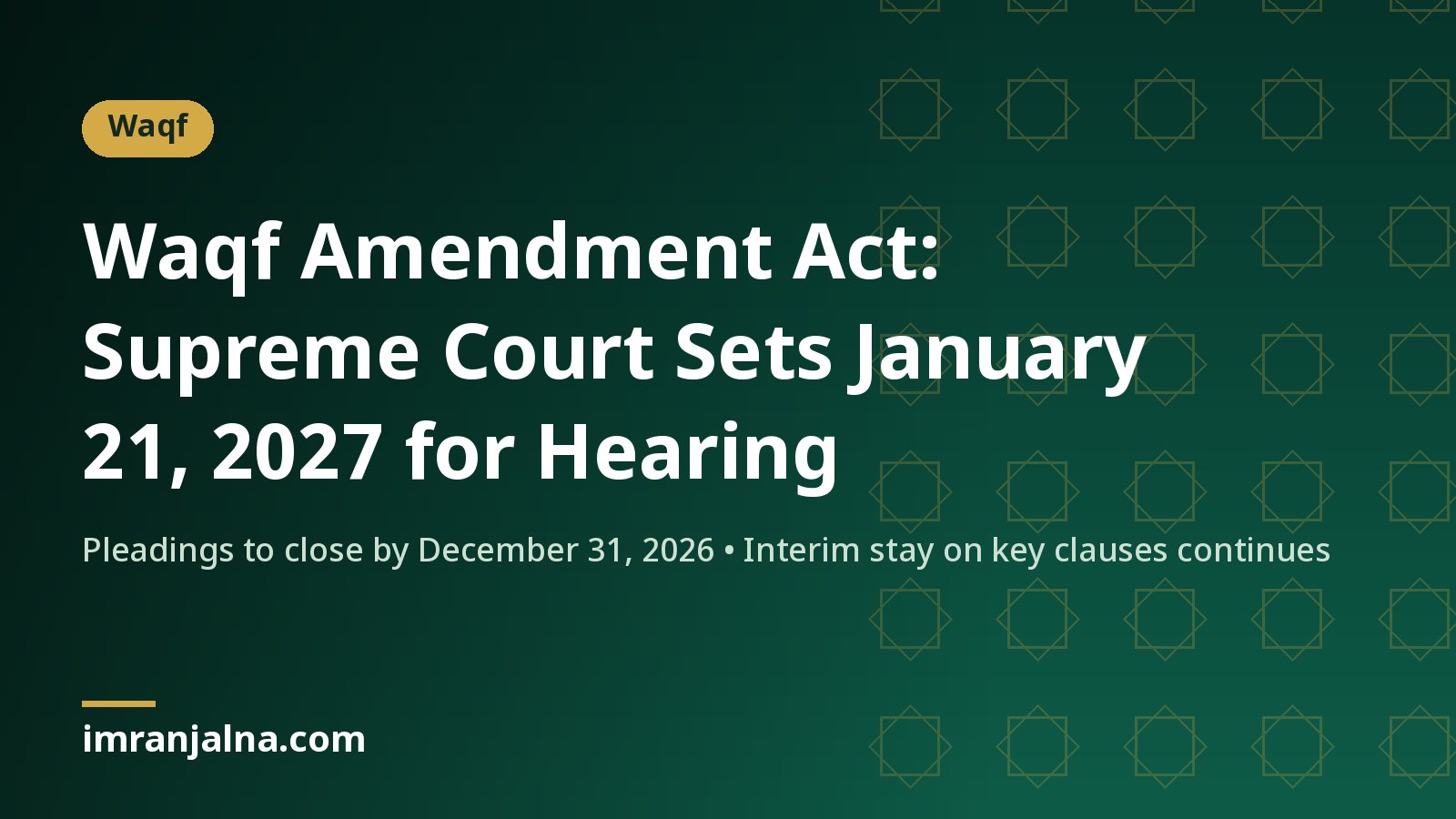
The Supreme Court on Tuesday, November 3, 2026, posted the petitions challenging the constitutional validity of the Waqf (Amendment) Act, 2025 for hearing on January 21, 2027. A bench of Justices MM Sundresh and PB Varale asked all parties to complete their pleadings by December 31, 2026, setting a clear timetable for one of the most closely watched cases for Indian Muslims and the country’s Waqf Boards.
What the Supreme Court ordered
According to a PTI report carried by ThePrint and Deccan Herald, the bench issued a set of procedural directions to get the case ready for final arguments:
- Applicants whose pleas had been treated as interlocutory applications may file separate writ petitions within two weeks.
- The nodal counsel will compile the judgments the petitioners rely on.
- The Additional Solicitor General will respond to the petitioners’ written submissions.
- All pleadings must be completed by December 31, 2026.
The nodal counsel told the court that five lead petitions had been identified earlier and 135 others had been converted into interlocutory applications. Solicitor General Tushar Mehta, appearing for the Centre, pointed to the court’s April 17, 2025 order that took up only five lead petitions to keep the case manageable, and urged that this arrangement not be disturbed.
Key facts
- Next hearing: January 21, 2027
- Bench: Justices MM Sundresh and PB Varale
- Pleadings deadline: December 31, 2026
- Petitions: 5 lead petitions; 135 others converted into interlocutory applications
- Interim order: The September 15, 2025 stay on key clauses remains in force
What the 2025 interim order still protects
Parliament passed the Waqf (Amendment) Bill in April 2025 after heated debates, and President Droupadi Murmu gave her assent. On September 15, 2025, the Supreme Court refused to stay the entire law, citing the presumption that laws passed by Parliament are constitutional. But it put several key provisions on hold:
- The condition that a person must show at least five years of practising Islam to create a Waqf, until states frame rules on how this is decided.
- The power given to the Collector to decide whether a property is Waqf property.
- The clause that a property would not be treated as Waqf until a designated officer files a report.
The court also capped non-Muslim membership: no more than four of the 20 members of the Central Waqf Council and no more than three of the 11 members of a state Waqf Board. These protections continue until the court rules otherwise.
Also read: Race Course Masjid: No Demolition Till Waqf Plea Decided, Centre Tells HC | Kerala Reconstitutes State Waqf Board
What it means for Masjids, Madrasas and Waqf property
Waqf properties across India support Masjids, Madrasas, Qabristans, Eidgahs and charitable work such as scholarships. In Marathwada, including Jalna, many old Masjids and Dargahs stand on Waqf land. For mutawallis and community trusts, the January date means the legal uncertainty will continue for at least two more months. Until the final verdict, the September 2025 interim order is the working rule, so mutawallis should keep property records, registration papers and Waqf Board correspondence up to date.
Community bodies that wish to join the case should note the two-week window the court gave for filing fresh writ petitions. After December 31, the court expects the written record to be complete so that final hearings can begin.
FAQ
Has the Supreme Court struck down the Waqf Amendment Act?
No. The law is in force, but key clauses remain stayed under the September 15, 2025 interim order. The final hearing is set for January 21, 2027.
Can non-Muslims be appointed to Waqf Boards?
Under the interim order, a state Waqf Board can have no more than three non-Muslim members out of 11, and the Central Waqf Council no more than four out of 20.
What happens before January 21?
All sides must finish filing pleadings by December 31, 2026, and some applicants may file fresh writ petitions within two weeks.
More from India: MP Waqf Board Gives ₹21.6 Lakh Scholarships to 289 Orphaned Students
Source: PTI via ThePrint — theprint.in; Deccan Herald — deccanherald.com
Discover more from ImranJalna
Subscribe to get the latest posts sent to your email.








Leave a Reply