

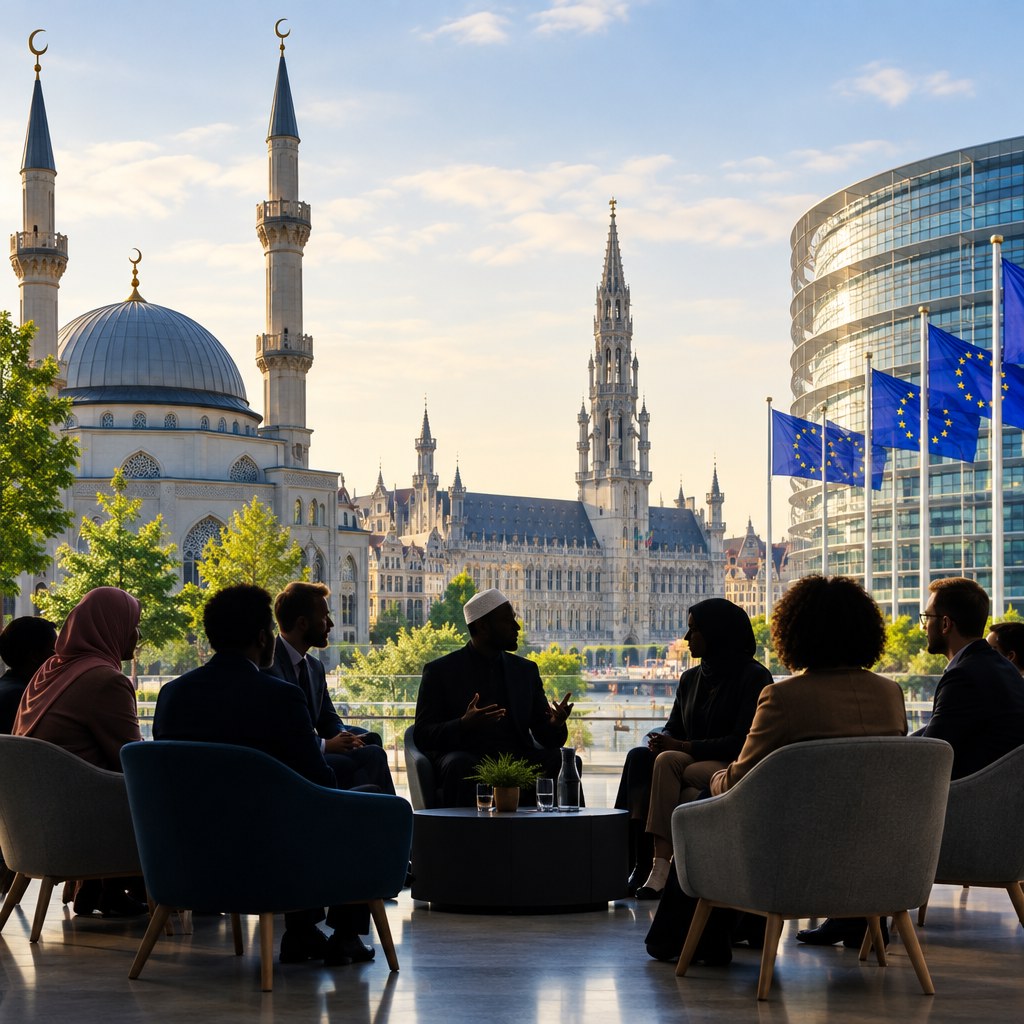
BRUSSELS: Muslim World League Secretary-General Sheikh Dr Mohammed bin Abdulkarim Al-Issa has met Muslim community leaders and activists in Belgium, with discussions focusing on coexistence, social cohesion and religious guidance suited to local circumstances.
The meeting took place in Brussels and was reported by the Union of OIC News Agencies.
Focus on Muslim life in a European context
Al-Issa praised the contribution of Belgian Muslims to coexistence and mutual respect. A central theme of his remarks was that religious guidance connected to local circumstances should come from trusted scholars familiar with the society in which Muslims actually live.
This is an important issue for Muslim communities in Europe, where questions involving family life, education, employment and civic participation often require an understanding of both Islamic scholarship and the local legal and social environment.
Why local knowledge matters
Muslim communities are not identical from one country to another. Laws, institutions, social customs and practical challenges vary widely. Guidance produced for one environment may not automatically answer every question faced in another.
The meeting highlighted the role of scholars who understand local realities while remaining connected to established religious scholarship.
Coexistence and social cohesion
Belgium is home to a diverse Muslim population with roots in Morocco, Türkiye and many other countries, as well as locally born generations. Like other European societies, it continues to debate integration, religious freedom, discrimination and the place of faith in public life.
Community leaders therefore operate at the intersection of religious identity and citizenship. Initiatives that encourage dialogue can help address misunderstandings while giving Muslim communities a stronger voice in civic discussions.
International Muslim institutions and Europe
The Muslim World League has increasingly engaged in interfaith and community dialogue outside Muslim-majority countries. Al-Issa said Belgian Muslim scholars would be welcome in the League’s conferences and forums, including events involving followers of different religions.
Such participation can broaden international discussions by bringing in the experiences of Muslim minorities rather than focusing only on Muslim-majority states.
What the meeting signals
The Brussels talks point to a wider trend in contemporary Muslim community leadership: local context is becoming increasingly important. Questions about religious practice are often linked with education systems, workplace rules, citizenship and social relationships.
The challenge is to preserve religious integrity while avoiding imported conflicts or advice disconnected from the realities of the community receiving it.
A continuing conversation
The meeting concluded with an open dialogue covering issues affecting Muslim communities globally. No major policy package was announced, but the emphasis on trusted local scholarship and social cohesion gives the meeting wider relevance for Muslims living as minorities around the world.
European Muslim communities face highly local questions
A Muslim family living in Brussels may encounter questions about schooling, employment, finance, family life, civic participation or religious accommodation that differ substantially from those faced in Riyadh, Karachi or Jakarta. That is why the emphasis on scholars who understand local society is significant.
Religious guidance can lose practical value when it ignores the legal system and everyday realities surrounding the person asking the question. At the same time, local adaptation does not mean abandoning scholarly standards. The challenge is combining sound religious knowledge with accurate understanding of context.
Belgium’s Muslim population is diverse
Belgian Muslims are not a single ethnic or organisational bloc. Communities include people with family roots in Morocco, Türkiye and many other countries, alongside converts and generations born in Belgium. Mosques and associations likewise vary in language, tradition and institutional background.
That diversity makes representative leadership difficult. International organisations meeting community figures should therefore avoid assuming that a small group speaks for every Muslim in the country.
Why social cohesion featured prominently
European debates about Islam frequently intersect with concerns over discrimination, extremism, migration and integration. Muslim organisations, meanwhile, raise concerns about anti-Muslim hatred, equal opportunity and religious freedom. Dialogue focused on social cohesion can be useful when it allows difficult issues to be discussed without treating ordinary religious identity as a security problem.
Interfaith engagement
The Muslim World League has increasingly presented interfaith engagement as a major part of its international activity. Inviting Belgian scholars to conferences involving different faith communities fits that approach. Such forums can create networks between religious leaders, but their value depends on whether discussions translate into local relationships and practical cooperation.
What local communities may expect
For ordinary Muslims, high-level meetings are most meaningful when they help address concrete needs: credible religious education, youth support, stronger community institutions and constructive relations with neighbours and public authorities. Our Editorial Policy explains how ImranJalna approaches community reporting and source verification. The Brussels meeting did not announce a large new programme, so its immediate significance is primarily diplomatic and community-focused. Future cooperation will show whether the conversation produces sustained projects.
The role of younger European Muslims
A growing share of Europe’s Muslim population was born and educated locally. Younger Muslims may speak European languages more fluently than the heritage languages of their parents and may expect religious institutions to address questions in a different style. That creates demand for scholars and community leaders who can communicate clearly across generations.
It also creates opportunities. Young professionals, students and volunteers can contribute to mosque governance, social projects, media literacy and interfaith work. International organisations can be most useful when they support local capacity rather than replacing it with imported structures.
Source: Union of OIC News Agencies.
Discover more from ImranJalna
Subscribe to get the latest posts sent to your email.


Leave a Reply