

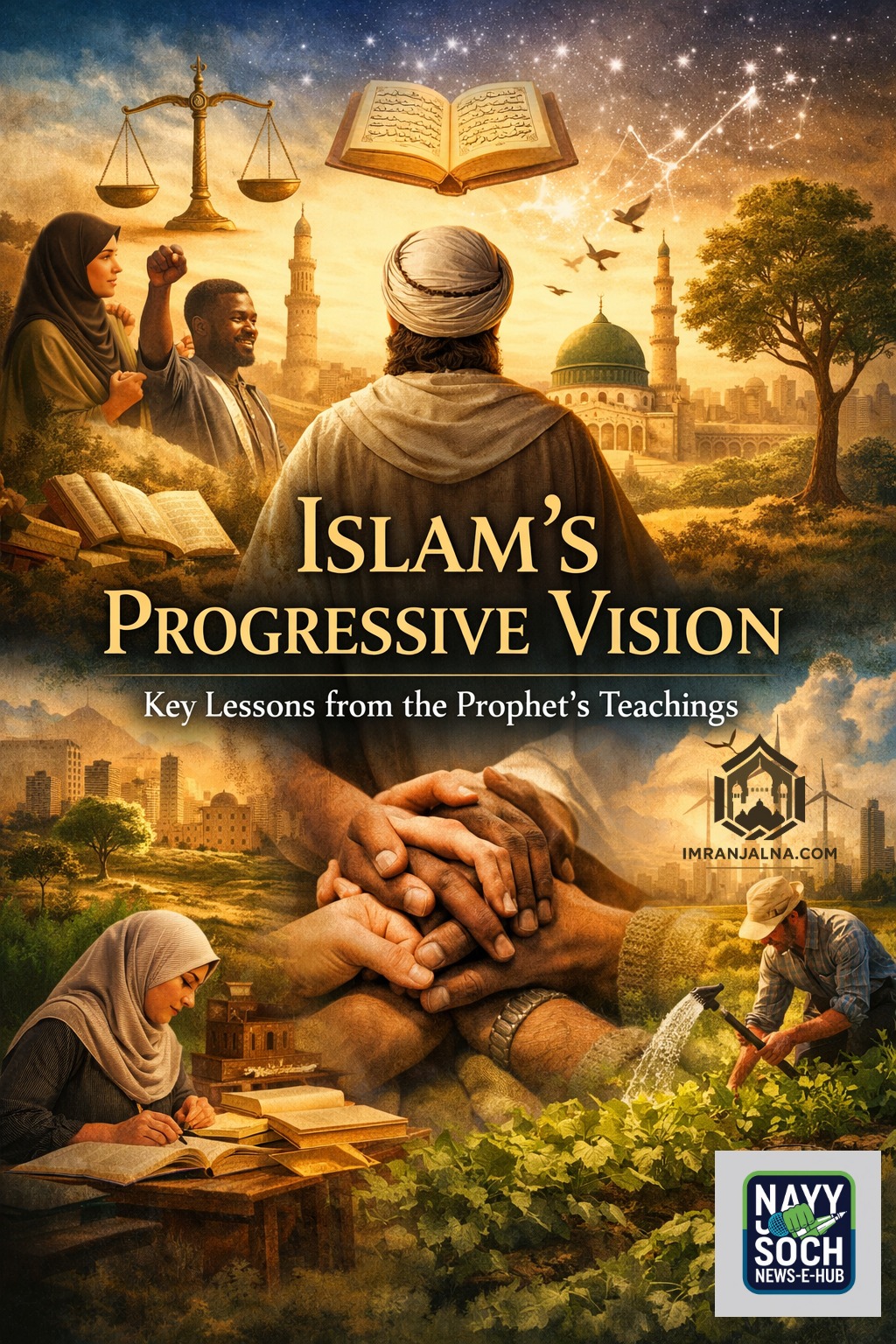
Islam’s Progressive Vision: Key Lessons from the Prophet’s Teachings
In today’s geopolitical climate, the word Islam is often framed within narratives of conflict, extremism, or rigid traditionalism. Yet historians and theologians who study the original seventh-century revelations in Mecca and Medina describe something profoundly transformative. Islam’s Progressive Vision.
The mission of Prophet Muhammad was not merely spiritual—it was social, economic, political, and moral reform at a revolutionary scale. In an era dominated by tribal supremacy, patriarchy, economic exploitation, and social inequality, Islam introduced principles that were strikingly progressive for their time—and remain deeply relevant today.
This article explores the key dimensions of that transformative vision.
1. The End of Tribal Supremacy: A Radical Vision of Human Equality
Seventh-century Arabia was built upon tribal hierarchy. Your tribe defined your protection, status, and survival. Powerful clans like the Quraysh held dominance, while slaves, foreigners, and the poor were marginalized.
Islam challenged this system at its foundation.
The Qur’anic declaration that humanity was created from “a single soul” (Surah An-Nisa 4:1) established the spiritual basis of universal equality.
(Reference: https://quran.com/4/1)
The Farewell Sermon: A Universal Human Rights Declaration
During his final pilgrimage, Prophet Muhammad delivered what many scholars consider one of history’s earliest universal declarations of human equality. He proclaimed:
“All mankind is from Adam and Eve. An Arab has no superiority over a non-Arab, nor does a non-Arab have superiority over an Arab… except by piety and good action.”
Full sermon reference:
https://www.iium.edu.my/deed/articles/thelastsermon.html
This was not symbolic rhetoric. The Prophet appointed Bilal ibn Rabah, a formerly enslaved Ethiopian, as the first Muezzin (caller to prayer), dismantling racial hierarchy in both theory and practice.
Key Lesson: True progress begins with dismantling ethnic and racial supremacy.
2. A Transformative Revolution in Women’s Rights
To appreciate Islam’s impact on women’s status, one must understand pre-Islamic Arabia (Jahiliyyah). Female infanticide was practiced. Women were inherited as property. Legal autonomy was virtually nonexistent.
Islam fundamentally altered this structure.
Legal and Economic Autonomy
Seventh-century Islamic law granted women rights that many Western societies would not formalize until the 19th and 20th centuries:
- Right to Inherit (Qur’an 4:7)
https://quran.com/4/7 - Independent Legal Identity (women retained property and financial control after marriage)
- Right to Education
The Prophet declared:
“Seeking knowledge is obligatory upon every Muslim.”
(Source: Sunan Ibn Majah 224)
Women like Aisha bint Abi Bakr became leading authorities in jurisprudence, medicine, and theology.
Marriage as a Social Contract
Islam redefined marriage from ownership to contract. Consent became essential. A woman’s approval was mandatory for a valid union, a revolutionary concept for its time.
3. Economic Justice: Circulation of Wealth
Modern economies often struggle with wealth concentration. Islam introduced a system designed to prevent accumulation in the hands of a few.
Institutionalized Welfare: Zakat
Zakat—an obligatory 2.5% annual charity on surplus wealth—established one of the world’s earliest structured social welfare systems.
Reference:
https://www.britannica.com/topic/zakat
This system ensured wealth circulation and poverty reduction within the community.
Ethical Marketplace Reforms
Prophet Muhammad, himself a merchant, introduced strict commercial ethics:
- Ban on Riba (Usury/Predatory Interest)
https://www.investopedia.com/terms/r/riba.asp - Fair Labor Practices – “Pay the worker before his sweat dries.”
- Prohibition of Gharar (deceptive contracts)
Commerce was to be transparent, ethical, and socially responsible.
4. Environmental Stewardship: The Khalifa Model
Long before “climate change” entered public discourse, Islamic teachings emphasized environmental responsibility.
The Qur’an speaks of balance (Mizan) and human beings as Khalifa (stewards of the earth).
(Qur’an 6:165)
https://quran.com/6/165
Conservation Principles
- Water conservation — Even during ablution by a flowing river, waste was forbidden.
- Tree planting as charity
- Animal welfare protections
In warfare, the Prophet prohibited cutting trees, destroying crops, or harming livestock—principles that predate modern environmental protection laws in armed conflict.
5. Knowledge as a Sacred Duty
Islam did not frame faith and reason as opposites. Instead, intellectual pursuit was considered an act of devotion.
The Qur’an’s first revealed word was: “Read” (Iqra). (Qur’an 96:1)
https://quran.com/96/1
The Prophet emphasized scholarship, stating:
“The ink of the scholar is more sacred than the blood of the martyr.”
(Reported in various classical sources)
Foundations of the Islamic Golden Age
These teachings fueled centuries of scientific advancement:
- Development of algebra (al-jabr)
- Early hospitals
- Astronomical mapping
- Medical encyclopedias
Historical overview:
https://www.britannica.com/event/Islamic-world/Science-and-technology
This intellectual flourishing was seen not as secular rebellion, but as religious fulfillment.
6. Social Justice and Protection of the Vulnerable
A society’s moral strength is measured by how it treats its weakest members.
Orphans
The Prophet, himself an orphan, emphasized their care repeatedly in the Qur’an (93:9).
https://quran.com/93/9
Prisoners of War
At a time when captives were often executed, Islamic guidance required humane treatment, including feeding prisoners equally.
(Qur’an 76:8)
https://quran.com/76/8
Religious Pluralism: The Constitution of Medina
The Covenant (or Constitution) of Medina established a multi-religious civic framework granting Jews, Christians, and Muslims shared protection and legal recognition.
Historical overview:
https://www.britannica.com/topic/Constitution-of-Medina
7. Shura: Consultation and Collective Governance
Though Prophet Muhammad was a spiritual leader, governance under him involved consultation (Shura).
(Qur’an 42:38)
https://quran.com/42/38
He frequently sought advice from companions—including women and individuals from modest backgrounds—on state and military matters.
Modern Muslim reformers often cite Shura as a foundational principle for participatory governance and democratic thought.
Conclusion: A Blueprint for Justice in the Modern World
Islam’s progressive vision is not a modern reinterpretation—it is rooted in its earliest teachings.
The Prophet Muhammad:
- Elevated women’s status in a patriarchal society
- Established racial equality in a tribal world
- Structured economic justice against exploitation
- Protected environmental balance
- Promoted intellectual inquiry
- Centered governance on consultation
For contemporary readers—whether scholars, believers, or social justice advocates—these teachings offer a framework for ethical reform grounded in history.
Progress does not always require abandoning tradition. Sometimes, it requires rediscovering its most transformative foundations.
Islam’s Progressive Vision
,

Discover more from ImranJalna
Subscribe to get the latest posts sent to your email.













Leave a Reply