


Ibn al-Haytham, known in Europe as Alhazen, was an Arab Muslim scientist who lived from about 965 to 1040 CE. He is often called the father of optics and a pioneer of the scientific method, because he explained how vision works and insisted that ideas must be tested by careful experiment. A thousand years later, his work lies behind cameras, microscopes and telescopes.
Quick facts
| Full name | Abu Ali al-Hasan ibn al-Hasan ibn al-Haytham |
| Born | c. 965 CE, Basra (in today’s Iraq) |
| Died | c. 1040 CE, Cairo, Egypt |
| Fields | Optics, physics, mathematics, astronomy |
| Most famous work | Kitab al-Manazir (Book of Optics), seven volumes |
| Known for | Theory of vision, camera obscura, experimental method |
Early life and the move to Cairo
Ibn al-Haytham was born in Basra and worked there as a scholar and official. His fame as a mathematician reached the Fatimid ruler of Egypt, al-Hakim, who invited him to Cairo. According to traditional accounts, he proposed a plan to regulate the flooding of the Nile, but once he saw the river he realised the project was impossible with the technology of the time. Fearing the ruler’s anger, he is said to have pretended to be mad and was confined to his house until al-Hakim died in 1021.
Whatever the details, those years of confinement were extraordinarily productive. It was during this period that he wrote much of his greatest work, the Book of Optics.
How do we see? His big discovery
Before Ibn al-Haytham, many scholars, following Euclid and Ptolemy, believed that the eye sends out rays that “touch” objects. Others, following Aristotle, had different ideas. Ibn al-Haytham showed through experiment and geometry that light travels from objects in straight lines into the eye, and that this is how we see. He pointed out, for example, that looking at a very bright light hurts the eye, which only makes sense if something is entering it.
He also described the parts of the eye, studied how light reflects from mirrors and bends (refracts) when it passes from air into water or glass, and explained optical illusions such as why the Moon looks larger near the horizon.
The camera obscura
Ibn al-Haytham carefully studied the camera obscura (Latin for “dark room”): a darkened room or box with a small hole. Light passing through the hole forms an upside-down image of the outside scene on the opposite wall. He used lamps placed outside the hole to show that each light produces its own image, proving that light travels in straight lines. The same principle is at work in every camera today, and our word “camera” comes from it.
A pioneer of the scientific method
What makes Ibn al-Haytham stand out is how he worked. He did not simply accept the opinions of famous earlier authorities. He wrote a book called Al-Shukuk ‘ala Batlamyus (Doubts Concerning Ptolemy), pointing out contradictions in the great Greek astronomer’s work. His approach followed steps we now recognise as the scientific method:
- Observe a problem carefully.
- Propose an explanation (a hypothesis).
- Test it with controlled, repeatable experiments.
- Analyse the results, often with mathematics.
- Accept, change or reject the idea based on the evidence.
He wrote that the person who seeks the truth should not simply trust the writings of the ancients, but should question them and test them by reason and demonstration, and should even be suspicious of his own opinions so that he does not fall into prejudice.
Other contributions
- Mathematics: “Alhazen’s problem”, finding the point on a curved mirror where light from one point is reflected to another, challenged mathematicians for centuries.
- Astronomy: he wrote on the structure of the universe, the light of the Moon and stars, and the Milky Way.
- A huge body of work: more than 90 books and treatises are attributed to him, on optics, mathematics, astronomy and philosophy.
His influence on Europe
The Book of Optics was translated into Latin around 1200 as De aspectibus (also known as Perspectiva). It became the leading work on optics in Europe for centuries and influenced scholars such as Roger Bacon and Witelo, and later Johannes Kepler. His ideas fed into the development of eyeglasses, lenses, telescopes and, eventually, modern photography.
How he is remembered today
- UNESCO’s International Year of Light in 2015 marked 1,000 years since his Book of Optics.
- A crater on the Moon (Alhazen) and an asteroid (59239 Alhazen) are named after him.
- His portrait has appeared on an Iraqi banknote.
Frequently asked questions
Why is Ibn al-Haytham called the father of optics?
Because his Book of Optics gave the first correct, experimentally tested explanation of vision (light entering the eye) and laid the foundations for the study of reflection, refraction and lenses.
Did Ibn al-Haytham invent the camera?
He did not invent the modern camera, and the basic pinhole effect had been noticed before him. But he was the first to study the camera obscura systematically and explain it correctly, and this principle is the basis of every camera.
What is Alhazen’s problem?
It asks where on a curved (spherical) mirror light from one point must reflect to reach a given second point. Ibn al-Haytham solved it geometrically, and later mathematicians worked on simpler algebraic solutions for centuries.
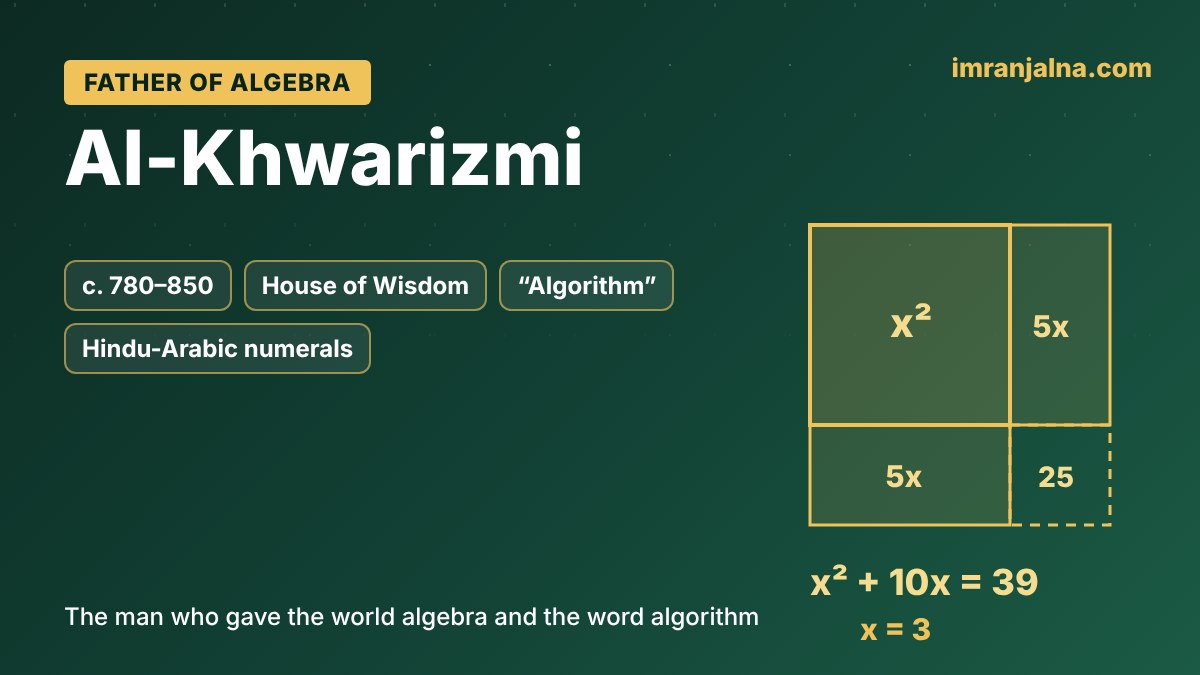
Read more: 16 Great Muslim Scientists of the Islamic Golden Age · Al-Khwarizmi: the father of algebra
Sources: Encyclopædia Britannica – Ibn al-Haytham; Muslim Heritage; UNESCO International Year of Light 2015. Dates are approximate; details of his life in Cairo come from traditional biographies.
Discover more from ImranJalna
नवीनतम पोस्ट अपने ईमेल पर प्राप्त करने के लिए सदस्यता लें।













Leave a Reply