

Muhammad ibn Musa al-Khwarizmi (c. 780–c. 850 CE) was a Persian Muslim mathematician, astronomer and geographer who worked at the House of Wisdom in Baghdad. He is called the father of algebra, because his book gave the subject its name and its first systematic method. Even more remarkably, the Latin form of his own name became the word “algorithm”, which today sits at the heart of every computer, phone and search engine.
Quick facts
| Full name | Abu Ja’far Muhammad ibn Musa al-Khwarizmi |
| Born | c. 780 CE, probably in Khwarazm (in today’s Uzbekistan and Turkmenistan) |
| Died | c. 850 CE, Baghdad |
| Worked at | Bayt al-Hikmah (House of Wisdom), Baghdad, under Caliph al-Ma’mun |
| Fields | Mathematics, astronomy, geography |
| Most famous work | Al-Kitab al-Mukhtasar fi Hisab al-Jabr wal-Muqabala (c. 820) |
The book that named algebra
Around 820 CE, al-Khwarizmi wrote The Compendious Book on Calculation by Completion and Balancing. Its two key operations gave the subject its vocabulary:
- Al-jabr (“restoration” or “completion”): moving a subtracted term to the other side of an equation so that it becomes positive. This word became “algebra”.
- Al-muqabala (“balancing”): cancelling equal terms on both sides.
He wrote the book, as he explained in its introduction, to help people with practical problems such as inheritance, trade, land measurement and digging canals. His great step was to treat equations in general, with step-by-step rules that work every time, rather than solving individual puzzles.
A worked example from his book
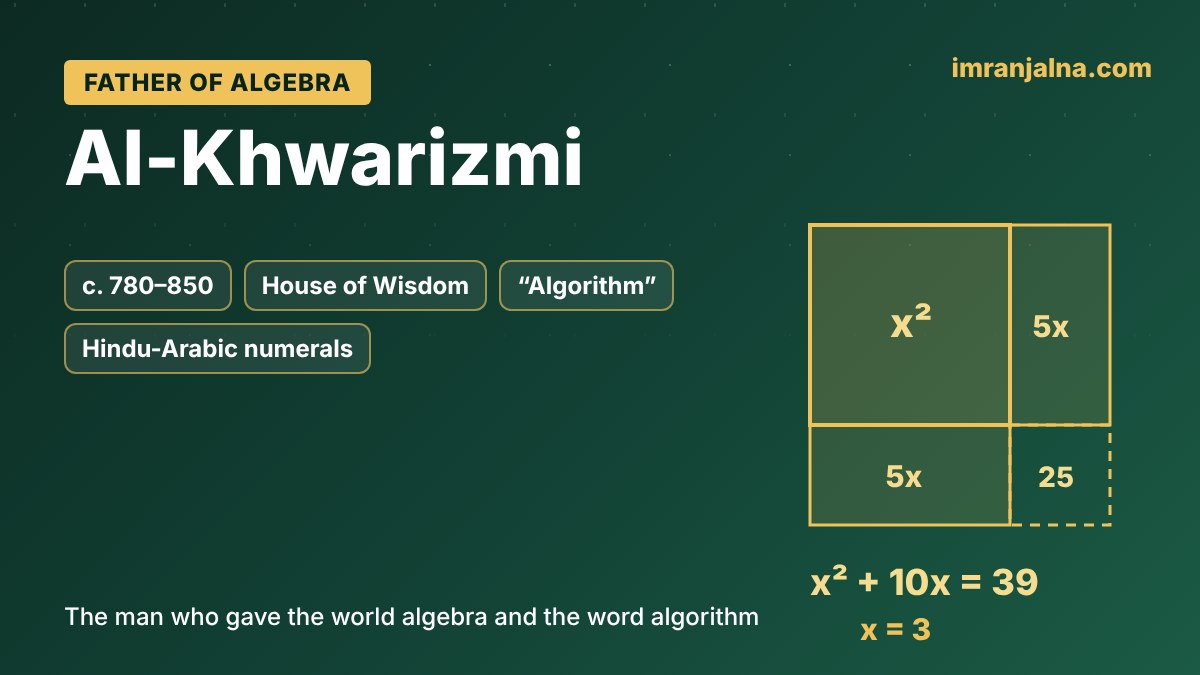
Al-Khwarizmi wrote everything in words, with no symbols. His most famous example asks: “A square and ten roots are equal to thirty-nine. What is the square?” In modern notation that is x² + 10x = 39. His method of “completing the square” goes like this:
- Take half the number of roots: half of 10 is 5.
- Multiply it by itself: 5 × 5 = 25.
- Add this to 39: 39 + 25 = 64.
- Take the square root: √64 = 8.
- Subtract half the roots: 8 − 5 = 3. So the root is x = 3, and the square is 9.
Check: 3² + 10 × 3 = 9 + 30 = 39. He also drew a geometric picture of a square with rectangles added to its sides to prove why the method works. Students around the world still learn this same method today.
Spreading India’s numbers to the world
Al-Khwarizmi also wrote a book on calculating with the Hindu numerals, the decimal place-value system with zero that had developed in India. The Arabic original is lost, but a Latin translation survives and begins with the words “Dixit Algoritmi” (“Al-Khwarizmi said”). Through this book Europeans learned the digits 0 to 9 and how to calculate with them, which is why they are often called Hindu-Arabic numerals. Before this, Europe used Roman numerals, which made multiplication and division very difficult.
Over time, “algoritmi” came to mean any step-by-step method of calculation, which is exactly what an algorithm is today.
Astronomy and geography
- Zij al-Sindhind: astronomical tables, based partly on Indian astronomy, for calculating the positions of the Sun, Moon and planets, and for calendars.
- Kitab Surat al-Ard (The Image of the Earth): a revised and corrected version of Ptolemy’s geography, listing latitudes and longitudes for thousands of places.
- He also wrote on the Jewish calendar, sundials and the astrolabe.
His legacy
His algebra was translated into Latin in the 12th century, by Robert of Chester in 1145 and by Gerard of Cremona, and it became a standard textbook in European universities. Leonardo Fibonacci’s Liber Abaci (1202), which helped make Hindu-Arabic numerals common in Europe, drew on this tradition. In 1983, the Soviet Union issued a postage stamp marking the 1,200th anniversary of his birth.
Frequently asked questions
Why is Al-Khwarizmi called the father of algebra?
Because his book was the first to treat algebra as an independent subject with general, step-by-step methods for solving linear and quadratic equations, and its title gave algebra its name. Greek mathematician Diophantus is sometimes also called a father of algebra for his earlier work on equations.
Where does the word “algorithm” come from?
It comes from Algoritmi, the Latin form of al-Khwarizmi’s name, used in translations of his book on Hindu numerals.
Did Al-Khwarizmi invent zero?
No. Zero as a number and the decimal place-value system developed in India; Indian mathematician Brahmagupta wrote rules for zero in 628 CE. Al-Khwarizmi’s great contribution was explaining this system clearly in Arabic, which spread it across the Muslim world and on to Europe.
Read more: 16 Great Muslim Scientists of the Islamic Golden Age · Ibn al-Haytham: the father of optics
Sources: Encyclopædia Britannica – al-Khwarizmi; MacTutor History of Mathematics, University of St Andrews; Muslim Heritage. Dates are approximate.
Discover more from ImranJalna
नवीनतम पोस्ट अपने ईमेल पर प्राप्त करने के लिए सदस्यता लें।














Leave a Reply