

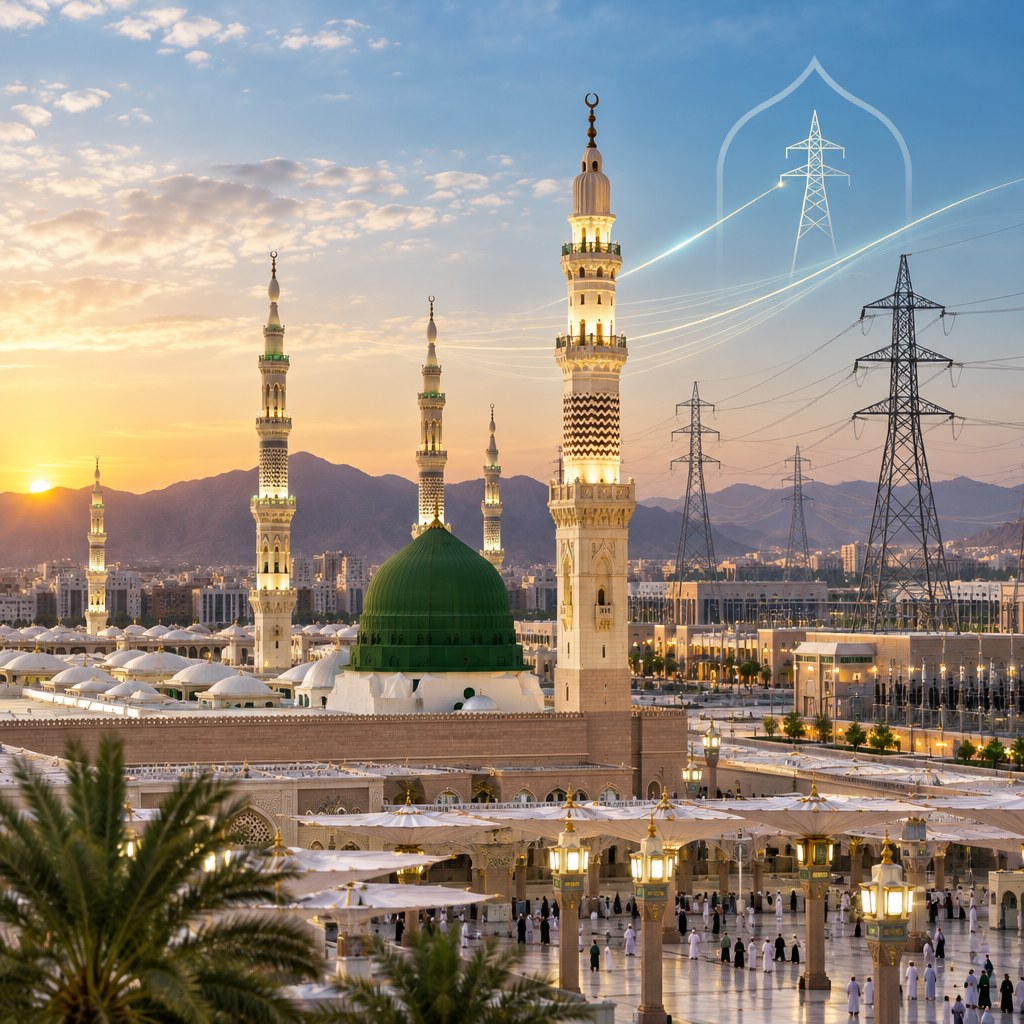
MADINAH: A reported attack on a power distribution station in Madinah that supplies electricity to the Prophet’s Mosque has triggered fresh concern across the Muslim world as regional tensions intensify.
According to Reuters, the Saudi-led coalition accused Yemen’s Iran-aligned Houthis of carrying out the attack. The coalition said one transformer was put out of service but the wider electricity network was not affected. A Houthi military source denied responsibility.
Why the incident has drawn international attention
Madinah is home to Al-Masjid an-Nabawi, the Prophet’s Mosque, and is one of the most sacred cities in Islam. Any security incident connected to infrastructure serving the city therefore carries significance far beyond an ordinary power disruption.
The incident comes during a renewed period of confrontation involving Saudi Arabia and the Houthis. Reuters described the latest escalation as the most serious cross-border fighting since a UN-brokered truce in 2022 largely halted such attacks.
OIC condemns the reported attack
The Organisation of Islamic Cooperation has also condemned the incident. Its public statements have framed attacks affecting Madinah and holy sites as a threat not only to civilians and infrastructure but also to places of immense religious importance to Muslims worldwide.
The competing claims remain important: Saudi authorities have attributed the attack to the Houthis, while the Houthis have denied targeting the site. Responsible reporting therefore requires keeping the allegation and denial clearly separated rather than presenting disputed responsibility as an uncontested fact.
Protection of pilgrims and holy sites
Millions of Muslims visit Makkah and Madinah for Hajj, Umrah and visits to the Prophet’s Mosque. Security around airports, roads, hotels, utilities and religious sites is consequently part of a large and complex system designed to keep worshippers safe.
A disruption to electricity infrastructure could have wider implications if it affected transport, accommodation, communications or services used by pilgrims. Saudi authorities said the network continued operating after the incident, limiting the immediate impact.
Regional escalation remains the bigger concern
The Madinah episode cannot be separated from wider instability around Yemen and the Red Sea. Continued military escalation raises risks for civilians on all sides and can also affect travel, energy infrastructure and regional commerce.
For Muslims planning Umrah or travel to Saudi Arabia, the practical approach is to rely on official Saudi travel, Hajj and Umrah guidance rather than rumours circulating on social media. Travellers should monitor airline notices and official advisories if regional conditions change.
Why verification matters
Events involving the Two Holy Mosques can generate strong emotions and viral claims. Photos or videos may be reposted without dates, locations or reliable attribution. Readers should verify dramatic claims against official statements and reputable news agencies before sharing them.
ImranJalna has repeatedly highlighted the importance of responsible digital behaviour and verification in Islamic community communication. Readers can also see our Editorial Policy for our approach to verification and sourcing. The same principle is especially important during fast-moving security events.
What happens next
The immediate power impact appears to have been contained, but the political consequences may continue. The central questions are whether cross-border attacks escalate further and whether diplomatic channels can reduce the risk to civilians and religious sites.
What the latest Yemen fighting means
The Medina incident is unfolding alongside a broader escalation. Reuters reported on October 5 that Saudi-backed Yemeni government forces pushed Houthi fighters from territory near the Bab el-Mandeb Strait and took Mocha, while fighting intensified around Taiz. Bab el-Mandeb is one of the world’s most strategically important maritime passages, connecting the Red Sea with the Gulf of Aden.
For Saudi Arabia, the security challenge therefore has several layers: protecting population centres and critical infrastructure, securing approaches to the holy cities, and dealing with instability along major shipping routes. For pilgrims, this does not mean ordinary travel should automatically be cancelled, but it reinforces the need to follow official Saudi and airline guidance rather than viral claims.
Why disputed claims require careful reporting
The Saudi-led coalition says its investigation linked the Medina strike to the Houthis. The Houthis deny responsibility. Those positions should remain visible together unless independent evidence establishes more. In conflict reporting, attribution matters because all sides have incentives to shape public understanding.
The same caution applies to social-media videos. Smoke, an explosion or a mosque skyline does not by itself prove where or when footage was recorded. Readers should check dates, location verification and reputable reporting before sharing.
Religious significance raises the stakes
The Prophet’s Mosque receives Muslims from almost every country. Although the reported damage affected a transformer rather than the mosque itself and the electricity network continued operating, any attack on infrastructure associated with Madinah resonates deeply across the Muslim world. That emotional importance makes accuracy more necessary, not less.
Saudi authorities have invested heavily in crowd management, transport, utilities and digital pilgrim services around Makkah and Madinah. Resilience of electricity and communications is a core part of maintaining those systems during periods of high visitor numbers.
What pilgrims should do
People with upcoming Umrah plans should keep passports and booking records accessible, monitor their airline, use official Saudi Hajj and Umrah channels, and avoid changing plans solely because of an unverified WhatsApp message. If authorities issue specific restrictions, those instructions should take priority over social-media commentary.
Sources: Reuters; Organisation of Islamic Cooperation.
Discover more from ImranJalna
Subscribe to get the latest posts sent to your email.







Leave a Reply